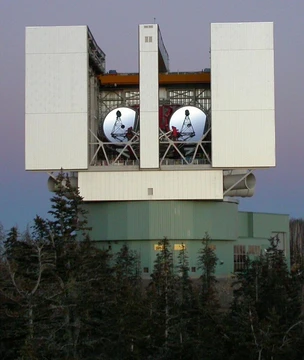
Mercator Telescope
1.2 m telescope on La Palma for exoplanet research.

The Mercator Telescope, a 1.2-meter instrument situated at the Observatorio del Roque de Los Muchachos on La Palma, is run by Belgium’s Katholieke Universiteit Leuven alongside the University of Geneva’s observatory. It takes its name from the renowned cartographer Gerard Mercator and was finished in 2000, built for a program searching for exoplanets.
The telescope is equipped with two main instruments. One is the MeropeII CCD camera, which uses a 2k-by-6k pixel frame transfer detector originally made for the canceled Eddington space mission. Its filters follow the Geneva photometric system. The other instrument is the HERMES echelle spectrograph, covering wavelengths from 380 to 875 nm at a spectral resolution of about 85,000. From May 2001 to July 2008, the P7 photometer was also active, measuring in the seven-band Geneva system. It observed the star in one channel and the sky in another to subtract background light, with its filter wheel spinning at 4 Hz to switch between filters.
The Mercator Telescope and the Swiss Euler 1.2m Telescope both took part in the Southern Sky extrasolar Planet search Programme, which led to the discovery of many exoplanets. In the 2010s, the HERMES spectrograph monitored the star Delta Cephei, with data hinting at an unknown stellar companion. Development of HERMES, a high-resolution fiber-fed echelle spectrograph, had been underway since at least 2004. In 2012, the MAIA instrument (Mercator Advanced Imager for Astroseismology) was installed, using a CCD to image in three passbands. Some of its technology also came from the canceled Eddington space telescope mission.
- Aperture
- 1.2 m
- Location
- Observatorio del Roque de Los Muchachos, La Palma
- Operator
- Katholieke Universiteit Leuven (Leuven University), Belgium, in collaboration with the Observatory of the University of Geneva
- Named after
- Gerard Mercator
- Completion year
- 2000
- Primary instruments
- MeropeII CCD camera, HERMES echelle spectrograph
- Hermes wavelength range
- 380–875 nm
- Hermes spectral resolution
- R~85000
Lore & Background
The Mercator Telescope was completed in the year 2000 for an exoplanet research program. It contains two different measuring devices: the MeropeII CCD camera, which has a size of 2k by 6k pixels Frame Transfer detector originally designed for ESA's canceled Eddington space mission, and the HERMES echelle spectrograph, which covers a wavelength range between 380 and 875 nm with a spectral resolution of R~85000. The filters used with the camera are according to the so-called Geneva photometric system. The P7 photometer was active from May 2001 until July 2008, measuring in the 7 band Geneva photometric system; it measured the star in one channel and the sky in another so that the sky can be subtracted, with the filter wheel turning at a rate of 4 Hz. The Swiss Euler 1.2m Telescope and the Mercator Telescope were part of the Southern Sky extrasolar Planet search Programme, which has discovered numerous extrasolar planets. The Hermes spectrograph was used to monitor the star Delta Cephei in the 2010s, and the data seemed to suggest a previously unknown stellar companion. The Hermes spectrograph for Mercator was in development from at least 2004, and is a 'high-resolution fiber-fed echelle spectrograph' type of design. In 2012, the MAIA instrument for astroseismology was installed; MAIA, also called the Mercator Advanced Imager for Astroseismology, uses CCD to image in three passbands. Some of the technology was developed for a space telescope called the Eddington mission, which was however cancelled and thus not sent into space at that time.
Reader's Guide
The Mercator Telescope is notable for its role in exoplanet research as part of the Southern Sky extrasolar Planet search Programme, which has discovered numerous extrasolar planets. Its two main instruments—the MeropeII CCD camera and the HERMES echelle spectrograph—provide complementary capabilities: the camera uses filters from the Geneva photometric system, while the spectrograph offers high spectral resolution across visible and near-infrared wavelengths. The telescope also hosted the P7 photometer from 2001 to 2008, which performed differential photometry by measuring star and sky in separate channels. The HERMES spectrograph contributed to stellar astrophysics, including monitoring Delta Cephei, where data suggested a previously unknown stellar companion. The later installation of the MAIA instrument for astroseismology expanded the telescope's scientific scope. The reuse of technology originally developed for the canceled Eddington space mission in both the MeropeII camera and MAIA highlights the telescope's role in repurposing space-mission hardware for ground-based astronomy. The telescope's collaborative operation between Belgian and Swiss universities underscores its international character.
Did You Know?
- The Mercator Telescope is named after Gerard Mercator, the famous cartographer.
- The MeropeII CCD camera uses a detector originally designed for ESA's canceled Eddington space mission.
- The P7 photometer measured star and sky in separate channels, with its filter wheel turning at 4 Hz.
- The HERMES spectrograph was used to monitor Delta Cephei in the 2010s, suggesting a previously unknown stellar companion.
More in Optical Telescopes 1-24
Spotted an error? Know more?
Reader corrections go straight into our review queue. Suggest an edit · How this site is sourced