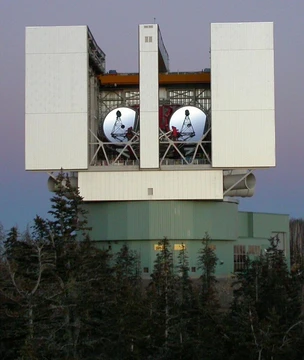
Livermore Optical Transient Imaging System
Automated telescope for rapid optical follow-up of gamma-ray bursts.

The Livermore Optical Transient Imaging System (LOTIS) was a fully automated telescope built to swing quickly toward gamma-ray bursts (GRBs) and capture their optical light at the same time. Because GRBs can appear anywhere in the sky, are often hard to pinpoint, and vanish rapidly, the system needed to reposition in under ten seconds and cover a field of view larger than 15 degrees. To meet this speed requirement, LOTIS was linked via an Internet socket to the Gamma-ray Burst Coordinates Network, which processes satellite data—from missions like HETE-2 and the Swift Gamma-Ray Burst Mission—and relays burst coordinates in real time. Its optics consisted of four commercial telephoto lenses, each with an 11 cm aperture, paired with custom 2048 × 2048 CCD cameras, giving it a 17.6 × 17.6 degree view. Routine operations began in October 1996, with a limiting magnitude of about Mv 11.5. An upgrade in March 1998 added cooled cameras, pushing the sensitivity to roughly Mv 14. LOTIS remained active until at least 2001, but it never directly detected a GRB optical counterpart, though it did establish upper limits on their brightness. By 2001, the four cameras had been aligned with each other, and two had filters installed. Between GRB alerts, LOTIS systematically scanned the entire visible sky each night for new optical transients. It was later succeeded by Super-LOTIS, a robotic telescope with a larger mirror but a narrower field of view. Super-LOTIS, the second version of the system, was installed at the Steward Observatory on Kitt Peak. Like its predecessor, it was automated and designed to race to GRB locations for simultaneous optical measurements. The original LOTIS’s wide field of view limited it to studying only the brightest GRB afterglows, but later satellites—including HETE-2 and the BATSE detector on the Compton Gamma Ray Observatory—provided much more accurate coordinates. This allowed Super-LOTIS to use a Boller and Chivens 0.6 meter telescope, which had a much smaller field of view (initially 51 arcminutes by 51 arcminutes) but far deeper imaging. It operated in this mode from 2000 to 2003. After the Swift mission launched in 2004 and delivered even tighter error boxes, Super-LOTIS’s optics were modified again, giving it a 17 by 17 arcminute field at the secondary focus and a simultaneous visible/near-infrared camera.
- Aperture
- 11 cm (4 commercial tele-photo lenses)
- Field of view
- 17.6 x 17.6 degrees
- Detector
- Custom 2048 x 2048 CCD cameras (4 cameras)
- Limiting magnitude initial
- Mv ≈ 11.5
- Limiting magnitude upgraded
- Mv ≈ 14 (after March 1998 upgrade with cooled cameras)
- Slew time
- Less than 10 seconds
- Operation start
- October 1996
Lore & Background
LOTIS began routine operation in October 1996 with a limiting magnitude of Mv ≈ 11.5. In March 1998 it was upgraded with cooled cameras, improving its limiting sensitivity to Mv ≈ 14. The system was built from four commercial tele-photo lenses of 11 cm aperture, each paired with a custom 2048 x 2048 CCD camera, providing a 17.6 x 17.6 degree field of view. It was fully automated and connected via Internet socket to the Gamma-ray Burst Coordinates Network, which analyzed telemetry from satellites such as HETE-2 and the Swift Gamma-Ray Burst Mission to deliver real-time GRB coordinates. LOTIS was in operation until at least 2001, but never successfully detected the optical counterpart of a GRB, though it did set upper limits.
Reader's Guide
LOTIS was succeeded by Super-LOTIS, a robotic telescope with a larger 0.6 meter mirror but a much smaller field of view, located at the Steward Observatory on Kitt Peak. Super-LOTIS was built because LOTIS's wide field of view meant it could not see faint sources, and only the brightest GRB afterglows could be studied. Later satellites such as HETE-2 and the BATSE detector delivered much more accurate GRB coordinates, enabling the construction of Super-LOTIS with deeper imaging. Super-LOTIS operated from 2000 to 2003 with a 51' by 51' field of view, and after the Swift Gamma-Ray Burst Mission launched in 2004, its optics were modified to a 17' by 17' field of view with a simultaneous visible/NIR camera. Super-LOTIS remained in operation as of 2012 and was also used for supernova searches and general astronomy. LOTIS itself never detected a GRB optical counterpart but set upper limits and conducted nightly sky surveys.
Did You Know?
- It had a field of view of 17.6 x 17.6 degrees.
- LOTIS never successfully detected the optical counterpart of a gamma-ray burst.
- In idle time, LOTIS systematically surveyed the entire available sky every night for new optical transients.
More in Optical Telescopes 1-24
Spotted an error? Know more?
Reader corrections go straight into our review queue. Suggest an edit · How this site is sourced