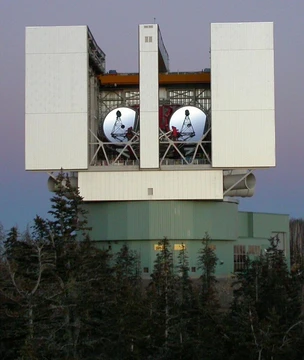
LAMOST
A Chinese meridian reflecting Schmidt telescope for wide-field spectroscopy.

The Large Sky Area Multi-Object Fiber Spectroscopic Telescope (LAMOST), also called the Guo Shoujing Telescope after a 13th-century Chinese astronomer, is a meridian reflecting Schmidt telescope at the Xinglong Station in Hebei Province, China. Run by the Chinese Academy of Sciences, it is designed for a five-year survey targeting 10 million stars in the Milky Way and millions of galaxies, with a budget of 235 million RMB.
Optically, LAMOST is a reflective Schmidt telescope using active optics. It has two mirrors built from hexagonal, deformable segments, each 1.1 meters across. The first mirror (MA) has 24 segments arranged in a 5.72-by-4.4-meter rectangle and sits in a ground-level dome as a Schmidt corrector plate. This nearly flat mirror reflects light southward up a slanted tunnel (25 degrees above horizontal) to the larger, spherical focusing mirror MB, which has 37 segments in a 6.67-by-6.09-meter rectangle. MB directs light to a 1.75-meter-diameter focal plane covering a five-degree field of view. This focal plane holds 4,000 fiber-positioning units, each feeding an optical fiber that carries light to one of sixteen 250-channel spectrographs located below. Each spectrograph uses two 4k-by-4k CCD cameras (e2v chips) for blue (370–590 nm) and red (570–900 nm) wavelengths; a higher-resolution mode covers 510–540 nm and 830–890 nm. Active optics control the reflecting corrector, allowing a large aperture combined with a wide field. The large focal plane can accommodate thousands of fibers, feeding light from objects as faint as magnitude 20.5 into the spectrographs, enabling tens of thousands of spectra per night.
The telescope’s scientific survey is called the LAMOST Experiment for Galactic Understanding and Evolution (LEGUE). Its goals include an extra-galactic spectroscopic survey to study the universe’s large-scale structure, a stellar survey to find metal-poor stars in the galactic halo and understand the Galaxy’s structure, and cross-identification of multi-waveband surveys. The large data output is expected to yield serendipitous discoveries; early commissioning observations confirmed a new method for identifying quasars by their infrared color. An overarching aim is to advance Chinese astronomy into the 21st century, leading in wide-field spectroscopy and large-sample astrophysics.
- Type
- Meridian reflecting Schmidt telescope
- Location
- Xinglong Station, Hebei Province, China
- Primary mirror segments
- MA: 24 segments (5.72×4.4 m rectangle); MB: 37 segments (6.67×6.09 m rectangle)
- Focal plane diameter
- 1.75 metres
- Field of view
- 5 degrees
- Number of fibers
- 4000
- Spectrographs
- 16 (each with two 4k×4k CCD cameras, blue 370–590 nm, red 570–900 nm)
- Budget
- RMB 235 million yuan
Lore & Background
LAMOST is configured as a reflective Schmidt telescope with active optics. It has two mirrors, each made up of 1.1-metre hexagonal deformable segments. The first mirror, MA (24 segments), is a Schmidt corrector plate in a dome at ground level; it reflects light southward up a slanted tunnel (25° above horizontal) to the larger spherical focusing mirror MB (37 segments). MB directs light to a focal plane 1.75 metres in diameter, corresponding to a five-degree field of view. The focal plane is tiled with 4000 fiber-positioning units, each feeding an optical fiber to one of sixteen 250-channel spectrographs below. Each spectrograph has two 4k×4k CCD cameras using e2v CCD chips, with blue (370–590 nm) and red (570–900 nm) sides; a higher spectral resolution mode covers 510–540 nm and 830–890 nm. The telescope uses active optics to control its reflecting corrector, enabling a large aperture with a wide field of view. The telescope is to conduct a wide-field survey called the 'LAMOST Experiment for Galactic Understanding and Evolution' (LEGUE). Scientific goals include an extra-galactic spectroscopic survey to study large-scale structure, a stellar spectroscopic survey including a search for metal-poor stars in the galactic halo, and cross-identification of multi-waveband surveys. Early commissioning observations confirmed a new method of identifying quasars based on their infrared color.
Reader's Guide
The telescope's significance lies in its planned spectroscopic survey of 10 million Milky Way stars and millions of galaxies, aiming to bring Chinese astronomy into the 21st century and take a leading role in wide-field spectroscopy and large-sample astronomy. However, a 2011 conference presentation noted initial problems with fiber positioner accuracy causing poor throughput, later rectified by an additional calibration step. The same presentation indicated that the telescope's location, only 115 km northwest of Beijing, suffers from high atmospheric and light pollution, with only about 120 clear nights per year, and the telescope has generally been disappointing. Despite these challenges, LAMOST has produced multiple data releases: DR1 in June 2013, followed by DR2 (2014), DR3 (2015), DR4 (2016), DR5 (2017), DR6 (2018), DR7 (2019), and DR8 in May 2020. The telescope's legacy includes the vast volume of data produced, which is hoped to lead to additional serendipitous discoveries, and its role in confirming a new quasar identification method.
Did You Know?
- LAMOST is also named after the 13th-century Chinese astronomer Guo Shoujing.
- The telescope's focal plane is 1.75 metres in diameter and accommodates 4000 fiber-positioning units.
- The telescope's location is only 115 km northwest of Beijing, with high light and atmospheric pollution.
- The first LAMOST data release occurred in June 2013, and the most recent (DR8) in May 2020.
More in Optical Telescopes 1-24
Spotted an error? Know more?
Reader corrections go straight into our review queue. Suggest an edit · How this site is sourced