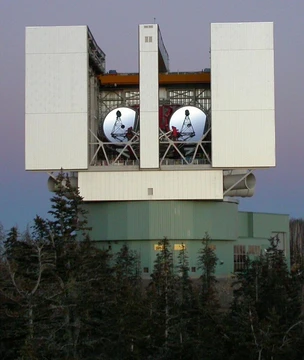
James Gregory Telescope
Largest working optical telescope in the UK.

The James Gregory Telescope, built by the University of St Andrews in 1962, uses a Schmidt-Cassegrain design and is equipped with a CCD camera. Its field of view is exceptionally large—covering 5 square degrees—even by wide-field standards. It remains the largest working optical telescope in the UK, still operated by the School of Physics and Astronomy for collaborative research projects like SuperWASP and studies of supermassive black holes and their effects on galaxy structure.
The telescope is named after James Gregory, a Scottish mathematician, astronomer, and University of St Andrews academic who invented the Gregorian telescope design. This was the first reflecting telescope design, predating Newton’s, though Newton is better known for building a working model. As of 2018, the James Gregory Telescope is recognized as the largest operational telescope in the UK and the largest Schmidt-Cassegrain. Its design was developed by Baker and Linfoot, and a half-scale model was built during development. In early 21st-century currency, its construction cost is estimated at about £1 million.
The telescope uses both a mirror and a corrector plate. It was originally capable of up to 16 degrees but was adjusted after coming online in 1962. Its aperture is 37 inches, though the current setup uses approximately 33 inches.
- Year of construction
- 1962
- Builder
- University of St Andrews
- Design
- Schmidt-Cassegrain
- Aperture
- 37 inches (about 33 inches used in current setup)
- Field of view
- 5 square degrees
- Cost (early 21st-century currency)
- about £1 million
- Status as of 2018
- largest telescope in operation in the UK and largest Schmidt-Cassegrain
Lore & Background
The James Gregory Telescope was constructed in 1962 by the University of St Andrews. It is of a Schmidt-Cassegrain design, a type developed by Baker and Linfoot, and a half-scale model was also made during its development. The telescope uses both a mirror and a corrector, and was capable up to 16 degrees but was adjusted after it came online in 1962. It is fitted with a CCD camera and has a very large field of view, compared even to regular 'wide field' designs, viewing 5 square degrees. The telescope is named after the Scottish mathematician, astronomer and University academic James Gregory, who invented the design Gregorian telescope, the first design for a reflecting telescope, which pre-dates Newton's design; however Newton is better known as he actually produced a functioning example.
Reader's Guide
The James Gregory Telescope is significant as the largest working optical telescope in the UK and the largest Schmidt-Cassegrain telescope, as recognized as of 2018. It is still used by the School of Physics and Astronomy for research in collaborative projects such as SuperWASP and the study of super massive black holes and their impact on galaxy structure. Its construction cost was estimated at about £1 million in early 21st-century currency. The telescope has an aperture of 37 inches, though in the current setup about 33 inches of aperture are used. Its design, developed by Baker and Linfoot, includes a half-scale model made during development. The telescope's very large field of view of 5 square degrees distinguishes it even from regular wide-field designs. Its namesake, James Gregory, invented the Gregorian telescope, the first reflecting telescope design, though Newton produced a functioning example.
More in Optical Telescopes 1-24
Spotted an error? Know more?
Reader corrections go straight into our review queue. Suggest an edit · How this site is sourced