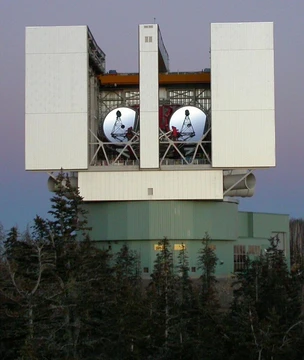
GOTO (telescope array)
Robotic optical array for gravitational-wave and multi-messenger follow-up.

The Gravitational-wave Optical Transient Observer (GOTO) is a network of robotic optical telescopes built to find the visible-light counterparts of gravitational wave events and other multi-messenger signals. Each telescope system in the array holds eight 0.4-meter telescopes on a single mount. As of May 2023, the network had two sites, each with two such systems: GOTO-N at the Roque de los Muchachos Observatory on La Palma, Spain, and GOTO-S at Siding Spring Observatory in Australia. An international consortium of universities and research institutes runs the project, including the University of Warwick, Monash University, the University of Sheffield, the University of Leicester, Armagh Observatory, the National Astronomical Research Institute of Thailand, the Instituto de Astrofísica de Canarias, the University of Portsmouth, the University of Turku, and the University of Birmingham.
Each GOTO system can point independently, but all eight unit telescopes (UTs) on a mount move together. Their orientations are offset so each covers a slightly different patch of sky, with small overlaps, making the whole system act like one large telescope with a very wide field of view. The UTs are ASA H400 Newtonian telescopes with a 400mm aperture and 960mm focal length (f/2.4). Each has a focuser, filter wheel, and a Finger Lakes Instrumentation ML50100 camera using the Onsemi KAF-50100 CCD sensor. The fast f/2.4 focal ratio and large sensor give each system a total field of view of about 40 square degrees—roughly 200 times the area of the full Moon. This speed also means each sky visit needs only three minutes of exposure time.
To find transients, GOTO uses difference imaging: it matches new images of the sky to older ones of the same region, and the differences reveal changes or new objects. This process generates thousands of candidate sources per image, most of which are processing artifacts. A convolutional neural network-based "real-bogus" classifier then identifies which sources are likely genuine.
Beyond gravitational wave follow-ups, GOTO can respond to gamma-ray bursts (GRBs). On September 11, 2023, the Fermi Gamma-ray Space Telescope detected GRB 230911A, and GOTO found its optical counterpart (GOTO23akf/AT 2023shv), later confirmed as a GRB afterglow by the Swift X-ray telescope.
Quick Facts
- Style
- Newtonian
- Area
- 0.4m / 2 / per unit telescope, 3.2m / 2 / per system, 12.8m / 2 / total.
- Focal Length
- 960mm (f/2.4)
- Mounting
- Equatorial
Facts from the source article.
Lore & Background
The first phase of GOTO's development was the deployment of a prototype system at the planned site of the northern node, consisting of four unit telescopes on a custom-built mount. The prototype system was deployed during the second LIGO-Virgo Collaboration observing run (O2), achieving first light in June 2017 with its official inauguration on July 3, 2017. The prototype was active during the first half of the third LVC observing run (O3a), between April and October 2019, during which GOTO could respond to gravitational-wave events and begin observing within one minute of alerts being received if the source region was visible. In late 2019 funding was awarded to expand the network with two full GOTO systems and a duplicate site in Australia. The deployment of the second northern system was completed in August 2021, and despite delays due to the 2021 volcanic eruption, the full northern node was completed in December 2021 with the upgrade of the prototype to the final hardware configuration. By the end of 2022 the site for GOTO-S had been prepared at Siding Spring Observatory and the two domes installed; in May 2023 it was announced that both systems at SSO had been successfully installed.
Reader's Guide
GOTO is notable for its dedicated role in rapidly identifying optical counterparts to gravitational wave events and gamma-ray bursts, operating as a coordinated network across both hemispheres. Its design—eight 0.4m telescopes on a single mount, each offset to cover adjacent sky with overlap—gives each system a very wide field of view of approximately 40 square degrees, about 200 times the area of the full Moon. The fast f/2.4 focal ratio allows short 3-minute exposures. When not performing follow-up campaigns, GOTO surveys the entire visible sky every 2–3 days if both sites have good weather, enabling serendipitous discovery of transients such as supernovae, tidal disruption events, and fast blue optical transients. The project is run by an international consortium including the University of Warwick, Monash University, the University of Sheffield, and others. As of June 27, 2026, GOTO data has contributed to the discovery of 5,859 astronomical transients, including 734 supernovae and five tidal disruption events. Notable discoveries include SN 2025rbs, a Type Ia supernova in NGC 7331; SN 2025wny, the first gravitationally lensed superluminous supernova; and SN 2024afav, a superluminous supernova whose light curve bumps were explained by a magnetar in a 2026 Nature paper. GOTO also discovered the optical counterpart of seven gamma-ray bursts in 2024, and the citizen science project Kilonova Seekers on Zooniverse has produced over 5 million classifications from over 4,400 volunteers.
Did You Know?
- Each GOTO system consists of eight 0.4m telescopes on a single mounting, giving a total field of view of about 40 square degrees.
- GOTO can respond to gravitational-wave alerts and begin observing within one minute if the source region is visible.
- The citizen science project Kilonova Seekers has received over 5 million classifications from more than 4,400 volunteers.
Frequently Asked Questions
What is GOTO (telescope array)?
GOTO, short for Gravitational-wave Optical Transient Observer, is a network of fully robotic optical telescopes built to snap visible-light images of gravitational-wave alerts and other multi-messenger signals within minutes. It is operated by an international consortium of universities and research institutes.
How is each GOTO system configured?
Every observing system bundles eight 400-mm telescopes onto a single mount, producing a combined field of view of roughly 40 square degrees. The optics run at f/2.4, and each visit captures a 3-minute exposure before the mount slews to the next target.
Where are GOTO's telescopes located?
As of May 2023 the array spans two sites: GOTO-N at the Roque de los Muchachos Observatory on La Palma, Spain, and GOTO-S at Siding Spring Observatory in Australia. Each site hosts two of the eight-telescope systems, giving the network coverage in both hemispheres.
Why does GOTO use many small telescopes instead of one large one?
The design trades raw aperture for speed and sky coverage: eight 0.4-m tubes on a shared mount let the system sweep a wide patch of sky in a single 3-minute exposure, which is critical for catching faint optical transients before they fade after a gravitational-wave trigger.
What is GOTO's role in multi-messenger astronomy?
GOTO acts as a rapid-response optical follow-up instrument, racing to image the sky region flagged by gravitational-wave detectors or other alert channels so that a visible counterpart—such as a kilonova—can be confirmed before it dims. Its robotic operation means no human observer is needed at the site to point the telescopes.
More in Optical Telescopes 1-24
Spotted an error? Know more?
Reader corrections go straight into our review queue. Suggest an edit · How this site is sourced