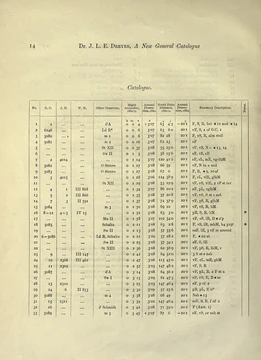
NGC 80
Giant lenticular galaxy and brightest member of the NGC 80 group.

NGC 80 is a giant lenticular galaxy in the constellation Andromeda, discovered by John Herschel on August 17, 1828. It is currently interacting with two other barred spiral galaxies, NGC 47 and NGC 68. The galaxy has a circumnuclear ring with a radius of 5 to 7 arcseconds, and its stellar population is about 10 billion years old, while the ring itself is around 7 billion years old. NGC 80 also contains a metal-rich, chemically distinct nucleus.
As the brightest cluster galaxy of the NGC 80 group, it gives its name to that collection. Other group members include NGC 79, NGC 81, NGC 83, NGC 85, NGC 86, Arp 65 (comprising NGC 90 and NGC 93), NGC 94, NGC 96, IC 1542, and IC 1546.
In 2008, astronomers used the BTA-6 telescope to study the bulges of seven group members, finding their stars to be between 10 and 15 billion years old. One exception was IC 1548, which showed signs of recent star formation: its bulge and nucleus were estimated at 3 billion and 1.5 billion years old, respectively. IC 1548 also has a thin gas structure, suggesting that an interaction transformed it into a lenticular galaxy.
The following year, the same telescope observed 13 disk galaxies in the group, nine of which were lenticulars. One case of ongoing star formation was found in UCM 0018+2216, and all studied galaxies displayed a two-layered stellar disk brighter than about magnitude -18 in the B band.
Quick Facts
- Epoch
- J2000
- Constellation Name
- Andromeda
- Ra
- 00 · 21 · 10.865
- Dec
- +22 · 21 · 26.11
- Z
- 0.019006
- H Radial V
- 5698
- Dist Ly
- 79.950 ±
- Group Cluster
- NGC 80 group
- Appmag V
- 12.07
- Appmag B
- 13.7
- Absmag V
- −22.38
- Names
- UGC 203, MCG+04-02-004, PGC 1351
Facts from the source article.
Lore & Background
NGC 80 was discovered on August 17, 1828, by John Herschel. It is classified as a giant lenticular galaxy and is currently interacting with two other barred spiral galaxies, NGC 47 and NGC 68. The galaxy possesses a circumnuclear ring measured at 5 to 7 in radius, with an age of 7 billion years, while an older stellar population in the galaxy is estimated at 10 billion years. NGC 80 also has a metal-rich chemically distinct nucleus.
NGC 80 is the brightest cluster galaxy of the NGC 80 group, which includes NGC 79, NGC 81, NGC 83, NGC 85, NGC 86, Arp 65 (NGC 90 and NGC 93), NGC 94, NGC 96, IC 1542, and IC 1546. In 2008, astronomers using the BTA-6 telescope studied the bulges of seven members of the group and found the stars have an estimated age of between 10 and 15 billion years. However, IC 1548, another member, was exceptional, showing signs of recent star formation with a bulge age of 3 billion years and a nucleus age of 1.5 billion years. IC 1548 also has a thin-like gas structure, indicating its interaction caused it to become a lenticular galaxy.
The following year, the same telescope observed 13 disk galaxies in the group, of which 9 were lenticulars. One case of ongoing star formation was found in UCM 0018+2216, and all studied galaxies exhibited a two-layered stellar disk brighter than M_B ~ -18.
Reader's Guide
NGC 80 holds significance as the dominant member of the NGC 80 group, a galaxy cluster that has been studied for its stellar populations and morphological evolution. Its status as a giant lenticular galaxy interacting with two barred spirals provides insight into how gravitational interactions can shape galaxy structure and trigger transformations. The 2008 and 2009 studies using the BTA-6 telescope revealed that the group's bulges contain very old stars, between 10 and 15 billion years, suggesting early formation, while the exceptional case of IC 1548 shows that interactions can rejuvenate star formation and convert galaxies into lenticulars. The discovery that 9 out of 13 disk galaxies in the group are lenticulars underscores the prevalence of this type in dense environments, likely due to interactions and gas stripping. The two-layered stellar disks observed in all studied galaxies indicate a common evolutionary pathway. NGC 80 itself, with its metal-rich nucleus and circumnuclear ring, serves as a benchmark for understanding the internal structure of giant lenticulars and their role in group dynamics.
Did You Know?
- It is currently interacting with two barred spiral galaxies: NGC 47 and NGC 68.
- The galaxy has a circumnuclear ring aged 7 billion years and an older stellar population of 10 billion years.
Frequently Asked Questions
What is NGC 80 and where can I find it?
NGC 80 is a giant lenticular galaxy located in the constellation Andromeda. It was first catalogued by John Herschel on August 17, 1828, and it serves as the brightest member of the NGC 80 galaxy group.
What is special about NGC 80's structure?
The galaxy hosts a circumnuclear ring spanning roughly 5 to 7 arcseconds in radius, which is estimated to be about 7 billion years old. Its overall stellar population is older still, at around 10 billion years, and it also possesses a metal-rich nucleus that is chemically distinct from the rest of the system.
Is NGC 80 interacting with any other galaxies?
Yes—NGC 80 is currently gravitationally interacting with two barred spiral galaxies, NGC 47 and NGC 68. These ongoing interactions are a key reason the system is of interest to observers and researchers.
What other galaxies are part of the NGC 80 group?
As the brightest cluster galaxy of its collection, NGC 80 lends its name to the group. Fellow members include NGC 79, NGC 81, NGC 83, and NGC 85, among others.
Who discovered NGC 80 and when?
John Herschel identified the galaxy on August 17, 1828, during his extensive survey of the southern and northern skies. It has carried its NGC designation ever since.
More in NGC Objects 1-24
Spotted an error? Know more?
Reader corrections go straight into our review queue. Suggest an edit · How this site is sourced