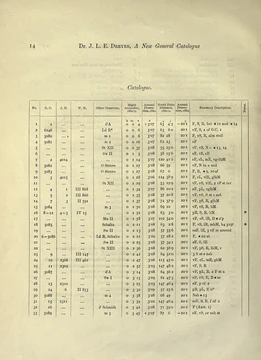
NGC 4
A faint lenticular galaxy with a corrected identification history.

NGC 4 is a lenticular galaxy of morphological type S0-a, located in the constellation Pisces. It was discovered by Albert Marth on 29 November 1864 using a 48-inch reflecting telescope, on the same night he discovered NGC 3. The galaxy is notable for a historical identification error in the Lyon-Meudon Extragalactic Database, where it was initially misidentified as PGC 620 before being corrected to PGC 212468.
Quick Facts
- Epoch
- J2000
- Ra
- 00 · 07 · 24.4
- Dec
- +08 · 22 · 26
- Constellation Name
- Pisces
- Appmag V
- 15.9
- Names
- GC 5080, LEDA 212468.
Facts from the source article.
Lore & Background
NGC 4 was first observed by Albert Marth on 29 November 1864, the same night he discovered NGC 3. Marth described the object as 'extremely faint'. It lies about 4.7 arcminutes northeast of NGC 3 and about 2.9 arcminutes west of a G-type star designated BD+07 1. The galaxy is a lenticular type S0-a, with an approximated distance of 406 million light years and an approximated size of 59,000 light years across, both figures carrying a high degree of uncertainty.
A notable error occurred in the Lyon-Meudon Extragalactic Database (LEDA), where the catalogers initially designated PGC 620 as NGC 4, not realizing that Marth, using a 48-inch aperture telescope, could see an object as faint as a 16th-magnitude galaxy. This error has since been corrected, and the galaxy is now designated as PGC 212468 for NGC 4, with the incorrect identification as PGC 620 noted as a warning.
Reader's Guide
NGC 4's significance lies partly in its faintness and the historical correction of its identity. Discovered by Albert Marth with a 48-inch reflecting telescope, it demonstrates the observational capabilities of 19th-century instruments in detecting 16th-magnitude galaxies. The galaxy's misidentification as PGC 620 in the Lyon-Meudon Extragalactic Database highlights the challenges of early cataloging, where assumptions about visibility led to errors. The correction to PGC 212468 underscores the ongoing refinement of astronomical databases. Its proximity to NGC 3 and the star BD+07 1 provides a reference for locating it in the constellation Pisces. The high uncertainty in its distance and size reflects the difficulty of measuring such faint, distant objects. NGC 4 remains a subject of interest for studies of lenticular galaxies and for understanding the history of astronomical observation and cataloging.
Did You Know?
- NGC 4 was discovered by Albert Marth on the same night he discovered NGC 3.
- The galaxy is about 4.7 arcminutes northeast of NGC 3 and 2.9 arcminutes west of the star BD+07 1.
- Its distance and size are approximated with a high degree of uncertainty.
Frequently Asked Questions
What is NGC 4?
NGC 4 is a lenticular galaxy of type S0-a, sitting roughly 406 million light years away in the constellation Pisces. It is an extremely faint object, making it a tough target for visual observers.
Who discovered NGC 4 and when?
German astronomer Albert Marth identified NGC 4 on 29 November 1864 while using a 48-inch reflecting telescope. He found NGC 3 on that very same night.
What is the PGC identification error associated with NGC 4?
The Lyon-Meudon Extragalactic Database originally cross-referenced NGC 4 as PGC 620, which was incorrect. The proper PGC designation is 212468, and the database entry has since been corrected.
How far away is NGC 4?
NGC 4 lies at an estimated distance of about 406 million light years from Earth. At that range it appears extremely faint, requiring substantial aperture to study in detail.
What does the S0-a classification tell us about NGC 4's structure?
The S0-a subtype indicates a lenticular galaxy with a smooth, featureless disk and a dominant central bulge, but without the well-defined spiral arms seen in later S0 subtypes. In short, it is a relatively early-stage lenticular morphology.
More in NGC Objects 1-24
Spotted an error? Know more?
Reader corrections go straight into our review queue. Suggest an edit · How this site is sourced