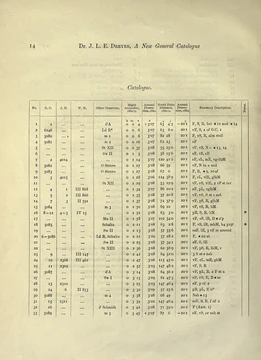
New General Catalogue
A foundational catalogue of 7,840 deep-sky objects.

The New General Catalogue of Nebulae and Clusters of Stars (NGC) is a list of 7,840 deep-sky objects—galaxies, star clusters, and emission nebulae—published in 1888 by John Louis Emil Dreyer. Many of these objects are still commonly referred to by their NGC numbers. Dreyer later issued two supplements, the Index Catalogues (IC), in 1895 and 1908, adding 5,386 more objects discovered primarily through photography.
The NGC consolidated earlier work by William and Caroline Herschel, as well as John Herschel’s General Catalogue of Nebulae and Clusters. Objects south of the celestial equator were less thoroughly catalogued, though many were included based on observations by John Herschel or James Dunlop. Dreyer compiled the catalogue during the 1880s, using observations from the Herschels and others. He had already published a supplement to John Herschel’s General Catalogue with about 1,000 new objects. In 1886, he proposed a second supplement, but the Royal Astronomical Society instead asked him to create a new version, which appeared in the *Memoirs of the Royal Astronomical Society* in 1888.
Assembling the NGC was difficult because Dreyer had to reconcile contradictory and unclear reports from telescopes with apertures ranging from 2 to 72 inches. He checked some objects himself, but the large number forced him to accept others as published. The catalogue contained several errors, mostly in positions and descriptions, but Dreyer referenced his sources, allowing later astronomers to review and correct them. He published lists of corrections at the end of the two Index Catalogues and in 1912, based on his revision of William Herschel’s catalogues.
Several later revisions aimed to fix the NGC’s errors. The Revised New Catalogue of Nonstellar Astronomical Objects (RNGC), compiled by Jack W. Sulentic and William G. Tifft in 1973, did not incorporate many previously published corrections, including some by Dreyer himself, and introduced new mistakes. For example, the Copeland Septet galaxy group was listed as non-existent, and nearly 800 objects were marked as non-existent overall—including duplicates, objects not detected in later observations, and star clusters later considered coincidental groupings. A 1993 study of 229 such clusters found five were duplicates, 99 existed in some form, and 124 needed more research.
- Compiled by
- John Louis Emil Dreyer
- Year of publication
- 1888
- Number of objects
- 7,840
- Types of objects
- Galaxies, star clusters, emission nebulae
- Supplemented by
- Index Catalogues (IC) with 5,386 additional objects
- Notable later revisions
- Revised New General Catalogue (RNGC, 1973), NGC2000.0 (1988), NGC/IC Project (1993–2017), RNGC/IC (2009, updated 2019)
Lore & Background
The New General Catalogue was compiled during the 1880s by John Louis Emil Dreyer using observations from William Herschel and his son John, among others. Dreyer had already published a supplement to Herschel's General Catalogue of Nebulae and Clusters (GC), containing about 1,000 new objects. In 1886, he suggested building a second supplement to the General Catalogue, but the council of the Royal Astronomical Society asked Dreyer to compile a new version instead. This led to the publication of the New General Catalogue in the Memoirs of the Royal Astronomical Society in 1888.
Assembling the NGC was a challenge, as Dreyer had to deal with many contradictory and unclear reports made with a variety of telescopes with apertures ranging from 2 to 72 inches. While he did check some himself, the sheer number of objects meant Dreyer had to accept them as published by others for the purpose of his compilation. The catalogue contained several errors, mostly relating to position and descriptions, but Dreyer referenced the catalogue, which allowed later astronomers to review the original references and publish corrections to the original NGC.
The NGC consolidated the cataloguing work of William and Caroline Herschel, and John Herschel's General Catalogue of Nebulae and Clusters of Stars. Objects south of the celestial equator are catalogued somewhat less thoroughly, but many were included based on observation by John Herschel or James Dunlop. Dreyer published lists of corrections to the NGC at the end of the two Index Catalogues and in 1912 based on his revision of Sir William Herschel's catalogues.
Reader's Guide
The New General Catalogue remains a cornerstone of observational astronomy, with thousands of its objects still best known by their NGC numbers. Its significance lies in its consolidation of earlier catalogues by William and Caroline Herschel and John Herschel into a single, widely adopted reference. The catalogue's errors, however, prompted multiple later revisions: the Revised New General Catalogue (RNGC) by Sulentic and Tifft in 1973, NGC2000.0 by Sinnott in 1988, and the NGC/IC Project begun in 1990 and completed by 2017. The RNGC introduced new errors and classified nearly 800 objects as non-existent, including some that were later found to exist. The most comprehensive modern treatment is the Revised New General Catalogue and Index Catalogue (RNGC/IC) by Wolfgang Steinicke in 2009, updated in 2019, which lists 13,957 objects and reduces the number of 'not found' objects to 301 (2.3%). The NGC/IC Project identified all NGC and IC objects, corrected mistakes, collected images and basic astronomical data, and checked all historical data. The legacy of the NGC is that it established a numbering system still in active use by astronomers and amateurs alike, despite its imperfections.
Did You Know?
- The NGC contains 7,840 objects, including galaxies, star clusters, and emission nebulae.
- Dreyer published two supplements to the NGC in 1895 and 1908, known as the Index Catalogues (IC), adding 5,386 objects.
- The Revised New Catalogue (RNGC) of 1973 classified nearly 800 objects as 'non-existent', but some were later found to exist.
- The brightest star in the RNGC/IC catalogue is NGC 771 with a magnitude of 4.0.
Frequently Asked Questions
Who is the New General Catalogue?
The New General Catalogue is a 1888 reference list of 7,840 deep-sky objects—galaxies, star clusters, and emission nebulae—compiled by John Louis Emil Dreyer. It was built by consolidating the earlier survey work of William, Caroline, and John Herschel into a single unified catalogue.
What is the New General Catalogue's role in the deep-sky community?
It provides the numbered naming system that astronomers and stargazers still use to identify and discuss deep-sky objects, such as NGC 4565 or NGC 7000. Essentially, it acts as the foundational shorthand that lets fans and professionals refer to thousands of galaxies, clusters, and nebulae by a simple catalogue number.
How does the New General Catalogue's story continue after 1888?
Dreyer issued two Index Catalogues (IC) in 1895 and 1908, adding 5,386 objects discovered largely through early photographic surveys. Later revisions, including the RNGC (1973) and the NGC/IC Project (1993–2017), further corrected and refined the original entries.
Why is the New General Catalogue important to fans of deep-sky observation?
It turned the scattered, era-specific observations of the Herschel family into one coherent, numbered list that became the universal reference point for the field. Without that framework, the common naming conventions fans rely on—like 'NGC 869' or 'NGC 2244'—would have no consistent basis.
How many objects does the New General Catalogue actually cover?
The original 1888 publication lists 7,840 deep-sky objects spanning galaxies, star clusters, and emission nebulae. When you include the 5,386 additional entries from the Index Catalogues supplements, the full Dreyer system accounts for more than 13,000 objects.
Spotted an error? Know more?
Reader corrections go straight into our review queue. Suggest an edit · How this site is sourced