NGC 157
A weakly-barred spiral galaxy with flocculent outer arms and two supernovae.

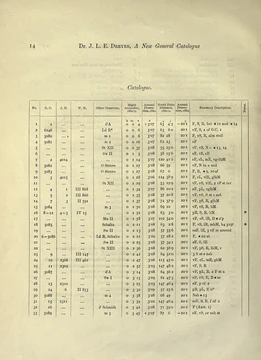
NGC 157 lies in the constellation Cetus, roughly 4° east of Iota Ceti, and is visible from suburban locations through a moderate-sized telescope. William Herschel discovered it on December 13, 1783. John Louis Emil Dreyer, who compiled the New General Catalogue, described it as "pretty bright, large, extended, between 2 considerably bright stars". This galaxy is relatively isolated, with its nearest comparably luminous neighbor about 1.3 Mpc away.
Classified as SAB(rs)bc, NGC 157 is a weakly-barred spiral with a transitional ring structure and moderately loose, symmetric arms that become flocculent and break into multiple arms in the outer regions. Its plane is inclined 61.8° to our line of sight. The rotation curve shows a sharp decline, hinting at a low mass or a small dark matter halo. Though generally quiescent with little star formation, its nucleus hosts a starburst region producing roughly one solar mass of new stars per year.
Two supernovae have been observed in this galaxy: SN 2009em (Type Ic, magnitude 16.6) on May 5, 2009, located 34″ west and 10″ south of the core; and SN 2022jli (Type Ic, magnitude 14.4) discovered by Berto Monard on May 5, 2022.
Quick Facts
- Epoch
- J2000
- Constellation Name
- Cetus
- Ra
- 00 · 34 · 46.751
- Dec
- −08 · 23 · 47.36
- Z
- 0.0055
- H Radial V
- 1651 km/s
- Dist Ly
- 12.08 Mpc / 23 Mpc
- Appmag V
- 10.4
- Appmag B
- 11.07
Facts from the source article.
Lore & Background
NGC 157 was discovered on December 13, 1783 by William Herschel. John Louis Emil Dreyer, compiler of the New General Catalogue, noted it as 'pretty bright, large, extended, between 2 considerably bright stars'. The galaxy is relatively isolated; the nearest other galaxy of comparable luminosity lies at a separation of 1.3 Mpc.
Its morphological classification is SAB(rs)bc, indicating a weakly-barred spiral with a transitional ring structure and moderate to loosely-wound arms. The plane of the galaxy is inclined at 61.8° to the line of sight. The rotation curve undergoes a sharp decline, suggesting a low mass or a small dark matter halo. It is considered a quiescent galaxy with little star formation activity, though a starburst region in the nucleus forms new stars at about one solar mass per year.
Two supernovae have been observed in NGC 157: SN 2009em (Type Ic, magnitude 16.6) discovered on 5 May 2009, and SN 2022jli (Type Ic, magnitude 14.4) discovered by Berto Monard on 5 May 2022.
Reader's Guide
NGC 157 holds significance as a relatively isolated intermediate spiral galaxy, offering a clear example of a weakly-barred structure with symmetric arms that transition to flocculent, multi-armed patterns in the outer regions. Its sharp decline in rotation curve provides evidence for a low mass or a small dark matter halo, making it a useful object for studying galaxy dynamics and dark matter distribution. The galaxy's quiescent nature, with little star formation overall, contrasts with its active starburst nucleus, which produces new stars at a rate of about one solar mass per year. This combination of features allows astronomers to investigate the interplay between nuclear activity and global galaxy evolution. The two observed supernovae—both Type Ic—add to its legacy as a site of massive stellar explosions. SN 2022jli, discovered by Berto Monard, reached magnitude 14.4, while SN 2009em was fainter at magnitude 16.6. These events contribute to the study of core-collapse supernovae and their progenitor systems. NGC 157 is accessible from suburban skies with a moderate-sized telescope, making it a target for amateur astronomers interested in observing a galaxy with a rich observational history.
Did You Know?
- NGC 157 was discovered by William Herschel on December 13, 1783.
- It is located about 4° east of the star Iota Ceti in the constellation Cetus.
- The galaxy has hosted two Type Ic supernovae: SN 2009em and SN 2022jli.
- Its rotation curve shows a sharp decline, suggesting a low mass or small dark matter halo.
Frequently Asked Questions
What is NGC 157?
NGC 157 is a weakly-barred spiral galaxy residing in the constellation Cetus. It displays a transitional ring structure with moderately open, symmetric arms that break into a patchy, flocculent pattern in the outer regions.
Who discovered NGC 157 and when?
William Herschel identified this galaxy during his systematic sky surveys on December 13, 1783. It was later recorded in Dreyer's New General Catalogue, where the compiler praised its noticeable brightness and extended, large appearance set between two bright stars.
What is NGC 157's Hubble classification?
It is typed as SAB(rs)bc, indicating a faint bar, a ring-like component, and bc-type spiral arms that are moderately loose and symmetric. The outer arm segments lose their coherent shape and dissolve into a flocculent, clumpy texture.
How isolated is NGC 157 among its neighbors?
NGC 157 is remarkably solitary; the closest galaxy of comparable luminosity lies roughly 1.3 megaparsecs away. This makes it a lone stellar island in a comparatively empty region of the Local Volume.
Can I observe NGC 157 from a suburban backyard?
Yes, it is reachable with a moderate-sized telescope from suburban sites, sitting about four degrees east of Iota Ceti in Cetus. Its relatively large angular size and decent surface brightness make it a rewarding target for small instruments.
More in NGC Objects 1-24
Spotted an error? Know more?
Reader corrections go straight into our review queue. Suggest an edit · How this site is sourced