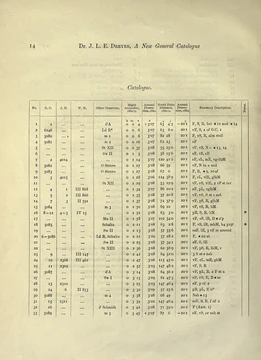
NGC 147
A faint dwarf spheroidal satellite of the Andromeda Galaxy.

NGC 147, also cataloged as DDO3 and Caldwell 17, is a dwarf spheroidal galaxy in the constellation Cassiopeia. It lies about 2.58 million light-years from Earth and belongs to the Local Group as a satellite of the Andromeda Galaxy (M31). Along with NGC 185, another remote satellite of M31, it forms a physical pair.
John Herschel discovered NGC 147 in September 1829. Compared to NGC 185, it appears fainter and slightly larger, giving it a much lower surface brightness and making it harder to see in small telescopes. The Webb Society Deep-Sky Observer's Handbook describes it as large, quite faint, and irregularly round, with a brightening toward a stellar nucleus. Walter Baade confirmed its membership in the Local Group in 1944 by resolving individual stars using the 100-inch telescope at Mount Wilson.
The galaxy’s last significant star formation occurred about 3 billion years ago, based on a survey of bright asymptotic giant branch stars within 2 arcminutes of its center. NGC 147 contains a large population of older stars with a spread in metallicity, indicating chemical enrichment. However, no atomic hydrogen (H I) has been detected, and the upper limit on its interstellar medium mass is far lower than expected if material from evolving stars had been retained—implying the ISM has been depleted.
Distance measurements yield varying results. The surface brightness fluctuations method gives 2.67 ± 0.18 million light-years (870 ± 60 kpc), while the tip of the red giant branch technique gives 2.21 ± 0.09 million light-years (680 ± 30 kpc). Averaging these yields a distance of 780 ± 120 kpc.
Quick Facts
- Epoch
- J2000
- Ra
- 00 · 33 · 12.1
- Dec
- +48 · 30 · 32
- Dist Ly
- 2.53 ± 0.11 Mly (780 ± 30 kpc)A · a · none
- Appmag V
- 10.5
- Constellation Name
- Cassiopeia
- Notes
- satellite galaxy of M31
- Names
- PGC 2004, UGC 326, DDO 3, LEDA 2004, Caldwell 17
Facts from the source article.
Lore & Background
NGC 147 was discovered by John Herschel in September 1829. Its membership in the Local Group was confirmed by Walter Baade in 1944, when he resolved the galaxy into individual stars using the 100-inch telescope at Mount Wilson near Los Angeles. Visually, NGC 147 is both fainter and slightly larger than its companion NGC 185, giving it a considerably lower surface brightness, making it more difficult to see; NGC 185 is visible in small telescopes. The Webb Society Deep-Sky Observer's Handbook describes its visual appearance as large, quite faint, irregularly round, brightening in the middle to a stellar nucleus.
A survey of the brightest asymptotic giant branch (AGB) stars within a radius of 2 arcminutes from the center indicates that the last significant star-forming activity in NGC 147 occurred around 3 billion years ago. The galaxy contains a large population of older stars with a spread in metallicity and age, suggesting chemical enrichment has taken place. However, no H I has been observed, and the interstellar medium (ISM) mass upper limit is much lower than expected if material from evolving stars had been retained, implying depletion of the ISM.
Distance measurements using surface brightness fluctuations give 2.67 ± 0.18 Mly (870 ± 60 kpc), while the tip of the red giant branch (TRGB) method yields 2.21 ± 0.09 Mly (680 ± 30 kpc). Averaged together, these give a distance estimate of 2.55 ± 0.39 Mly (780 ± 120 kpc).
Reader's Guide
NGC 147 is significant as a dwarf spheroidal galaxy in the Local Group and a satellite of the Andromeda Galaxy, forming a physical pair with NGC 185. Its low surface brightness and faintness make it a challenging target for amateur observers, yet it provides a clear example of a galaxy with a stellar nucleus and a population of old stars. The confirmation of its Local Group membership by Walter Baade in 1944, using the 100-inch telescope at Mount Wilson, marked an important step in understanding the structure of our local galactic neighborhood. The galaxy's star formation history, with the last significant activity about 3 billion years ago, and its depleted interstellar medium—despite chemical enrichment from older stars—offer insights into the evolution of dwarf galaxies and the processes that strip or retain gas. The distance measurements, though showing some variation between techniques, place NGC 147 firmly within the Local Group and help calibrate distance indicators used for more remote galaxies. Its legacy lies in contributing to the study of galaxy formation, stellar populations, and the dynamics of satellite systems around major galaxies like M31.
Frequently Asked Questions
What is NGC 147?
NGC 147 is a dwarf spheroidal galaxy located in the constellation Cassiopeia. It also carries the designations DDO 3 and Caldwell 17, and it orbits as a satellite of the Andromeda Galaxy (M31) within the Local Group.
Who discovered NGC 147 and when?
The British astronomer John Herschel first identified NGC 147 in September 1829 during his systematic survey of the southern sky.
How far is NGC 147 from Earth?
NGC 147 sits roughly 2.58 million light-years away, placing it well beyond the Milky Way but still comfortably within the Local Group of galaxies.
How does NGC 147 compare to its companion NGC 185?
Although the two form a physical pair of Andromeda satellites, NGC 147 is noticeably fainter and spread over a slightly larger area, giving it a lower surface brightness. That makes it considerably tougher to pick out in small telescopes than its brighter counterpart NGC 185.
Why is NGC 147 interesting to deep-sky observers?
Its extremely low surface brightness and extended, diffuse appearance make it a classic challenge object for dark-sky observers. The Webb Society Deep-Sky Observer's Handbook specifically notes it as a large but very faint target, rewarding patient, high-magnification viewing.
More in NGC Objects 1-24
Spotted an error? Know more?
Reader corrections go straight into our review queue. Suggest an edit · How this site is sourced