NGC 1
First object in the New General Catalogue, a spiral galaxy in Pegasus.

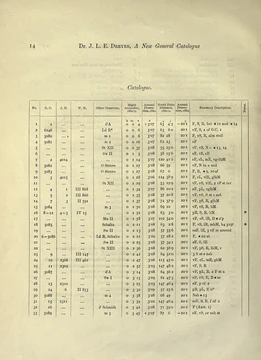
NGC 1 is an intermediate spiral galaxy in the constellation Pegasus, classified as type Sbc. It is the first object listed in the New General Catalogue, a result of its low right ascension when the catalog was compiled—though its coordinates have since shifted, and it no longer holds that distinction.
Heinrich d'Arrest discovered the galaxy on 30 September 1861 while testing an 11-inch refractor at the Copenhagen Observatory. This was his first deep-sky find, though he was unsure whether it matched earlier entries h4 or h5 (both referring to NGC 16). Over four observations, he described it as faint, small, round, 20 arcseconds across, with no concentration, lying in a straight line between two stars of magnitudes 11 and 14. Herman Schultz observed it three times in 1866 and 1868 with a 9.6-inch refractor at Uppsala. Both d'Arrest and Schultz missed the much fainter NGC 2, which appears nearby but is unrelated. NGC 2 was first noted as a companion by Lawrence Parsons.
NGC 1 spans about 140,000 light-years, roughly the size of the Milky Way (estimated at 160,000 light-years). Its apparent magnitude of 13.65 makes it invisible to the naked eye, but its absolute magnitude of -22.08 indicates it is two to three times more luminous than our galaxy. Its nearest major neighbor, UGC 69, lies about 4 million light-years away and is 80,000 light-years across. The galaxy’s visual size is 1.6 by 1.2 arcminutes. Classified as SABbc on the Hubble sequence and De Vaucouleurs system, it has a weak nuclear bar and loosely wound spiral arms. The central region is about 90,000 light-years across, with a large, diffuse arm extending eastward, possibly from a past merger.
Distance estimates based on a redshift of about 0.015177 and a recessional velocity of 4450 km/s place NGC 1 roughly 210 to 215 million light-years from Earth, consistent with redshift-independent estimates ranging from 175 to 245 million light-years. An alternative recessional velocity of 2215 km/s would imply a distance of about 100 million light-years, but most astronomers consider this a misattribution to another galaxy.
NGC 1 is part of the NGC 23 group (also known as LGG 2), which includes at least six other galaxies: NGC 23, NGC 26, UGC 69, UGC 79, UGC 110, and UGC 127.
Quick Facts
- Epoch
- J2000
- Ra
- 00 · 07 · 15.8672
- Dec
- +27 · 42 · 28.911
- Constellation Name
- Pegasus
- Z
- 0.015177 ± 0.000002
- H Radial V
- 4550 ± 1 km/s
- Gal V
- 4723 ± 7 km/s
- Dist Ly
- 56.627 ± 2.710 Mpc
- Group Cluster
- NGC 23 Group (LGG 2)
- Appmag V
- 13.65
- Appmag B
- 13.6
- Absmag V
- -22.08
Facts from the source article.
Lore & Background
NGC 1 was discovered on 30 September 1861 by Heinrich d'Arrest while testing the 11-inch f/17.5 Merz refractor of the Copenhagen Observatory. This was d'Arrest's first deep-sky discovery, though he was uncertain whether his object was identical to h4 or h5 (both referring to NGC 16). His descriptions, based on four observations, read: 'faint, small, round, 20", no concentration. In a straight line connecting two stars 11 and 14 mag.' Herman Schultz observed NGC 1 three times in 1866 and 1868 with a 9.6-inch refractor at Uppsala; both d'Arrest and Schultz missed the fainter NGC 2, which was later observed as a 'companion' of NGC 1 by Lawrence Parsons. The two galaxies are not physically related: NGC 1 lies at a distance of about 200 million light-years, while NGC 2 is roughly 320 million light-years away.
NGC 1 is a spiral galaxy with a weak nuclear bar and loosely wound arms, classified as SABbc using the Hubble sequence and De Vaucouleurs system. Although the central galaxy is only about 90,000 light-years across, a large, diffuse arm extends eastward, possibly from a past merger. The galaxy is part of the NGC 23 group (also known as LGG 2), which includes at least six other galaxies: NGC 23, NGC 26, UGC 69, UGC 79, UGC 110, and UGC 127. Its nearest major neighbor is UGC 69, a galaxy 80,000 light-years wide, located 4.0 million light-years away.
Reader's Guide
NGC 1 holds a unique place in astronomical cataloging as the first entry in the New General Catalogue, a distinction originally due to its low right ascension in the epoch 1860 coordinate system. Although its coordinates have since shifted and it no longer holds the lowest right ascension among NGC objects, its position as the catalog's opening entry remains fixed. The galaxy's discovery by Heinrich d'Arrest in 1861 marked his first deep-sky find, and the subsequent observations by Herman Schultz and Lawrence Parsons illustrate the early challenges of identifying faint neighboring objects—NGC 2 was missed by the first two observers. The pair forms an optical double but is not physically associated, with NGC 1 being significantly closer. NGC 1 is roughly the size of the Milky Way but two to three times more luminous, with an absolute magnitude of -22.08. Its membership in the NGC 23 group places it within a small cluster of galaxies, and its diffuse eastern arm hints at a possible past merger. The galaxy's distance, derived from its redshift of about 0.015177 and recessional velocity of 4450 km/s, is consistent with redshift-independent estimates, though a conflicting measurement of 2215 km/s is regarded as likely misattributed to another galaxy.
Did You Know?
- NGC 1 was discovered by Heinrich d'Arrest on 30 September 1861 using an 11-inch f/17.5 Merz refractor at the Copenhagen Observatory.
- It is the first object listed in the New General Catalogue because it had the lowest right ascension at the time of the catalog's compilation (epoch 1860).
- NGC 1 and NGC 2 form an optical double but are not physically related; NGC 1 is about 200 million light-years away, while NGC 2 is roughly 320 million light-years distant.
- The galaxy is roughly the same diameter as the Milky Way (140,000 light-years) but is two to three times more luminous.
Frequently Asked Questions
What is NGC 1?
NGC 1 is an intermediate spiral galaxy sitting in the constellation Pegasus, roughly 210 to 215 million light-years from Earth. It spans about 140,000 light-years in diameter and appears at an apparent magnitude of 13.65, so it is far too faint for the naked eye.
Who discovered NGC 1 and when?
Heinrich d'Arrest identified the galaxy on 30 September 1861 while testing an 11-inch refractor at the Copenhagen Observatory. It turned out to be his very first deep-sky discovery, though he initially wasn't sure whether it matched his earlier notes labeled h4 or h5.
Why is NGC 1 the first entry in the New General Catalogue?
It simply had the lowest right ascension of all objects when the NGC was being assembled, so it landed at position one. Its measured coordinates have since drifted, meaning it no longer actually holds that lowest-RA distinction.
How big is NGC 1 compared to the Milky Way?
At roughly 140,000 light-years across, NGC 1 is a bit smaller than our own galaxy, which is around 100,000–200,000 light-years in diameter depending on how you measure the disk. It is a solid, mid-sized spiral rather than a dwarf or a giant.
What does the SABbc classification of NGC 1 mean?
The 'SAB' prefix tells you it has a weak central bar, while 'bc' places its arm winding between the tighter Sb and looser Sc types. In plain terms, it is a barred spiral with moderately open arms and no dominant ring structure.
More in NGC Objects 1-24
Spotted an error? Know more?
Reader corrections go straight into our review queue. Suggest an edit · How this site is sourced