NGC 2
An intermediate spiral galaxy forming an optical double with NGC 1.

NGC 2 is an intermediate spiral galaxy classified as Sab, situated in the constellation Pegasus. It was discovered by Lawrence Parsons, the 4th Earl of Rosse, on 20 August 1873. The galaxy lies roughly 345 million light-years from the Solar System and has an apparent magnitude of +14.2. Its diameter spans about 60,000 light-years, making it smaller than the Milky Way.
Though NGC 2 appears close to NGC 1 in the sky, the two are unrelated. NGC 1 is about 210 million light-years away, so the pair forms an optical double—a line-of-sight coincidence rather than a physical association. The nearest galaxy to NGC 2 is AGC 102559, a spiral galaxy 60,000 light-years across, located just 1.8 million light-years away.
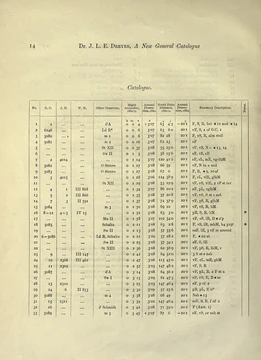
NGC 2 was first cataloged as GC 6246 in an addendum to Dreyer’s 1877 Supplement to the General Catalogue of Nebulae and Clusters of Stars. It also appears in other catalogues as UGC 59, PGC 567, CGCG 478–027, and MCG +04-01-026.
Quick Facts
- Epoch
- J2000
- Ra
- 00 · 07 · 17.1
- Dec
- +27 · 40 · 42
- Z
- 0.025214
- H Radial V
- 7559 km/s
- Gal V
- 7720 km/s
- Dist Ly
- 305 ± 10 Mly / (93.738 ± 3.28 Mpc)
- Appmag V
- +15.0
- Absmag V
- -22.58
- Constellation Name
- Pegasus
Facts from the source article.
Lore & Background
NGC 2 was discovered by Lawrence Parsons, 4th Earl of Rosse on 20 August 1873. It was first observed on 24 August 1873 and described as 'very faint, small, south of GC 1.' The galaxy is cataloged as GC 6246 in Dreyer's 1877 Supplement to the General Catalogue of Nebulae And Clusters of Stars, and also appears as UGC 59, PGC 567, CGCG 478–027, and MCG +04-01-026.
NGC 2 is a spiral galaxy with a diameter of about 60,000 light-years, smaller than the Milky Way. It lies approximately 345 million light-years from the Solar System. Its closest known galactic neighbor is AGC 102559, a spiral galaxy 60,000 light-years in diameter, located only 1.8 million light-years from NGC 2. Although NGC 2 is visually close to NGC 1 in the sky, the two are at very different distances—NGC 1 is about 210 million light-years away—making them an optical double rather than a physical pair.
Reader's Guide
NGC 2 holds significance as one of the earliest cataloged galaxies in the NGC, discovered by Lawrence Parsons in 1873. Its classification as an intermediate spiral galaxy (Sab) places it in a transitional morphological category between barred and unbarred spirals. The galaxy's optical pairing with NGC 1 is a classic example of a chance alignment, where two objects at vastly different distances appear close together in the sky. This phenomenon is well illustrated by the fact that NGC 2 is about 345 million light-years away, while NGC 1 is only 210 million light-years distant. The proximity of NGC 2 to the spiral galaxy AGC 102559—just 1.8 million light-years apart—highlights the complex local environment of galaxies in the Pegasus constellation. With a diameter of roughly 60,000 light-years, NGC 2 is smaller than the Milky Way, yet it remains a key object for studying intermediate spiral structures and the distribution of galaxies in the local universe. Its multiple catalog designations (UGC 59, PGC 567, etc.) reflect its importance in various astronomical surveys.
Frequently Asked Questions
What is NGC 2 and what type of galaxy is it?
NGC 2 is an intermediate spiral galaxy with a Sab classification, meaning it has a moderate central bulge and clearly defined spiral arms. It spans roughly 60,000 light-years in diameter and resides in the constellation Pegasus.
Who discovered NGC 2 and when?
Lawrence Parsons, the 4th Earl of Rosse, first recorded the galaxy on 20 August 1873.
Is NGC 2 physically associated with NGC 1?
No. Although the two galaxies appear as a close pair through a telescope, they are unrelated objects at very different distances—NGC 1 sits about 210 million light-years away while NGC 2 is roughly 345 million light-years out. They form what astronomers call an optical double, a mere line-of-sight coincidence.
How far away is NGC 2 and can you see it with the naked eye?
The galaxy lies approximately 345 million light-years from the Solar System and has an apparent magnitude of +14.2, far too faint for unaided eyes. Even modest backyard telescopes would struggle to reveal more than a faint smudge.
How does NGC 2's size compare to the Milky Way?
At about 60,000 light-years across, NGC 2 is significantly smaller than our own galaxy, which stretches roughly 100,000 light-years in diameter. It is a compact spiral by comparison.
More in NGC Objects 1-24
Spotted an error? Know more?
Reader corrections go straight into our review queue. Suggest an edit · How this site is sourced