NGC 637
A young, compact open cluster in Cassiopeia.

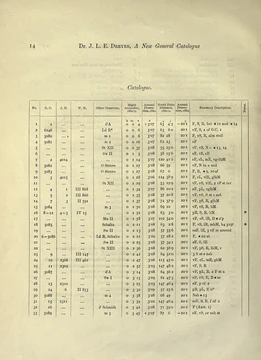
NGC 637 is a compact open star cluster in the northern constellation Cassiopeia, roughly 1.5° west-northwest of the star Epsilon Cassiopeiae. Discovered by William Herschel on 9 November 1787, it sits in the Perseus Arm of the Milky Way, about 7,045 light-years from the Sun. Though small, the cluster is dense and easy to spot with a small telescope.
This young cluster is between 5 and 15 million years old. Its Trumpler classification is I2m, meaning it is strongly concentrated, shows an intermediate range of stellar brightness, and has a moderate number of stars. The cluster contains 55 members, with an angular radius of 4.2 arcminutes, which corresponds to a physical radius of 3.0 parsecs. Its core radius is not given.
The seven brightest stars are all fainter than magnitude 10, and five of them are known to vary in brightness. Among these, four are β Cephei-type variables—one of the highest counts of such variables in any open cluster. A candidate classical Be star has also been identified. The cluster’s Hertzsprung–Russell diagram reveals a clear gap along the main sequence, which cannot be attributed to missing data.
Quick Facts
- Epoch
- J2000.0
- Constellation
- Cassiopeia
- Ra
- 01 · 43 · 04.0
- Dec
- +64 · 02 · 24
- Dist Ly
- 2.160 ±
- Appmag V
- 8.2
- Age
- 10 ± 5 Myr
Facts from the source article.
Lore & Background
NGC 637 was discovered on 9 November 1787 by German-born English astronomer William Herschel. The cluster is young, with an estimated age of 5–15 million years, and is strongly concentrated (Trumpler class I2m), showing an intermediate range of brightness variation and moderate richness of stars. Its angular radius of 4′.2 corresponds to a physical radius of 3.0 parsecs.
The seven brightest members are all over 10th magnitude, five of which are known to be variable. Notably, four β Cephei-type variables have been identified in the cluster, one of the highest such totals for any open cluster. A classical Be star candidate has also been detected. The Hertzsprung–Russell diagram of the cluster reveals a noticeable gap on the main sequence, which is not explained by missing data.
Reader's Guide
NGC 637 holds significance as a young open cluster that offers a rich field for studying stellar variability and early stellar evolution. Its high number of β Cephei-type variables—four in total—makes it an important target for understanding these pulsating stars, which are rare in open clusters. The presence of a classical Be star candidate further adds to its interest for studies of rapid rotation and circumstellar disks. The cluster's compact, concentrated structure (Trumpler class I2m) and moderate richness provide a clear laboratory for examining star formation and cluster dynamics in the Perseus Arm. The unexplained gap in the main sequence on its Hertzsprung–Russell diagram presents an unresolved puzzle that may prompt further investigation into the cluster's star formation history or internal processes. Discovered by William Herschel in 1787, NGC 637 remains a readily observable object for amateur astronomers with small telescopes, bridging historical discovery with ongoing astrophysical inquiry.
Did You Know?
- NGC 637 contains four β Cephei-type variables, one of the highest totals for an open cluster.
- The cluster has an angular radius of 4′.2, corresponding to a physical radius of 3.0 parsecs.
- A classical Be star candidate has been detected in the cluster.
- The cluster's Hertzsprung–Russell diagram shows a noticeable gap on the main sequence that is not explained by missing data.
More in NGC Objects 1-24
Spotted an error? Know more?
Reader corrections go straight into our review queue. Suggest an edit · How this site is sourced