NGC 525
A faint lenticular galaxy with a ring structure in Pisces.

NGC 525 is a lenticular galaxy in the constellation Pisces, roughly 95.6 million light-years away. It was discovered on 25 September 1862 by Heinrich d'Arrest using an 11-inch refractor telescope in Copenhagen. The galaxy has a faint outer ring, which is characteristic of its lenticular classification. D'Arrest made two observations to pinpoint its position, aided by a magnitude 11–12 star located 2 arcminutes to the northwest, making his coordinates fairly accurate. Later, John Louis Emil Dreyer included it in the New General Catalogue, describing it as "very faint, very small," with an 11th or 12th magnitude star 5 seconds of time to the west. With an apparent visual magnitude of 13.3, NGC 525 is dim and requires a telescope to observe. It is classified as type S0 on the Hubble Sequence, and its distance of about 95.6 million light-years is estimated from its redshift using Hubble's law. The galaxy is also cataloged as PGC 5232 and UGC 972.
Quick Facts
- Epoch
- J2000
- Ra
- 01 · 24 · 52.9
- Dec
- +09 · 42 · 12
- Constellation Name
- Pisces
- Appmag B
- 14.3
- Appmag V
- 13.3
- H Radial V
- (2138 ± 50) km/s
- Dist Ly
- 95.6 Mly
- Z
- 0.007158 ± 0.000167
- Names
- PGC 5232, UGC 972, MGC +01-04-054, 2MASS J01245290+09421164
Facts from the source article.
Lore & Background
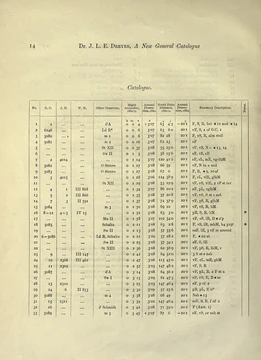
Heinrich d'Arrest discovered NGC 525 on 25 September 1862 using his 11-inch refractor telescope at Copenhagen. He located the galaxy's position with two observations, noting a magnitude 11–12 star just 2' northwest, which made his position fairly accurate. The galaxy was later catalogued by John Louis Emil Dreyer in the New General Catalogue, where it was described as 'very faint, very small, 11th or 12th magnitude star 5 seconds of time to west'.
The galaxy appears very dim in the sky, with an apparent visual magnitude of 13.3, and can only be observed with telescopes. It is classified as type S0 on the Hubble Sequence, indicating a lenticular morphology. Its distance of roughly 95.6 million light-years is estimated using its redshift and Hubble's law. The galaxy possesses a faint outer ring structure, which contributes to its lenticular classification.
Reader's Guide
NGC 525 holds significance as a lenticular galaxy with a faint outer ring, a structure that defines its morphological type. Discovered by Heinrich d'Arrest in the 19th century, it was one of many faint objects catalogued by John Louis Emil Dreyer in the New General Catalogue, where it was noted for its dim appearance and proximity to a bright star. The galaxy's distance, derived from redshift and Hubble's law, places it about 95.6 million light-years away, making it a relatively nearby example of an S0 galaxy. Its faintness (apparent magnitude 13.3) means it is accessible only to telescopic observers, and its discovery history reflects the careful positional work of early astronomers using refractor telescopes. The galaxy's legacy lies in its contribution to the NGC catalogue and its role in illustrating the properties of lenticular galaxies, particularly those with ring structures.
Did You Know?
- NGC 525 was discovered by Heinrich d'Arrest on 25 September 1862.
- It has a faint outer ring structure that gives it its lenticular classification.
- The galaxy is located approximately 95.6 million light-years from the Solar System.
- D'Arrest used an 11-inch refractor telescope at Copenhagen to discover it.
More in NGC Objects 1-24
Spotted an error? Know more?
Reader corrections go straight into our review queue. Suggest an edit · How this site is sourced