NGC 517
Lenticular galaxy in Pisces discovered by William Herschel.

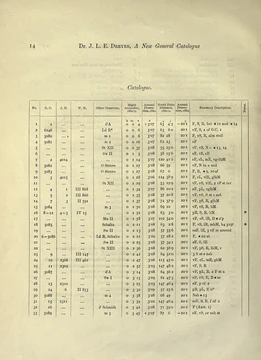
NGC 517, also catalogued as PGC 5214 and UGC 960, is a lenticular galaxy in the constellation Pisces, about 188 million light-years away. William Herschel discovered it on 13 September 1784. While observing with Beta Andromedae as a reference, Herschel found both NGC 517 and NGC 515, describing them as "two, both stellar" because he mistook them for stars. He recorded only one position, roughly 35 arcseconds east of NGC 515. Heinrich d'Arrest later made the first accurate measurement using data from three separate nights. John Herschel also observed the object, and John Louis Emil Dreyer included it in the New General Catalogue, noting it as "pretty faint, round, stellar, southeastern of 2" (the other being NGC 515). The galaxy has an apparent visual magnitude of 12.5 and is classified as type S0 on the Hubble Sequence. Its distance of roughly 190 million light-years is derived from its redshift and Hubble's law.
Quick Facts
- Epoch
- J2000
- Ra
- 01 · 24 · 43.8
- Dec
- +33 · 25 · 46
- Constellation Name
- Pisces
- Appmag B
- 13.5
- Appmag V
- 12.5
- H Radial V
- (4169 ± 58) km/s
- Dist Ly
- 188 Mly
- Z
- 0.014003 ± 0.000193
- Names
- PGC 5214, UGC 960, GC 301, MGC +05-04-054, 2MASS J01244381+3325465, h 114
Facts from the source article.
Lore & Background
William Herschel discovered NGC 517 along with NGC 515 using Beta Andromedae as a reference star. He described his discovery as 'two, both stellar', indicating his misidentification of the object as a star. While Herschel only noted one position about 35" east of NGC 515, Heinrich d'Arrest made the first accurate measurement of the object, using observation data of three separate nights. The object was also observed by John Herschel, son of William Herschel, and later catalogued by John Louis Emil Dreyer in the New General Catalogue, where the galaxy was described as 'pretty faint, round, stellar, southeastern of 2' with the other one being NGC 515.
The galaxy has an apparent visual magnitude of 12.5 and can be classified as type S0 using the Hubble Sequence. The object's distance of roughly 190 million light-years from the Solar System can be estimated using its redshift and Hubble's law.
Reader's Guide
NGC 517 is a lenticular galaxy in Pisces, notable for its discovery by William Herschel in 1784 and its subsequent observation history. Herschel initially misidentified it as a star, a common error in early deep-sky observations. The accurate position was later determined by Heinrich d'Arrest, and the object was included in the New General Catalogue by John Louis Emil Dreyer. Its classification as type S0 places it in the lenticular category, a transitional form between elliptical and spiral galaxies. The galaxy's distance, estimated via redshift and Hubble's law, situates it roughly 188 million light-years away. NGC 517 is often listed alongside NGC 515, as the two were discovered together and are frequently referenced as a pair. Its inclusion in the NGC catalog and its study by multiple astronomers over centuries contribute to its significance in the history of astronomical cataloging and galaxy classification.
Did You Know?
- NGC 517 was discovered by William Herschel on 13 September 1784.
- Herschel initially misidentified NGC 517 as a star, describing it as 'stellar'.
- Heinrich d'Arrest made the first accurate measurement of NGC 517 using data from three nights.
- The galaxy is classified as type S0 (lenticular) on the Hubble Sequence.
More in NGC Objects 1-24
Spotted an error? Know more?
Reader corrections go straight into our review queue. Suggest an edit · How this site is sourced