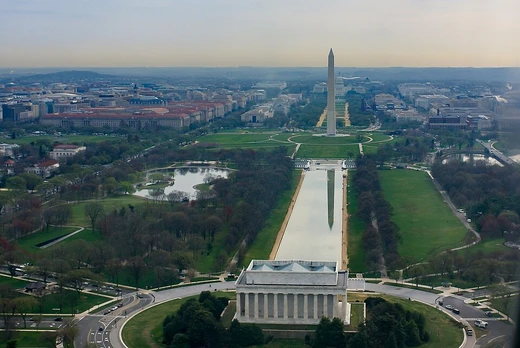
Arlington Memorial Bridge
Neoclassical bridge linking the Lincoln Memorial and Arlington House.
Last updated

via Wikipedia: Arlington Memorial Bridge · see source
Where it is
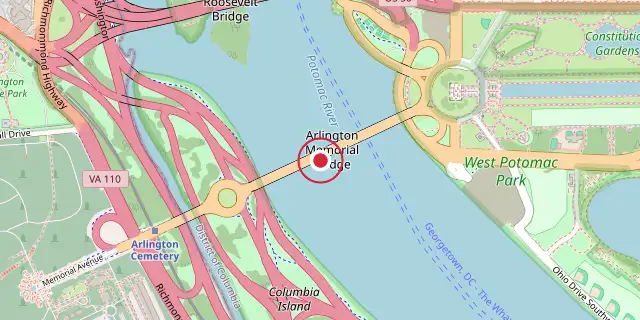
Coordinates: 38°53′13″N 77°03′22″W (38.8870, -77.0560) · Open in OpenStreetMap
Coordinates and connected clubs: the infobox of Wikipedia: Arlington Memorial Bridge (CC BY-SA 4.0). Map: drawn by Codexery from OpenStreetMap tiles.
The Arlington Memorial Bridge is a Neoclassical masonry, steel, and stone arch bridge crossing the Potomac River in Washington, D.C. First proposed in 1886, it went unbuilt for decades due to political quarrels over its memorial purpose. Traffic problems at the dedication of the Tomb of the Unknown Soldier and the desire to complete it for George Washington's bicentennial led to its construction in 1932.
Early attempts to build a bridge
Congress first proposed a bridge at the site on May 24, 1886, and the War Department studied feasibility, later suggesting a Lincoln-Grant Memorial Bridge. The Washington Post supported naming it after both Robert E. Lee and Grant. In 1887 the department proposed a General Ulysses S. Grant Memorial Bridge, a suspension bridge 105 feet high with 98 feet of clearance. Designs included a bare steel truss, a low masonry arch, and a Romanesque Revival structure by Paul J. Pelz with two central towers and barbicans.
Senator John W. Daniel sponsored 1897 legislation funding a bedrock survey, which the Army Corps of Engineers conducted from July 1897 to March 1898. Because the bridge was conceived as a memorial to Grant, Congress repeatedly blocked funding. After the survey, Congress authorized $5,000 for a design competition. The National Memorial Bridge Association formed, and four New York bridge engineers submitted designs.
A five-member board selected a design by William H. Burr and architect Edward P. Casey, calling for a steel and stone drawbridge with 36 arches, classical towers with bronze Victory statues, and statues of generals and statesmen lining the bridge.
Construction: 1922–1932
President Warren G. Harding, caught in a three-hour traffic jam on November 11, 1921, while traveling to the Tomb of the Unknown Soldier dedication, sought a $25,000 appropriation in 1922; Congress approved it on June 12, 1922. The Arlington Memorial Bridge Commission initially proposed a site at New York Avenue, but the Commission of Fine Arts opposed it. At a December 18, 1922 meeting with Harding and Vice President Calvin Coolidge, the parties unanimously decided to build the bridge on a line of sight between the Lincoln Memorial and Arlington House, adhering to the McMillan Plan, and to construct a low bridge with a bascule in the center.
The Commission of Fine Arts recommended direct selection of a designer and named three firms; the bridge commission chose McKim, Mead and White on April 4, 1923, with William Mitchell Kendall as lead designer. D.C. business community members pressed for a draw span to allow large ships to reach Georgetown harbor, and on February 17, 1923, Colonel C.O. Sherrill of the Army Corps of Engineers stated the Corps would only approve a bridge with a draw span.
Description
The northeastern approaches frame the Lincoln Memorial, and the southwestern landing is on Columbia Island. The northeastern end marks the western edge of the National Mall, while the southwestern end connects with Memorial Drive, crossing the Boundary Channel Bridge into Virginia and leading to Arlington National Cemetery. In 2011 the bridge carried about 54,000 vehicles daily. The northeastern entrance features The Arts of War sculptures, Sacrifice and Valor, completed by Leo Friedlander in 1951, one cast by Ferdinando Marinelli Artistic Foundry of Florence, Italy.
On the pylons of each pier are circular discs with eagles and fasces by sculptor Carl Paul Jennewein. The closest Metro station is Arlington Cemetery. The bridge symbolically connects the Lincoln Memorial and Arlington House, former home of General Robert E. Lee, representing reunification of North and South. At the southwestern terminus, the bridge connects with the George Washington Memorial Parkway, State Route 27, and State Route 110; at the northeastern terminus, with Constitution Avenue, Independence Avenue, the Rock Creek and Potomac Parkway, and Interstate 66.
A peculiarity of the southwestern traffic circle is that traffic already in the circle must yield to entering traffic. The center was originally a metal draw span, last opened on February 28, 1961; its bascule leaves were counterbalanced with Swedish iron ore due to scrap shortages during the Great Depression. The bridge was added to the National Register of Historic Places on April 4, 1980.
Renovation history
Floods in March 1936 damaged the bridge's electrical equipment; repairs in late 1938 and early 1939 by the Electrical Underground Construction Co. of New York City cost $9,245. In October 1936 a gear and crankshaft in the drawbridge broke, closing the bridge for nine hours, the longest closure since it opened. Major maintenance in 1939 included repainting the draw span, repaving, heating the west engine room, and repointing and cleaning granite on Virginia abutments, causing six-hour closures on August 30, 31, and September 1.
In 1945 the bridge closed for two hours due to a jammed draw span; on August 2–3, 1947, it closed for a gear and shaft replacement, the second-longest closing. In 1951 granite blocks were replaced with asphalt in a $207,000 repaving project by Corson and Gruman Co., closing lanes on weekdays and the entire bridge on weekends for four weeks. Minor repaving occurred in July 1957. In November 1976 the draw span was immobilized and sealed, approaches repaired, with lane restrictions lasting several weeks.
More in National Park Service Areas in Washington, D.C.
Sources
Compiled from Wikipedia and the sources listed below. Text from Wikipedia is available under CC BY-SA 4.0; this entry is adapted from it.
- Wikipedia: Arlington Memorial Bridge (CC BY-SA 4.0).
Spotted an error? Know more?
Reader corrections go straight into our review queue. Suggest an edit · How this site is sourced