
Ocmulgee Mounds National Historical Park
Preserving 12,000 years of Indigenous culture and Mississippian earthworks.
Last updated
Where it is
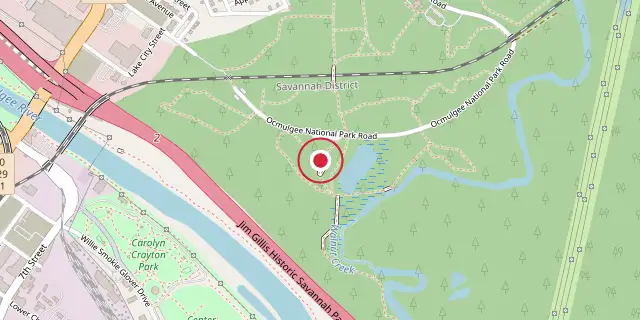
Coordinates: 32°50′13″N 83°36′29″W (32.8370, -83.6080) · Open in OpenStreetMap
Coordinates and connected clubs: the infobox of Wikipedia: Ocmulgee Mounds National Historical Park (CC BY-SA 4.0). Map: drawn by Codexery from OpenStreetMap tiles.
Ocmulgee Mounds National Historical Park, located in Macon, Georgia, preserves traces of over ten millennia of Indigenous culture in the Southeastern Woodlands. Its chief remains are major earthworks built before 1000 CE by the South Appalachian Mississippian culture, including the Great Temple and other ceremonial mounds.
History
The name Ocmulgee comes from the Mikasuki phrase Oki Molki, which means "Bubbling Water." This site holds evidence of people living there for 12,000 years, starting with Ice Age hunters and continuing through the historic Muscogee Creek tribe. The Macon Plateau saw habitation during the Paleoindian, Archaic, and Woodland periods. The main period of activity was between about 950 and 1150 CE, during the Early Mississippian phase.
This organized society, known as the Macon Plateau culture, built large earthworks that reflected their religion and government. Leaders oversaw the construction of platform mounds, including the Great Temple Mound, which stands 55 feet tall on a high bluff. Magnetometer scans show it had a unique spiraling staircase facing the floodplain. There is also at least one burial mound.
Rectangular wooden buildings on top of the mounds were used for ceremonies. The mounds here are spaced farther apart than at other Mississippian sites, likely to create public space and room for homes.
Circular earth lodges served as meeting and ceremony spaces. One lodge was carbon dated to 1050 CE, and a reconstruction now stands in the park. Inside, a raised-earth platform is shaped like an eagle with a forked-eye motif, with molded seats for leaders.
National Historical Park
Professional excavation began in the 1930s under President Franklin D. Roosevelt during the Great Depression, sponsored by the Works Progress Administration between 1933 and 1942. Workers excavated portions of eight mounds, revealing artifacts indicating a wide trading network and complex culture. Congress authorized the park as a national monument on June 14, 1934, and it was formally established on December 23, 1936, under the National Park Service.
It was listed on the National Register of Historic Places on October 15, 1966. In 1997, the NPS designated Ocmulgee Old Fields as a Traditional Cultural Property, the first such site east of the Mississippi River.
The John D. Dingell Jr. Conservation, Management, and Recreation Act, signed March 12, 2019, redesignated it as a national historical park and increased its size by about 2,100 acres. The NPS-owned area is 701 acres. 906 acres were transferred to the park on February 9, 2022, after negotiations halted incompatible industrial development; an additional 45 acres were transferred to the Ocmulgee Land Trust for wetlands restoration.
The visitor center, completed in 1951, is styled in Streamline Moderne architecture to contrast with the prehistoric mounds. Inside is an archaeology museum displaying artifacts and interpreting successive cultures, including the historic Muscogee Creek tribe. The center includes a short orientation film and a gift shop. The NPS renovated its facilities in the early 1990s.
More in National Historical Parks of the United States
Sources
Compiled from Wikipedia and the sources listed below. Text from Wikipedia is available under CC BY-SA 4.0; this entry is adapted from it.
- Wikipedia: Ocmulgee Mounds National Historical Park (CC BY-SA 4.0).
Spotted an error? Know more?
Reader corrections go straight into our review queue. Suggest an edit · How this site is sourced