Nez Perce National Historical Park
38 sites across four states honoring Nez Perce history.
Last updated
Where it is
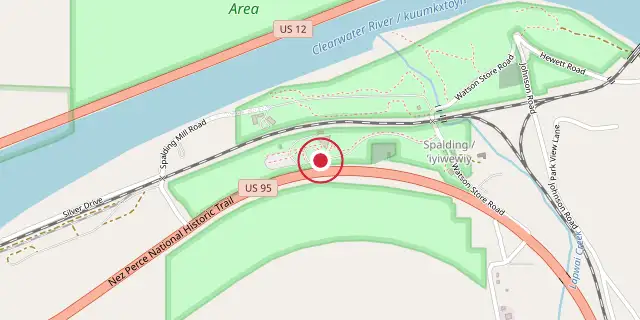
Coordinates: 46°26′49″N 116°49′23″W (46.4470, -116.8230) · Open in OpenStreetMap
Coordinates and connected clubs: the infobox of Wikipedia: Nez Perce National Historical Park (CC BY-SA 4.0). Map: drawn by Codexery from OpenStreetMap tiles.
The Nez Perce National Historical Park is a United States National Historical Park comprising 38 sites across Idaho, Montana, Oregon, and Washington. It preserves traditional aboriginal lands of the Nez Perce people and is strongly associated with the 1877 resistance of Chief Joseph and his band, who attempted to reach Canada to avoid forced relocation. The park was established in 1965, and a museum opened at its headquarters in Spalding, Idaho, in 1983.
Sites
The park consists of 38 discontiguous sites spread over four states, linked by Nez Perce history rather than geography. Twenty-six sites are on or near the Nez Perce Indian Reservation in Idaho and can be toured in one day; the other twelve are in adjacent states. Several sites connect via the Nez Perce National Historic Trail, managed by the United States Forest Service, which preserves the 1877 route of Chief Joseph and his band.
Ecology
The park sites span three main ecoregions. The first, in the Palouse grasslands and Missouri Basin, is shortgrass prairie with altitudes of about 1000 to 3500 ft. The second, on the Columbia and Snake river plateaus, is sagebrush steppe at around 3000 ft, including lava fields and flows. The third, in the Blue Mountains, Salmon River Mountains, southwestern Montana, and northern Rocky Mountains, is conifer and alpine meadows with lower temperatures and greater precipitation.
Numerous mammal, amphibian, reptile, bird, and invertebrate species inhabit the sites. Sensitive species include Montana Arctic grayling, mountain plover, swift fox, great grey owl, boreal owl, and several fish; gray wolf and bald eagles are sometimes seen. Ecological concerns include invasive plants, habitat degradation from human activity, protection of endangered species, and effects of climate change.
More in National Historical Parks of the United States
Sources
Compiled from Wikipedia and the sources listed below. Text from Wikipedia is available under CC BY-SA 4.0; this entry is adapted from it.
- Wikipedia: Nez Perce National Historical Park (CC BY-SA 4.0).
- Word definitions: the , each quoted from its Wikipedia article.
Spotted an error? Know more?
Reader corrections go straight into our review queue. Suggest an edit · How this site is sourced