Pullman National Historical Park
First model planned industrial community and site of the 1894 Pullman strike.
Last updated
Where it is
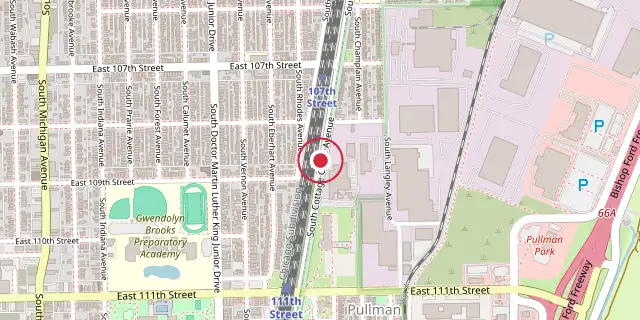
Coordinates: 41°41′49″N 87°36′32″W (41.6970, -87.6090) · Open in OpenStreetMap
Coordinates and connected clubs: the infobox of Wikipedia: Pullman National Historical Park (CC BY-SA 4.0). Map: drawn by Codexery from OpenStreetMap tiles.
Pullman National Historical Park is a historic district in Chicago, Illinois, that preserves the first model, planned industrial community in the United States. Built for George Pullman to manufacture railroad sleeping cars, it became a notable company town and the site of the violent 1894 Pullman strike. The park includes the administration buildings, Hotel Florence, and worker housing, and was designated a national monument in 2015 before being redesignated a national historical park in 2022.
Background
George Pullman, born in Brocton, New York, studied engineering and gained wealth in Chicago by designing a method to raise buildings for better drainage. He founded the Pullman Palace Car Company in 1867 to manufacture luxury sleeping cars, which were rented to railroads with trained employees, many formerly enslaved. Seeking to integrate employee welfare with manufacturing efficiency, Pullman purchased 4,000 acres south of Chicago between the Illinois Central Railroad and Lake Calumet. The Pullman Land Association oversaw non-manufacturing real estate.
Benzette Williams developed utilities and drainage. Construction began in early 1880, with factories nearly complete by fall. Housing consisted of red brick rowhouses with indoor plumbing, a marked improvement over tenements, and predominantly featured Queen Anne style with Romanesque details.
Pullman Strike
The Panic of 1893 devastated the railroad industry, leading Pullman to lower wages while rents remained unchanged. The American Railway Union (ARU), led by Eugene V. Debs, formed on June 20, 1893, and grew to 150,000 members, including many white Pullman workers. After pleas for wage increases were ignored, employees struck on May 11, 1894. The ARU launched a boycott refusing to run trains with Pullman cars, crippling rail traffic.
Twenty-four Chicago railroads, organized as the General Managers' Association, used strikebreakers and ran Pullman cars with mail cars to force federal intervention. The government found the boycott violated the Sherman Antitrust Act. Thousands of U.S. Marshals and Army troops were deployed; fights left dozens dead or injured. ARU leaders including Debs were jailed, ending the strike.
Some workers renouncing the union returned to work. The strike tarnished the Pullman brand.
Pullman died in 1897 and was buried in a concrete-and-steel grave. The strike demonstrated union power but affirmed government intervention rights, upheld by the Supreme Court in In re Debs (1895). The Illinois Supreme Court forced the company to sell non-industrial holdings in 1898; most land was sold by 1907.
Landmarks
The Administration and Factory Complex featured unusually ornate industrial buildings in a park-like setting overlooking artificial Lake Vista, a cooling reservoir for the Corliss steam engine. The buildings were well-lit and ventilated, with a main facade mirrored in the lake facing the Illinois Central tracks. Beman designed them for linear manufacturing, an early assembly line adaptation. Hotel Florence, named for Pullman's daughter, opened November 1, 1881, with fifty rooms and the community's only bar.
A second-floor suite was kept for Pullman. Each floor offered different service classes, from opulent on the second to modest on the fourth. The first floor and basement recently underwent extensive rehabilitation; the annex remains closed.
Preservation and rehabilitation
A 1960 demolition proposal for an industrial park spurred the Pullman Civic Organization (PCO) to advocate preservation. The remaining 300-acre neighborhood was listed on the National Register of Historic Places on October 8, 1969, and declared a National Historic Landmark District in 1970. The southern portion became a Chicago Landmark on October 16, 1972; a northern landmark was created in 1993 and merged in 1999. The PCO provided restoration grants, and the Historic Pullman Foundation purchased key buildings in the 1970s.
The State of Illinois bought Hotel Florence and the Administration and Factory Complex in 1991, creating a state historic site. A 1998 arson destroyed much of the factory before it opened. President Barack Obama designated Pullman a national monument on February 19, 2015, the first NPS unit in Chicago. In 2017, the NPS approved restoring the clock tower as a visitor center, requiring removal of toxic soil.
The visitor center opened on Labor Day, September 6, 2021, with Illinois Governor J. B. Pritzker and Secretary of the Interior Deb Haaland attending. The Consolidated Appropriations Act, 2023 redesignated the site as Pullman National Historical Park in December 2022.
Did You Know?
- The Brotherhood of Sleeping Car Porters, founded by A. Philip Randolph in 1925, reached the first major labor agreement between a company and an African American union in 1937.
- The park partners with the American Passenger Rail Heritage Foundation to provide on-board educational programs for South Shore Line passengers.
More in National Historical Parks of the United States
Sources
Compiled from Wikipedia and the sources listed below. Text from Wikipedia is available under CC BY-SA 4.0; this entry is adapted from it.
- Wikipedia: Pullman National Historical Park (CC BY-SA 4.0).
Spotted an error? Know more?
Reader corrections go straight into our review queue. Suggest an edit · How this site is sourced