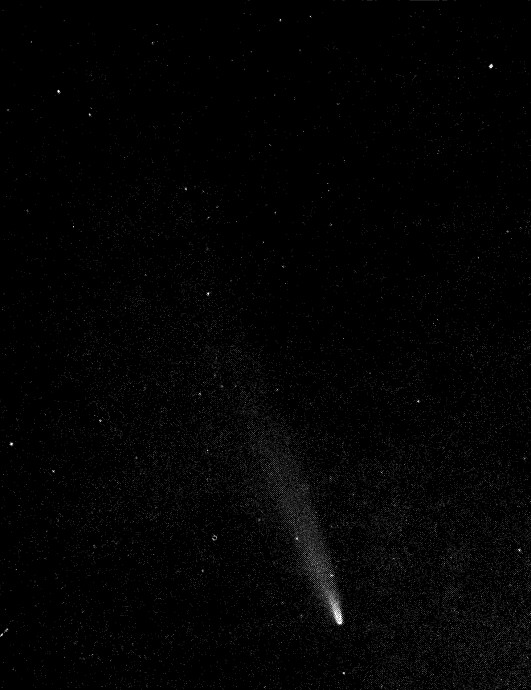
Southern Comet of 1947
A bright Southern Hemisphere comet visible in December 1947.

Carlos A. Etchecopar · Public domain
In December 1947, a brilliant comet appeared in the Southern Hemisphere, known as the Southern Comet of 1947 (also cataloged as C/1947 X1, 1947 XII, and 1947n). It was the brightest comet seen in twenty years and remains one of the most luminous since 1935, reaching an estimated maximum apparent magnitude of −3.
The comet reached perihelion on 2 December 1947, passing just 0.11 AU from the Sun, and made its closest approach to Earth on 7 December at 0.85 AU. Because of its trajectory, the comet might have been too faint to spot while approaching the Sun. After early October, it sped toward the Sun and grew brighter but remained hard to observe. On perihelion day, it was estimated to be just 6 degrees from the Sun in the morning sky. It then moved into conjunction with the Sun and reappeared in the evening sky.
Many observers first spotted the comet in evening twilight on 8 December 1947, though unconfirmed reports from Cape Colony suggest it was seen a day earlier. In Horsham, Australia, someone reported seeing it in daylight about an hour before sunset. Harold Pallot, a local school astronomy teacher, estimated its magnitude at −5 or brighter. John Paraskevopoulos judged the tail to be at least 25 degrees long upon discovery, and the next day he placed the comet’s magnitude at +1.
On 10 December, Jorge Bobone at the National Astronomical Observatory in Córdoba, Argentina, observed the comet telescopically and noted two nuclei separated by 6.3 arcseconds. Zdenek Sekanina later estimated that the nuclei had split on 30 November 1947. The comet reached its southernmost declination of −35° on 11 December. By mid-December, its magnitude was estimated between 4 and 5, though Paraskevopoulos put it at 2.5 to 3. The tail, now about 1.5 degrees long, appeared ragged and consisted of three components. Willem Hendrik van den Bos observed the two nuclei about 10 arcseconds apart.
The comet faded quickly. It was last seen with the naked eye on 25 December, and by month’s end its magnitude was around 8. A plate taken on 31 December still showed the nuclei, now about 17 arcseconds apart. George Van Biesbroeck made the final detection on 20 January 1948.
Quick Facts
- Discovery Date
- 7–8 December 1947
- Designations
- 1947nICQ1 / 1947 XII
- Orbit Ref
- jpl1 · jpl2
- Epoch
- 19 December 1947 (JD 2432538.5)
- Observation Arc
- 25–38 days
- Obs
- 11–29
- Aphelion
- ~1,400 AU (A) / ~590 AU (B)
- Perihelion
- 0.110 AU
- Semimajor
- 700 AU (A) / 300 AU (B)
- Eccentricity
- 0.99984 (A) / 0.99963 (B)
- Period
- ~18,500 years (A) / ~5,100 years (B)
- Inclination
- 138.51°
Facts from the source article.
Lore & Background
The comet passed perihelion on 2 December 1947 at 0.11 AU from the Sun, with its closest approach to Earth on 7 December at 0.85 AU. The approach geometry may have made it too faint to be discovered as it approached the Sun. After early October, it approached the Sun rapidly and, despite brightening, was difficult to observe. On perihelion date, it was estimated to be 6 degrees from the Sun in the morning sky, then moved into conjunction and entered the evening sky.
The comet was discovered in evening twilight by many observers on 8 December 1947, though unconfirmed reports from Cape Colony placed a sighting on 7 December. A report from Horsham, Australia, described the comet seen in daylight about an hour before sunset; Harold Pallot estimated its magnitude at least −5. John Paraskevopoulos estimated the tail upon discovery to be at least 25 degrees long, and the next day he estimated the magnitude at +1. Jorge Bobone observed two nuclei 6.3 arcseconds apart on 10 December; Zdenek Sekanina estimated the nuclei separated on 30 November. On 11 December the comet reached its southernmost declination of −35°. By mid-December, magnitude estimates ranged from 4 to 5, while Paraskevopoulos gave 2.5–3; the tail was about 1.5 degrees long, with three ragged components. The two nuclei were about 10 arcseconds apart as observed by Willem Hendrik van den Bos.
The comet faded rapidly, last seen by naked eye on 25 December; by month's end its magnitude was around 8. The nuclei remained observable, about 17 arcseconds apart on a plate from 31 December. The comet was last detected on 20 January 1948 by George Van Biesbroeck.
Reader's Guide
The Southern Comet of 1947 stands as one of the brightest comets observed since 1935, reaching an estimated maximum apparent magnitude of −3. Its discovery in evening twilight by multiple observers on 8 December 1947, with unconfirmed reports a day earlier, highlights the challenging geometry of its approach: it passed very close to the Sun (0.11 AU at perihelion) and was difficult to observe before perihelion. The comet's tail was initially estimated at least 25 degrees long, a remarkable length, and it exhibited a split nucleus with two components first noted by Jorge Bobone on 10 December, with the separation estimated to have begun on 30 November. The nuclei were tracked as they drifted apart, reaching about 17 arcseconds by 31 December. The comet's rapid fading after mid-December, with naked-eye visibility ending by 25 December, and final detection on 20 January 1948, underscores its brief but brilliant appearance. Its legacy is that of a notable southern sky event, documented by astronomers across the Southern Hemisphere, including Harold Pallot, John Paraskevopoulos, and George Van Biesbroeck, and preserved in observations from Argentina, Australia, and elsewhere.
Did You Know?
- The comet reached an estimated maximum apparent magnitude of −3, making it one of the brightest since 1935.
- It was discovered in evening twilight on 8 December 1947 by many observers, with unconfirmed reports from Cape Colony on 7 December.
Origins: From Western Swing to the Comets Name
Bill Haley's musical journey began in the mid-1940s, when he performed with the Down Homers and assembled a group called the Four Aces of Western Swing. The ensemble that would become legendary first operated as 'Bill Haley and the Saddlemen' between roughly 1949 and 1952, playing country and western material with an occasional bluesy edge. During this era, Haley was widely regarded as one of America's premier cowboy yodelers. The core lineup included pianist and accordionist Johnny Grande and steel guitarist Billy Williamson, with bass duties rotating among Al Thompson, Al Rex, and Marshall Lytle. A pivotal moment arrived in July 1951, when the Saddlemen became the first act to record a cover of 'Rocket 88,' originally a jump blues track by Jackie Brenston and his Delta Cats—in reality, Ike Turner and his Kings of Rhythm. Released on Philadelphia's Holiday Records in a nascent rockabilly style, the single sold well and was followed in 1952 by a cover of 'Rock the Joint' on Essex Records. A friend's observation about the common mispronunciation of Halley's Comet to rhyme with Bailey inspired the new band name, adopted in the fall of 1952.
The Breakthrough: 'Crazy Man, Crazy' and the Decca Years
In 1953, Haley scored his first national success with 'Crazy Man, Crazy,' an original song built around a phrase he reportedly heard from his teenage audience. Released on Essex Records, the track blended R&B, western, and pop elements, and some sources consider it a contender for the title of first rock and roll record, while others describe it as the first rock and roll song to chart on the pop side. It was also said to be the first rock and roll recording played on national American television, appearing in an episode of Omnibus that year. Haley later claimed the recording sold a million copies, though this figure is generally regarded as an exaggeration. On the band's final Essex release, new member Joey Ambrose can be heard on the B-side, 'Straight Jacket.' In the spring of 1954, Haley and His Comets departed Essex for New York-based Decca Records, where they were placed under the guidance of veteran producer Milt Gabler. Gabler, who had been involved in creating many proto-rock and roll recordings by artists such as the Andrews Sisters and Louis Jordan dating back to the 1940s, went on to produce all of the band's recordings for the label.
Peak Success: Nine Top-Twenty Hits and Early Rock Films
From late 1954 through late 1956, Bill Haley and His Comets achieved an extraordinary run of commercial success, recording nine top-20 singles, one of which reached number one and three that cracked the top ten. Their hit catalog included 'Shake, Rattle & Roll,' 'Dim, Dim the Lights,' 'Rock-A-Beatin' Boogie,' 'Razzle-Dazzle,' 'See You Later, Alligator,' 'The Saints Rock 'N' Roll,' and 'Rip It Up.' The crown jewel, however, was 'Rock Around the Clock,' which became the best-selling rock single in the history of the genre and held that position for several years. The group was widely regarded as being at the forefront of rock and roll during the genre's formative years. In 1956, they appeared in two early rock and roll films alongside disc jockey Alan Freed: 'Rock Around the Clock' and 'Don't Knock the Rock,' further embedding the band in the cultural landscape of the era.
Decline, European Longevity, and the Comets Legacy
By 1956, the arrival of more risqué acts such as Elvis Presley and Little Richard shifted public taste, and the more clean-cut Haley and His Comets began to decline in popularity. Nevertheless, Haley remained popular in Europe, where his music continued to find an audience. In the 1970s, he experienced a comeback as a nostalgia act, performing alongside many of his contemporaries from the early rock and roll era. The band itself, which had been active from 1947 until Haley's death in 1981, left behind a complicated legacy. Following his passing, no fewer than seven different groups have operated under the Comets name, each claiming—with varying degrees of authority—to be the legitimate continuation of Haley's original group. As of the close of 2014, four of these successor groups were still taking the stage in the United States and abroad, keeping the Comets identity alive decades after the original band's dissolution.
Gallery
Frequently Asked Questions
What is the Southern Comet of 1947?
It is a bright comet that lit up the Southern Hemisphere sky in December 1947 and is cataloged as C/1947 X1. At the time of its appearance, it was the most luminous comet observers had seen in roughly twenty years.
What designations does the Southern Comet of 1947 carry?
The object is listed under three identifiers: C/1947 X1, 1947 XII, and 1947n. All three names refer to the same comet observed in late 1947.
How bright did the Southern Comet of 1947 get at its peak?
Its estimated maximum apparent magnitude reached about −3, placing it among the brightest comets recorded since 1935. From the Southern Hemisphere, it would have been a striking naked-eye object in the December 1947 sky.
When did the Southern Comet of 1947 pass closest to the Sun and to Earth?
It swung to perihelion on 2 December 1947 at a mere 0.11 AU from the Sun, then reached its closest approach to Earth on 7 December at 0.85 AU. Because of its tight solar trajectory, the comet may have been too washed out to spot while still approaching.
Why is the Southern Comet of 1947 considered significant in comet history?
It outshone every other comet for the preceding two decades, making it a standout entry in brightness records. Its very close perihelion pass and high peak magnitude keep it a frequently cited example in discussions of notable 20th-century comets.
More in Named Comets, Part 4 1-24
Spotted an error? Know more?
Reader corrections go straight into our review queue. Suggest an edit · How this site is sourced