
Great Comet of 1811
A long-visible comet with a massive coma and cultural impact.

Wikimedia Commons · CC BY 4.0
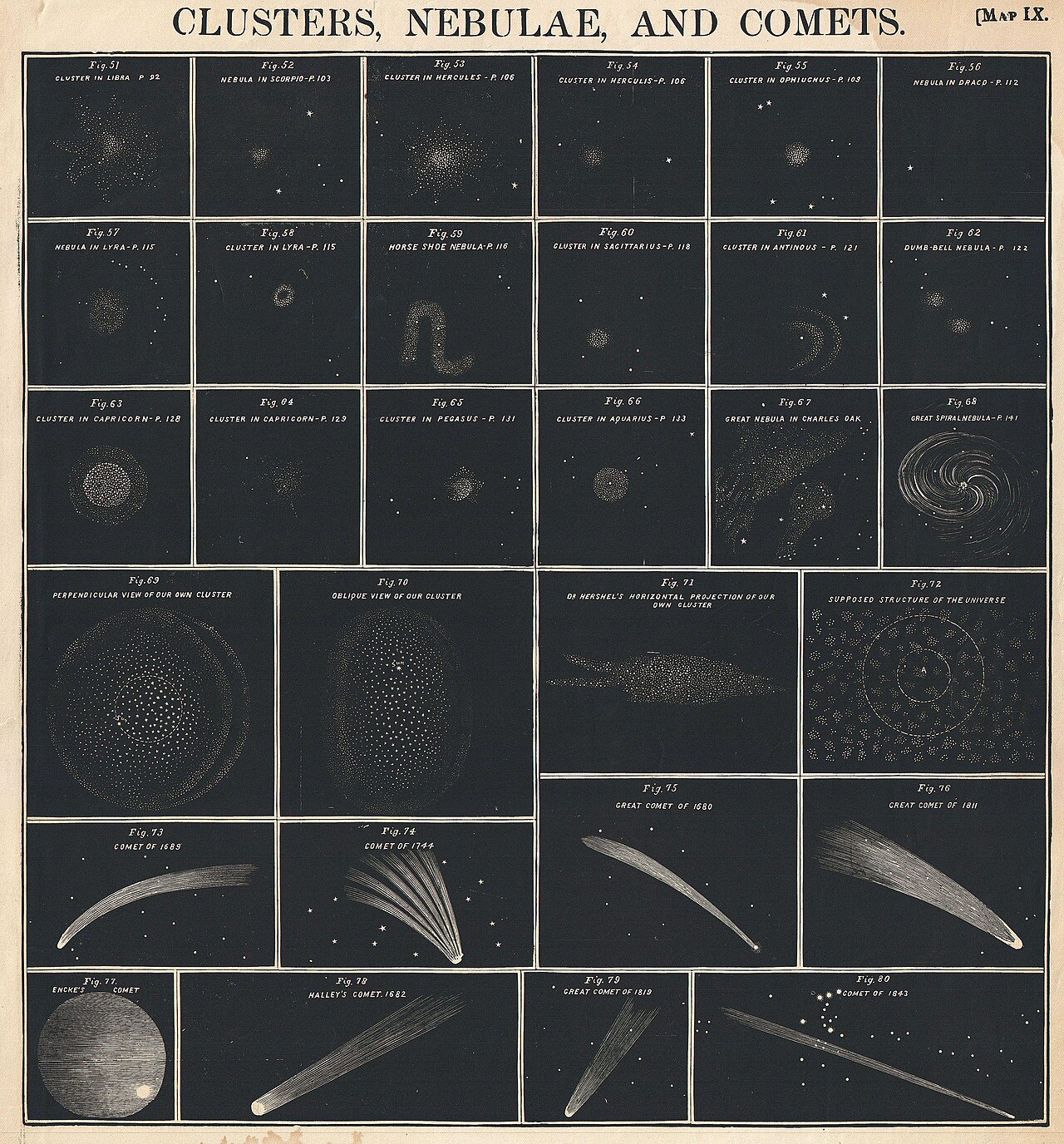
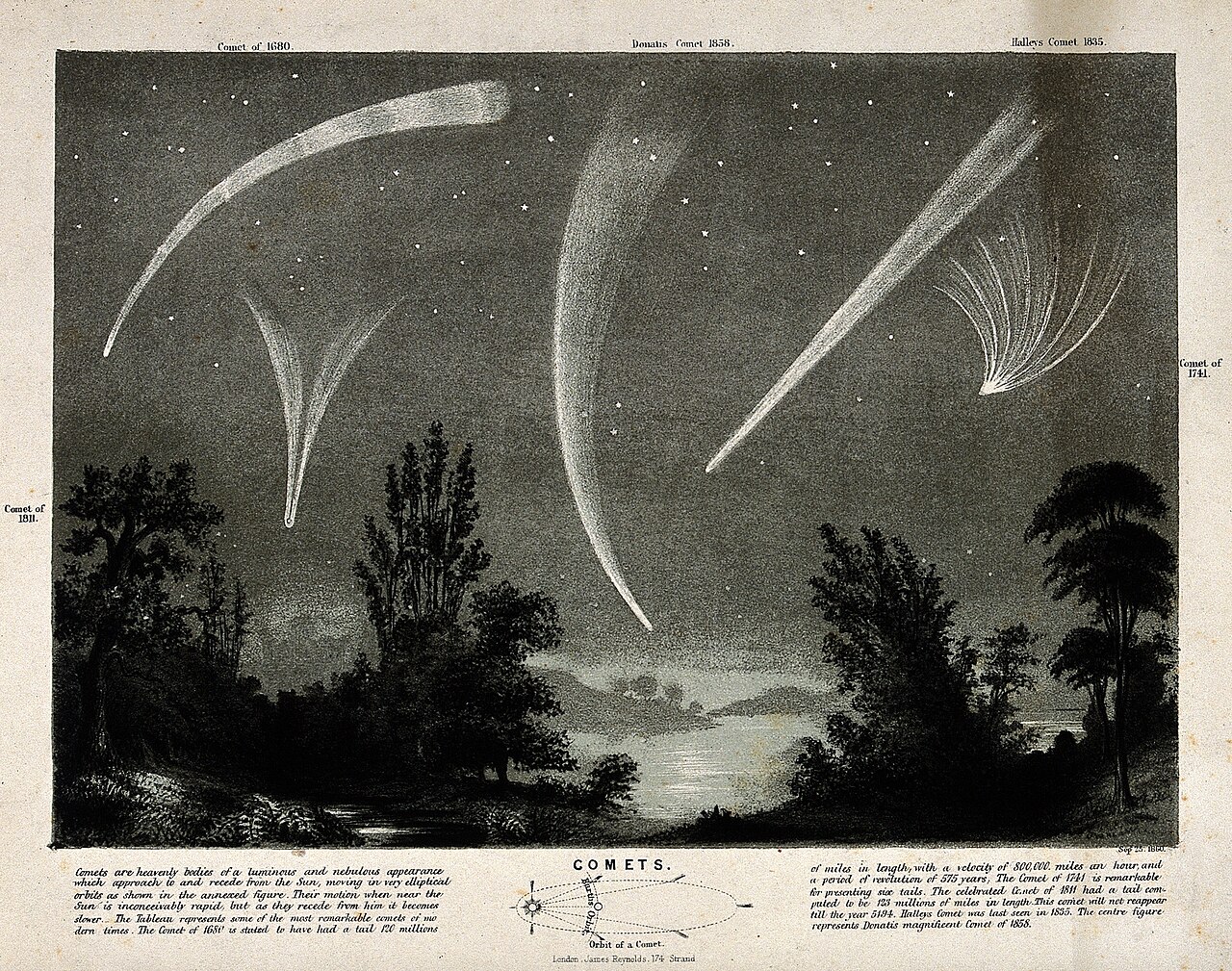
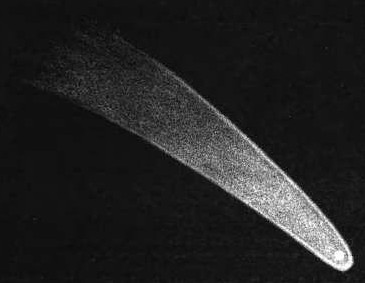
The Great Comet of 1811, officially known as C/1811 F1, remained visible without a telescope for roughly 260 days—a record that stood until Comet Hale–Bopp appeared in 1997. At its peak brightness in October 1811, when it was 1.2 astronomical units from Earth, it reached an apparent magnitude of 0 and showed a clearly visible coma.
Honoré Flaugergues first spotted the comet on March 25, 1811, while it was 2.7 AU from the Sun in the constellation Argo Navis (no longer recognized). After moonlight obscured it for several days, Jean-Louis Pons independently found it on April 11, and Franz Xaver, Baron Von Zach confirmed Flaugergues’s discovery that same night. Johann Karl Burckhardt calculated the first preliminary orbit in June. Using these figures, Heinrich Wilhelm Matthäus Olbers predicted the comet would become extremely bright later in the year.
From May through August, the comet was hard to see due to its low altitude and evening twilight. Both Flaugergues and Olbers recovered it in Leo Minor during August, with Olbers noting a small but distinct tail made of two rays forming a parabola when viewed through a comet seeker. James Veitch of Inchbonny made the first sighting in the United Kingdom that August. By September, the comet had moved into Ursa Major and became a striking object in the evening sky as it neared perihelion. William Herschel observed that its tail had grown to 25° long by October 6.
The comet’s brightness faded by January 1812. Several astronomers continued telescopic observations for months; the last recorded sighting was by Vincent Wisniewski at Novocherkassk on August 12, when it barely reached an apparent magnitude of 11. The comet’s coma was thought to be exceptionally large—perhaps over 1 million miles across, 50% larger than the Sun. Its nucleus was later estimated at 30–40 kilometers in diameter. In many ways, the comet resembled Hale–Bopp: it became spectacular without passing especially close to either Earth or the Sun, thanks to its extremely large and active nucleus.
Astronomers found it memorable. William Henry Smyth, comparing it to the later Donati’s Comet, said that as a visual object, the branched tail was more interesting, the nucleus with its “head-veil” was more distinct, and its circumpolar position was a lucky break for observers.
Quick Facts
- Discoverer
- Honoré Flaugergues
- Discovery Date
- March 25, 1811
- Designations
- 1811 I
- Orbit Ref
- barycenter · jpldata
- Epoch
- 1811-Sep-05 / 2382760.5
- Observation Arc
- 505 days (1.38 years)
- Obs
- 1000
- Orbit
- Long period comet
- Semimajor
- 212.4 AU
- Perihelion
- 1.04 AU
- Aphelion
- 423 AU
- Eccentricity
- 0.995125
Facts from the source article.
Lore & Background
The comet was discovered on March 25, 1811, by Honoré Flaugergues at 2.7 AU from the Sun in the now-defunct constellation of Argo Navis. After being obscured for several days by moonlight, it was also found by Jean-Louis Pons on April 11, while Franz Xaver, Baron Von Zach was able to confirm Flaugergues' discovery the same night. The first provisional orbit was computed in June by Johann Karl Burckhardt. Based on those calculations, Heinrich Wilhelm Matthäus Olbers predicted that the comet would go on to become extremely bright later that year.
From May to August, the comet's position made it difficult to spot because of its low altitude and the evening twilight. Both Flaugergues and Olbers were able to recover it in Leo Minor during August, Olbers noting a small but distinct tail, consisting of two rays forming a parabola, when viewing through a comet seeker. In August, the comet was first sighted in the United Kingdom by James Veitch of Inchbonny. By September, in Ursa Major, it was becoming a conspicuous object in the evening sky as it approached perihelion: William Herschel noted that a tail 25° long had developed by October 6. By January 1812, the comet's brightness had faded. Several astronomers continued to obtain telescopic observations for some months, the last being Vincent Wisniewski at Novocherkassk, who noted it as barely reaching an apparent magnitude of 11 by August 12.
The Great Comet of 1811 was thought to have had an exceptionally large coma, perhaps reaching over 1 million miles across, 50% larger than the Sun. The comet's nucleus was later estimated at 30–40 km in diameter. In many ways, the comet was quite similar to Comet Hale–Bopp; it became spectacular without passing particularly close to either the Earth or the Sun but had an extremely large and active nucleus. Before perihelion passage on September 12, 1811, the comet had an orbital period of about 2742 years. Computing the barycentric orbital period of the comet after perihelion passage when it is outside the planetary region (using an epoch of 2200) shows an orbital period of about 2974 years, which would give a return year of around 4785.
Reader's Guide
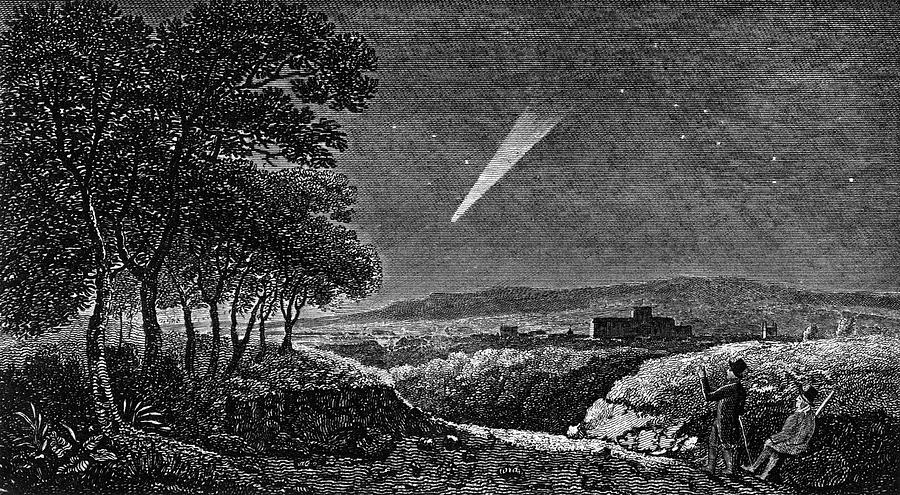
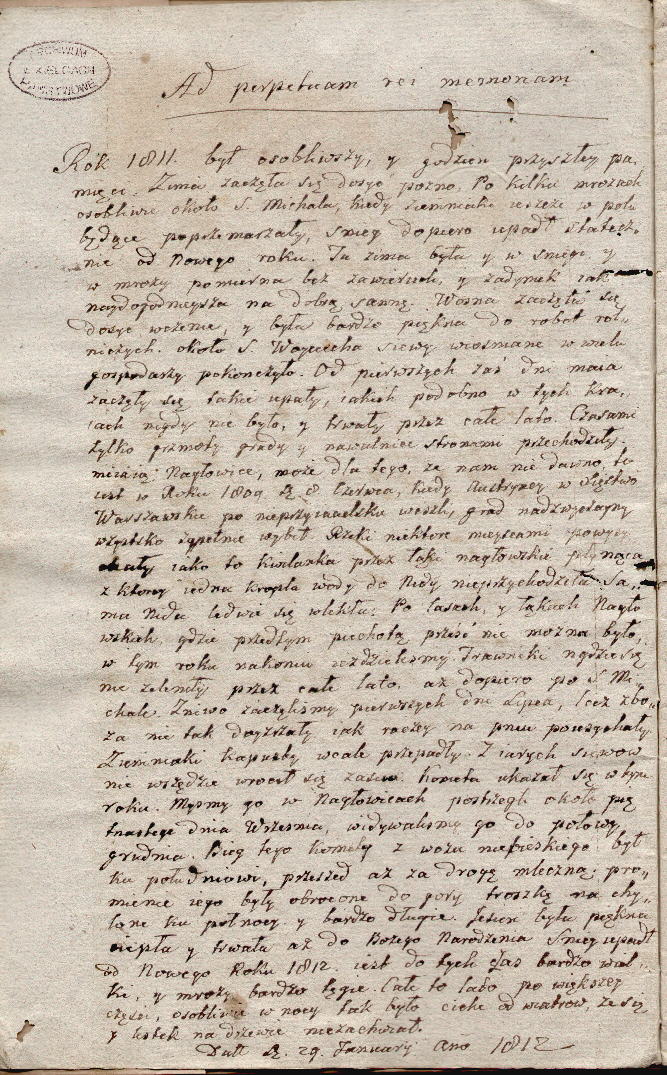
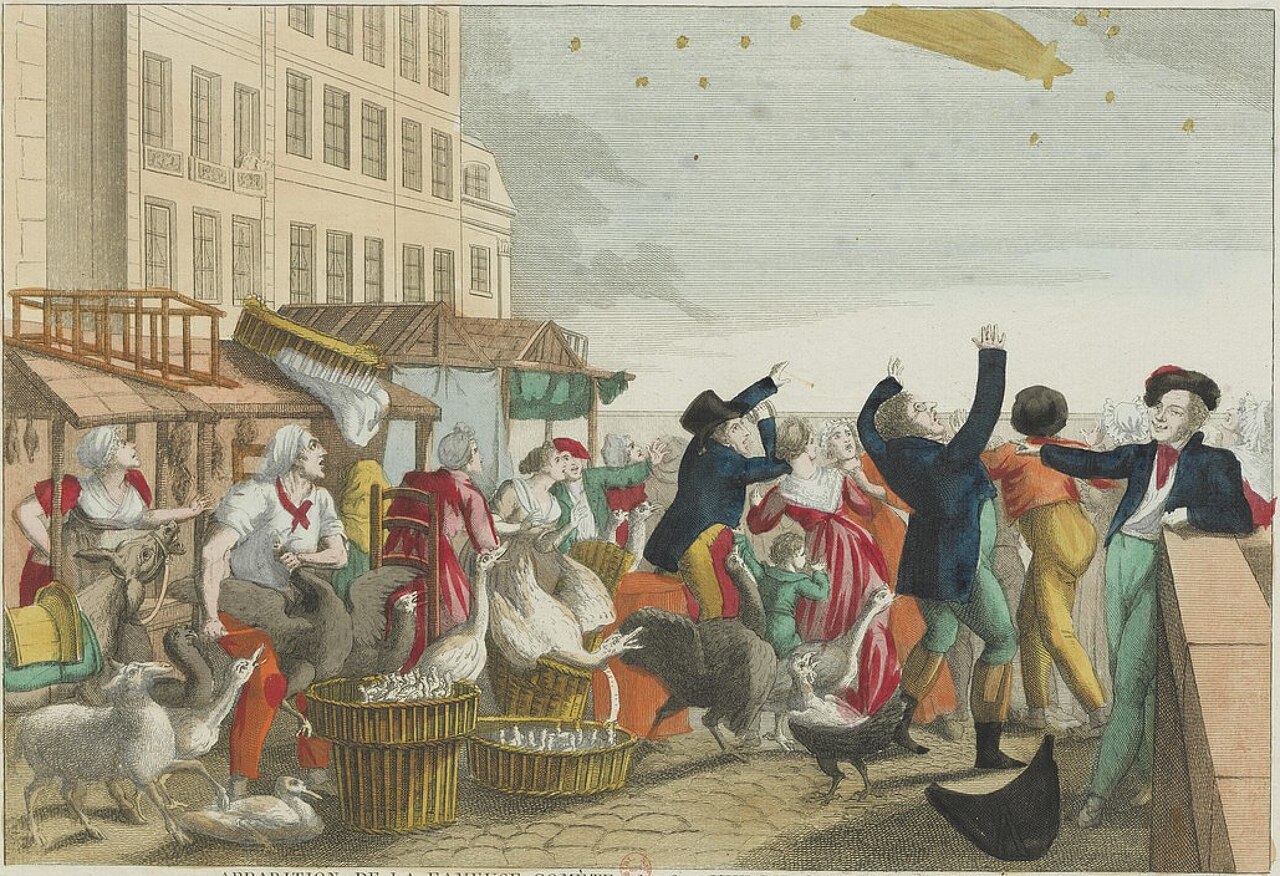
The Great Comet of 1811 had a particularly profound impact on non-astronomers. The artists John Linnell and William Blake both witnessed it and produced several sketches; the latter possibly incorporated in his famous panel The Ghost of a Flea. The English travel writer, novelist and political economist Harriet Martineau made an odd reference to not seeing the comet in her Autobiography, noting that despite having remarkably good eyes at age nine, she could not see it while her family exclaimed over it night after night. In China, some leaders of the Eight Trigram Sect took the comet to be an auspicious blessing for their enterprise to overthrow the Qing dynasty, launching their uprising in 1813. The comet was popularly thought to have portended Napoleon's invasion of Russia (even being referred to as 'Napoleon's Comet') and the War of 1812, among other events. At the midpoint of War and Peace, Tolstoy describes the character of Pierre observing the enormous and brilliant comet which was said to portend all kinds of woes and the end of the world. In the musical Natasha, Pierre & The Great Comet of 1812, Pierre witnesses the comet. The year 1811 proved to be particularly favorable for wine production, and merchants marketed 'Comet Wine' at high prices for many years afterwards. The film Year of the Comet, a 1992 romantic comedy adventure film, is based on this premise and tells the story of the pursuit of a contemporarily discovered bottle of wine from the year of the Great Comet, bottled for Napoleon. The Great Comet is mentioned in Pan Tadeusz by Adam Mickiewicz, and in Les Misérables by Victor Hugo. The comet also acts as a divine source of revival for a dying hero in the Thomas Hardy novel Two on a Tower. Native Americans interpreted the appearance of the comet as a vindication of Shawnee military leader Tecumseh's words: his name was translated as 'shooting star', and the comet was seen as an omen during his mostly unsuccessful efforts that year to bring southern tribes into his pan-Native American alliance.
Did You Know?
- The comet was visible to the naked eye for about 260 days, a record until Comet Hale–Bopp in 1997.
- Its coma was thought to be over 1 million miles across, 50% larger than the Sun.
- The comet was popularly called 'Napoleon's Comet' and was thought to portend Napoleon's invasion of Russia.
- The year 1811 was favorable for wine, and merchants sold 'Comet Wine' at high prices for years afterward.
The Hidden Core Beneath the Glow
The solid heart of a comet — the nucleus — is a compact body of rock, dust, and frozen gases that remains largely invisible to the naked eye. When solar heating drives these ices into vapor through sublimation, an enveloping atmosphere called the coma swells around the core, and radiation pressure combined with the solar wind flings material outward into a vast tail that always stretches away from the Sun. What makes the nucleus remarkable is its extraordinary darkness: a typical albedo of roughly 0.04 means its surface is even blacker than coal, likely because a thick blanket of fine dust has accumulated over the underlying material. For a spectacular apparition such as the Great Comet of 1811, all of the brilliance that observers saw was produced by this gaseous and dusty envelope, not by the solid body itself. The nucleus, buried beneath its own coma, remained a hidden object whose true nature had to be inferred from indirect evidence for well over a century before spacecraft finally revealed its surface.
From Swarms to Solid Bodies: A Shifting Understanding
For much of the nineteenth century, astronomers could not resolve a comet's nucleus through telescopes, so its physical identity remained a matter of theoretical debate. The flying-sandbank concept, articulated in the late 1800s and later championed by Raymond Lyttleton, pictured a comet not as a single object but as a loose swarm of grains held together by weak gravitational capture as the Sun swept through interstellar material. By the 1950s, Fred Lawrence Whipple's icy conglomerate — popularly dubbed the dirty snowball — gained traction because it could explain puzzling nongravitational timing shifts in comet returns: a cohesive body releasing volatiles asymmetrically would experience a gentle thrust. The model's undoing came with the 1986 Halley flybys, which showed a single dark body venting through a handful of jets. Subsequent missions confirmed that refractory material vastly outweighs ice, densities hover near 0.6 g/cm³, and porosity is extreme. The Rosetta team even coined the phrase mineral organices to capture the reality that ices are the minority component, a complete inversion of the snowball picture.
Ancient Building Blocks of the Solar System
Comets and their precursors are believed to have assembled in the cold outer reaches of the protoplanetary disk, possibly millions of years before the planets themselves took shape. The prevailing nebular hypothesis holds that these bodies are essentially leftover planetesimal building blocks — the raw material from which the planets grew. Astronomers generally locate their long-term reservoirs in the Oort cloud, the scattered disk, and the outer Main Belt. Three-dimensional computer simulations suggest that the major structural features seen on cometary nuclei today can be reproduced by pairwise, low-velocity accretion of weakly bound cometesimals, implying a gentle, stepwise growth history rather than violent collisions. Data from the Rosetta and Philae mission on 67P/Churyumov–Gerasimenko added another layer: the nucleus carries no detectable magnetic field, hinting that magnetism likely played no significant role in the early formation of these small bodies. Together, these findings paint comets as pristine time capsules preserving the chemical and physical conditions of the Solar System's earliest epochs.
Scale, Shape, and the Limits of Observation
Most cometary nuclei are thought to measure no more than about sixteen kilometers across, though a handful of larger objects — Chiron at roughly 200 km, Hale-Bopp at about 60 km, and Halley's potato-shaped 15 × 8 × 8 km core — push the upper boundary. Even with today's giant telescopes, a nucleus of this scale would yield only a few pixels on the detector, and the surrounding coma often obscures the solid body entirely when the comet is near Earth. This observational limitation forced generations of scientists to reconstruct the nucleus from multiple indirect lines of evidence. Spacecraft flybys changed the picture: Deep Space 1's 2001 pass of Borrelly revealed a similarly potato-shaped, dark-surfaced body roughly half the size of Halley's, releasing gas only through small crustal openings where ice was exposed to sunlight. Densities derived from such missions cluster around 0.1 to 0.6 g/cm³, confirming that these objects are highly porous and fragile at both micro and macro scales, far from the dense icy balls once imagined.
Gallery
Frequently Asked Questions
Who discovered the Great Comet of 1811?
French astronomer Honoré Flaugergues first spotted it on March 25, 1811, while it sat 2.7 AU from the Sun in the now-defunct constellation Argo Navis. Jean-Louis Pons independently rediscovered it on April 11 after a few days of moonlight had hidden it from view.
How long was the Great Comet of 1811 visible to the naked eye?
It stayed above the naked-eye visibility threshold for roughly 260 days, a longevity record that stood until Comet Hale-Bopp appeared in 1997.
How bright did the Great Comet of 1811 get at its peak?
In October 1811, while sitting 1.2 AU from Earth, it reached an apparent magnitude of 0 and displayed a clearly visible coma.
What is the formal designation of the Great Comet of 1811?
It is officially catalogued as C/1811 F1, with a perihelion passage on September 12, 1811.
Why is the Great Comet of 1811 still a favorite topic among comet fans?
Its record-setting 260-day naked-eye visibility, massive coma, and the cultural buzz it generated across early-19th-century Europe make it one of the most talked-about comets in modern observational history.
More in Named Comets, Part 4 1-24
Spotted an error? Know more?
Reader corrections go straight into our review queue. Suggest an edit · How this site is sourced