Great Southern Comet of 1887
A bright sungrazing comet seen without a visible head.

George Frederick Chambers 1841-1915 · Public domain
The Great Southern Comet of 1887 (IAU designation C/1887 B1) was a bright comet observed from the Southern Hemisphere in January 1887. It is notable for its lack of a visible cometary head or nucleus, leading some older texts to call it the 'Headless Wonder,' and for later being identified as a member of the Kreutz Sungrazing group.
Quick Facts
- Discoverer
- J. M. Thome
- Discovery Date
- January 19, 1887
- Designations
- 1887 I; 1887a; Great Southern Comet of 1887; the "Headless Wonder"; Thome's Comet
- Observation Arc
- 8 days (very short arc)
- Obs
- 15
- Orbit
- Kreutz sungrazer
- Perihelion
- 0.00483 AU
- Max Speed
- 606.1 km/s @ perihelion
- Inclination
- 144.383°
- Mean Radius
- 1.2 kmFernandez_2021
- Last P
- January 11, 1887
Facts from the source article.
Lore & Background
The comet was officially discovered by astronomer John Macon Thome at Córdoba, Argentina, on January 19, 1887, in the constellation Grus. Correspondence from William Henry Finlay suggests it may also have been seen from Blauwberg, South Africa, on January 18. At discovery, the comet had already passed perihelion a week earlier, and its closest approach to Earth had been a month earlier on 22 December 1886.
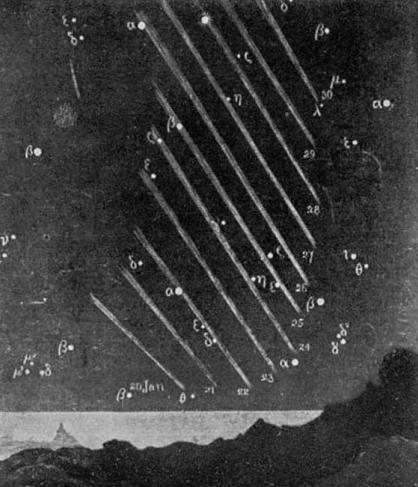
Observers in the Southern Hemisphere widely recorded the comet at first magnitude for the remainder of January. On the 22nd, Finlay described it as a 'pale narrow ribbon of light, quite straight' about 35 degrees long, with no cometary head distinguishable. On the 23rd, Thome measured a tail over 40 degrees but also could not find a nucleus. On January 27, C. Todd saw the head as a 'diffused nebulous mass' but noted a break between head and tail, possibly a tail disconnection event. The comet faded rapidly and never became visible from northern latitudes; it was last observed by John Tebbutt from New South Wales on January 30.
Reader's Guide
The Great Southern Comet of 1887 holds significance as a member of the Kreutz Sungrazing group, a family of comets that pass extremely close to the Sun. Its unusual appearance—a bright tail with little or no discernible head—prompted the nickname 'Headless Wonder' and made orbital calculation difficult, as no nucleus observations were available. Heinrich Kreutz produced the first speculative orbit, and by February Finlay had linked it firmly to the Kreutz group. A more definitive orbit was calculated in 1978 by Zdeněk Sekanina, who assumed the comet's head lay on a great circle through the Sun and inner tail. Sekanina later speculated that the comet's appearance resulted from a 'tail formation event,' an outburst of dust about six hours after perihelion. He argued that C/1887 B1, along with C/1945 X1 (du Toit), represented a class of comets intermediate between the great sungrazers (like the Great Comet of 1882) and the many smaller objects later discovered by the Solar and Heliospheric Observatory. The comet's rapid fading and short observation period underscore its transitional nature.
Did You Know?
- The comet passed about 27,000 km from the Sun's surface at perihelion.
- It was nicknamed the 'Headless Wonder' because few observations recorded a cometary head or nucleus.
- The comet was last observed on January 30, 1887, by John Tebbutt from New South Wales.
- Zdeněk Sekanina calculated a definitive orbit in 1978 based on the assumption that the head lay on a great circle through the Sun and inner tail.
Gallery

Frequently Asked Questions
What is the Great Southern Comet of 1887?
It is a bright sungrazing comet catalogued as C/1887 B1 that put on a spectacular display for Southern Hemisphere observers in early January 1887. Despite its brilliance, it was remarkable for showing no discernible cometary nucleus or head.
Why is it nicknamed the 'Headless Wonder'?
Older astronomy texts gave it that moniker because, unlike most bright comets, observers could not spot any visible nucleus or coma at its core. The tail and glow were striking, but the central head simply wasn't there to see.
What orbital family does C/1887 B1 belong to?
It was later recognized as a member of the Kreutz Sungrazer group, a family of comets that pass extremely close to the Sun. Its perihelion of just 0.00483 AU (roughly 723,000 km) on 11 January 1887 places it firmly in that category.
How close did the Great Southern Comet of 1887 get to Earth?
Its closest approach to our planet occurred on 22 December 1886, when it passed at a distance of about 0.57 AU, or roughly 85 million kilometres. That proximity is what made it bright enough to be a major event for southern skywatchers.
When was C/1887 B1 officially recorded as discovered?
The comet was formally noted on 19 January 1887, just days after it swung by the Sun at perihelion. By that point it had already been bright enough to draw widespread attention from observers in the Southern Hemisphere.
More in Named Comets, Part 4 1-24
Spotted an error? Know more?
Reader corrections go straight into our review queue. Suggest an edit · How this site is sourced