
Great Comet of 1823
Bright comet with two tails, one pointing toward the Sun.

George Frederick Chambers 1841-1915 · Public domain
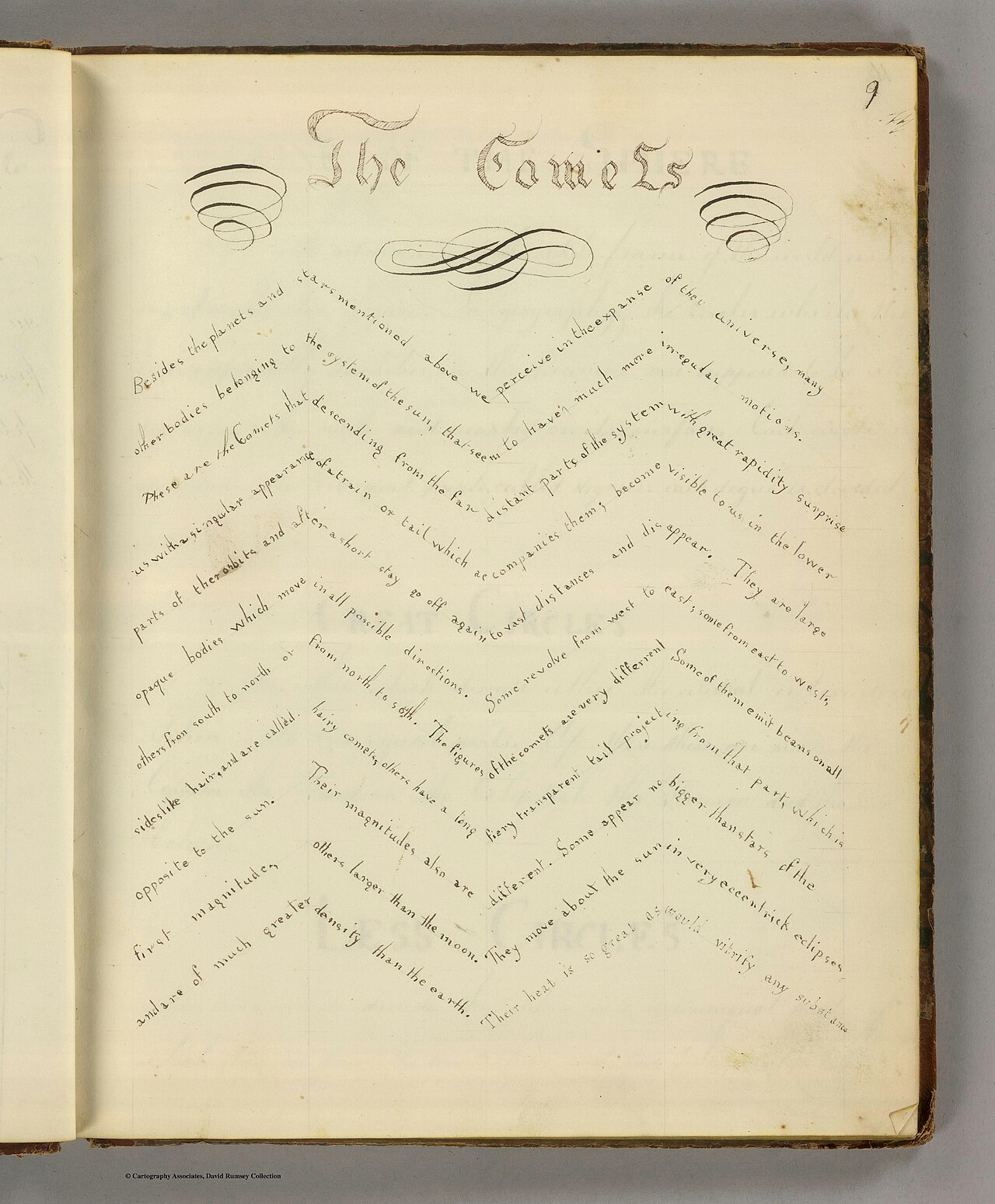
The Great Comet of 1823 (also known as C/1823 Y1 and Comet De Bréauté-Pons) shone brightly from December 1823 through April 1824. Three astronomers spotted it independently within two days: Nell de Bréauté in Dieppe on December 29, and both Jean-Louis Pons and Wilhelm von Biela on the morning of December 30. Already visible without a telescope when found, Pons first mistook it for chimney smoke rising over a hill, only realizing it was a comet when its shape did not change. He later noted the odd fact that it appeared more clearly to the naked eye than through a telescope. Biela observed that it was noticeably brighter than the Great Comet of 1819. The comet was especially known for displaying two tails: one pointing away from the Sun and another, called an "anomalous tail" by Karl Harding and Heinrich Olbers, pointing toward it. Caroline Herschel recorded her observation on January 31, 1824, as the final entry in her observing book. Pons made the last known sighting of the comet on April 1, 1824.
Quick Facts
- Discoverer
- Nell de Bréauté / Jean-Louis Pons
- Discovery Date
- 29 December 1823
- Orbit Ref
- jpl
- Observation Arc
- 67 days
- Obs
- 200
- Epoch
- 15 February 1824 (JD 2387306.5)
- Perihelion
- 0.2267 AU
- Eccentricity
- ~1.000
- Inclination
- 103.819°
- Asc Node
- 305.505°
- Arg Peri
- 28.487°
- Last P
- 9 December 1823
Facts from the source article.
Lore & Background
The comet was independently discovered by Nell de Bréauté at Dieppe on December 29, by Jean-Louis Pons on the morning of December 30, and by Wilhelm von Biela at Prague on the same morning. It was already visible to the naked eye when discovered: Pons initially thought he was seeing smoke from a chimney rising over a hill, but continued observing when he noticed it did not change appearance. He later noted that the comet was, puzzlingly, more easily visible to the naked eye than through a telescope. Biela also noted that it was noticeably brighter than the Great Comet of 1819 had been.
The comet was particularly known at the time for exhibiting two tails, one pointing away from the Sun and the other (termed an "anomalous tail" by Karl Harding and Heinrich Olbers) pointing towards it. Caroline Herschel recorded an observation of the comet on January 31, 1824, as the last entry in her observing book. Pons was also the last astronomer to detect the comet, on April 1, 1824.
Reader's Guide
The Great Comet of 1823 holds significance in cometary astronomy for its unusual dual-tail appearance, which included a tail pointing toward the Sun—a phenomenon termed an "anomalous tail" by contemporary astronomers Karl Harding and Heinrich Olbers. This feature distinguished it from typical comets, which usually display only a tail pointing away from the Sun. The comet's independent discovery by three astronomers—Nell de Bréauté, Jean-Louis Pons, and Wilhelm von Biela—within two days underscores the brightness and prominence of the object in the night sky. Pons's observation that the comet was more easily visible to the naked eye than through a telescope added to its peculiarity. Caroline Herschel's recording of the comet as the final entry in her observing book marks a notable moment in her long career. The comet's visibility from December 1823 to April 1824 allowed extensive observation, and Pons's detection on April 1, 1824, as the last astronomer to see it, closed the observational record. The comet's legacy lies in its contribution to understanding cometary tail structures and the historical record of bright comets in the early 19th century.
Did You Know?
- The comet was independently discovered by three astronomers within two days.
- Jean-Louis Pons initially thought the comet was smoke from a chimney.
- The comet had an 'anomalous tail' pointing toward the Sun, noted by Karl Harding and Heinrich Olbers.
- Caroline Herschel recorded the comet as the last entry in her observing book.
From a Single Beast to a Named Team
The earliest known depiction of Santa's sleigh being drawn by a reindeer appeared in an 1821 illustrated children's poem called "Old Santeclaus with Much Delight," published in New York by William B. Gilley under the title The Children's Friend: A New-Year's Present, to the Little Ones from Five to Twelve. Neither the poet nor the illustrator is identified in the record. The small paperback contained eight colored lithographic plates, and the illustration accompanying the opening verse shows a modest sleigh bearing a sign that reads "REWARDS," hitched to a single, unnamed reindeer. This lone animal would remain the norm in popular imagination for only a couple of years. By December 1823, the landscape of Christmas lore had shifted dramatically, as a new poem introduced a full team of eight individually named animals, transforming what had been a simple, anonymous beast of burden into a recognizable cast of characters. The jump from one faceless reindeer to a roster of eight distinct names marks one of the most consequential leaps in the history of holiday storytelling, establishing the framework that would persist for nearly two centuries.
The 1823 Poem and the Question of Names
The poem most commonly credited to Clement Clarke Moore, A Visit from St. Nicholas, first saw print in the Sentinel of Troy, New York, on December 23, 1823. In that original version, all eight members of the sleigh team received names: Dasher, Dancer, Prancer, Vixen, Comet, and Cupid occupied the first six slots, while the final two were rendered as "Dunder" and "Blixem," a pair drawn from a Dutch exclamation meaning thunder and lightning. Moore himself was not settled on those last two names. In a revised edition that appeared in 1844, he had changed them to "Donder" and "Blitzen," aligning the latter with the German word for lightning. The modern German spelling "Donner" did not become the standard form until the early twentieth century, well after Moore had passed away, though a handful of nineteenth-century examples of that spelling do survive. This slow evolution of two names across more than a century illustrates how even the most beloved details of Christmas lore were once fluid, contested, and far from fixed in the public mind.
Rudolph and the Expanding Menagerie
Long before Rudolph entered the picture, other writers had already tried to expand or replace the reindeer roster. L. Frank Baum's 1902 narrative The Life and Adventures of Santa Claus, for instance, listed ten animals whose names bore no resemblance to Moore's cast: Flossie, Glossie, Racer, Pacer, Reckless, Speckless, Fearless, Peerless, Ready, and Steady. The character who would ultimately reshape the team was created by Robert L. May, an employee of the Montgomery Ward department-store chain, who wrote Rudolph the Red-Nosed Reindeer in verse form in 1939. Montgomery Ward published it as a small book intended for children in their stores during the Christmas season. A decade later, Gene Autry's 1949 recording of the song bearing the same title propelled Rudolph into the mainstream of American holiday culture. The character's popularity spawned a constellation of lesser-known relatives in comedic settings, including an implied son called Robbie and a redneck cousin named Leroy. Because of copyright and trademark entanglements, most unofficial productions that wish to allude to Rudolph resort to euphemistic language rather than naming him directly.
Reindeer Across a Century of Media
The reindeer team has proven remarkably adaptable across more than a century of storytelling. John C. Fleming's 1897 short story "A Costly Christmas" introduced the names Slasher and Crasher alongside Donner and Blitzen. The 1947 film Miracle on 34th Street featured the full eight-reindeer cast drawn from Moore's poem. Chuck Berry paid tribute to Rudolph in his 1958 track "Run Rudolph Run." In 1989, the film Prancer told the story of a young girl who discovers an injured reindeer. Disney's 2009 animated special Prep & Landing brought Dasher and Dancer to the screen while introducing a larger reindeer called Thrasher; notably, in that particular universe Rudolph does not exist at all. The 1999 special Hooves of Fire depicted a later generation of the sleigh team after "Ru" had retired, with Prancer and Blitzen still active and Ru's son Robbie making his debut. More recently, KC & The Sunshine Band released "Let's Go Dancing With Santa" in 2015, and the 2024 production That Christmas cast Guz Khan as the voice of Dasher, who serves as Santa's talking sidekick.
Gallery


Frequently Asked Questions
What is the Great Comet of 1823?
It is a bright long-period comet designated C/1823 Y1, commonly known as Comet De Bréauté-Pons. The object displayed two tails, one of which pointed back toward the Sun. It was easily visible to the naked eye throughout its apparition.
Who discovered the Great Comet of 1823?
Three astronomers independently identified the comet within a two-day span in late December 1823. Nell de Bréauté spotted it first from Dieppe on December 29, and both Jean-Louis Pons and Wilhelm von Biela observed it separately on the morning of December 30.
How long was the Great Comet of 1823 visible?
The comet was tracked from its discovery on December 29, 1823, until its last confirmed detection on April 1, 1824. That spans roughly four months of visibility, a notably long run for a cometary apparition.
What made the Great Comet of 1823 unusual to observe?
Pons recorded the strange effect that the comet appeared sharper and more distinct to the unaided eye than when looked at through a telescope. He also initially mistook the glowing object for chimney smoke rising over a hilltop before noticing its shape remained fixed in the sky.
Why is the Great Comet of 1823 also called Comet De Bréauté-Pons?
The alternative name combines the surnames of two of the three independent discoverers, Nell de Bréauté and Jean-Louis Pons, following the traditional convention of honoring those who first identified a comet. It serves as a shorthand that distinguishes this apparition from other comets of the same year.
More in Named Comets, Part 4 1-24
Spotted an error? Know more?
Reader corrections go straight into our review queue. Suggest an edit · How this site is sourced