Great January Comet of 1910
A brilliant daylight comet that outshone Venus in January 1910.

Maryland Agricultural College · Public domain
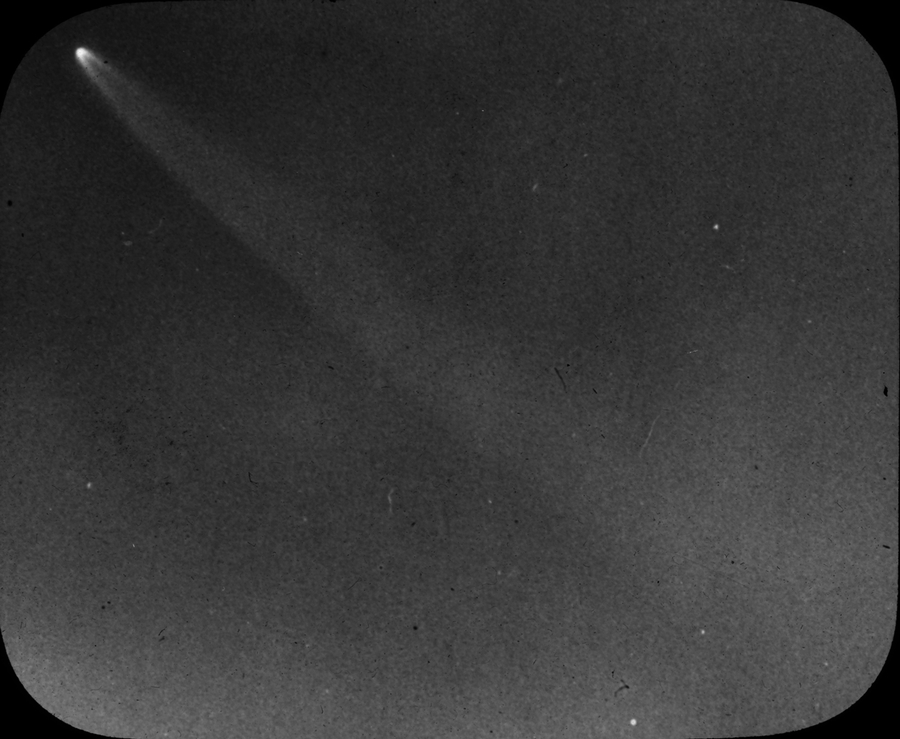
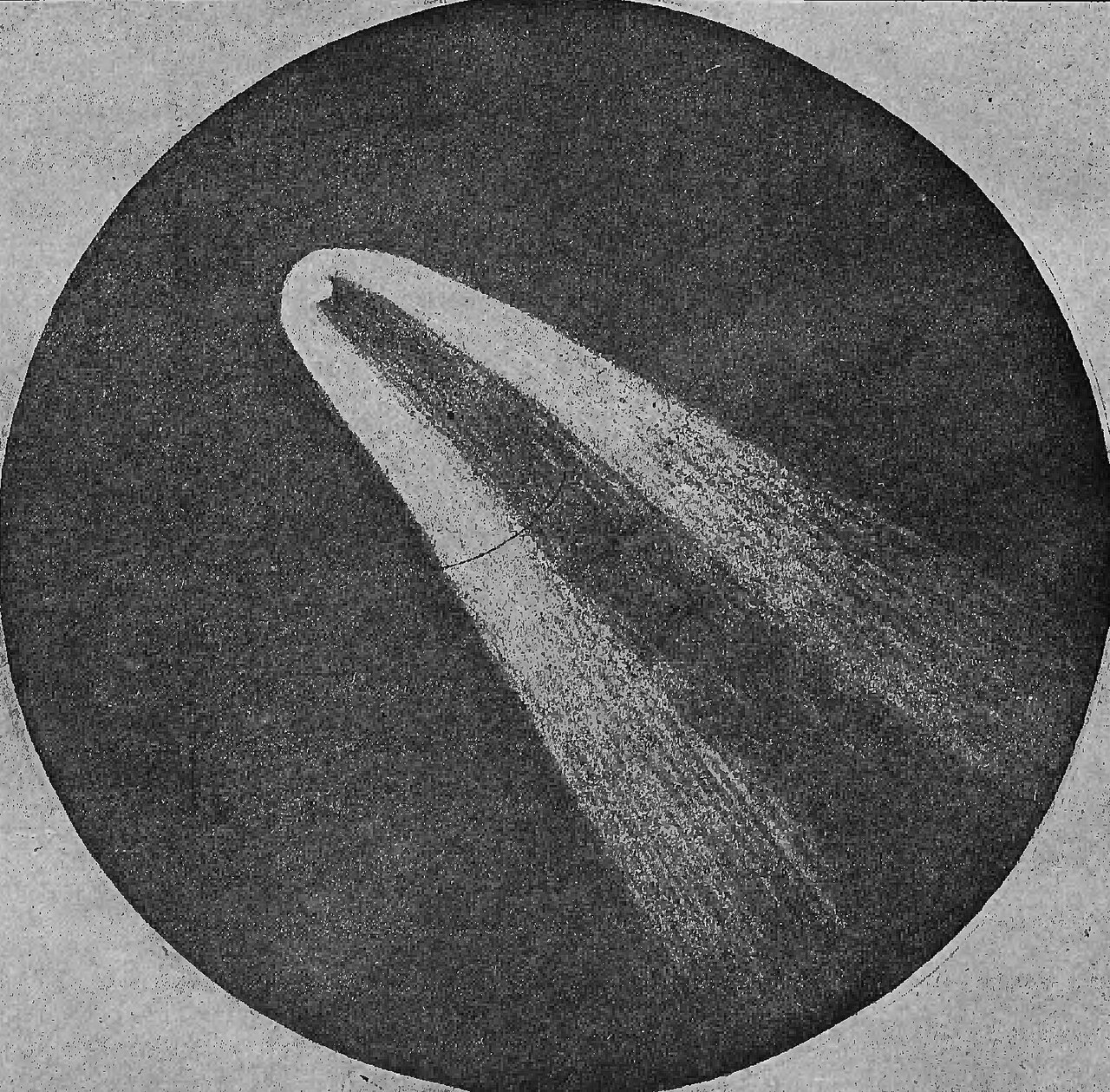
The Daylight Comet, also known by its formal designation C/1910 A1 and the Great January Comet of 1910, appeared in the sky during January 1910. It was already bright enough to see without a telescope when people first spotted it, and numerous individuals claimed to have found it independently. At its peak, it was brighter than Venus and may have been the most brilliant comet of the entire 20th century.
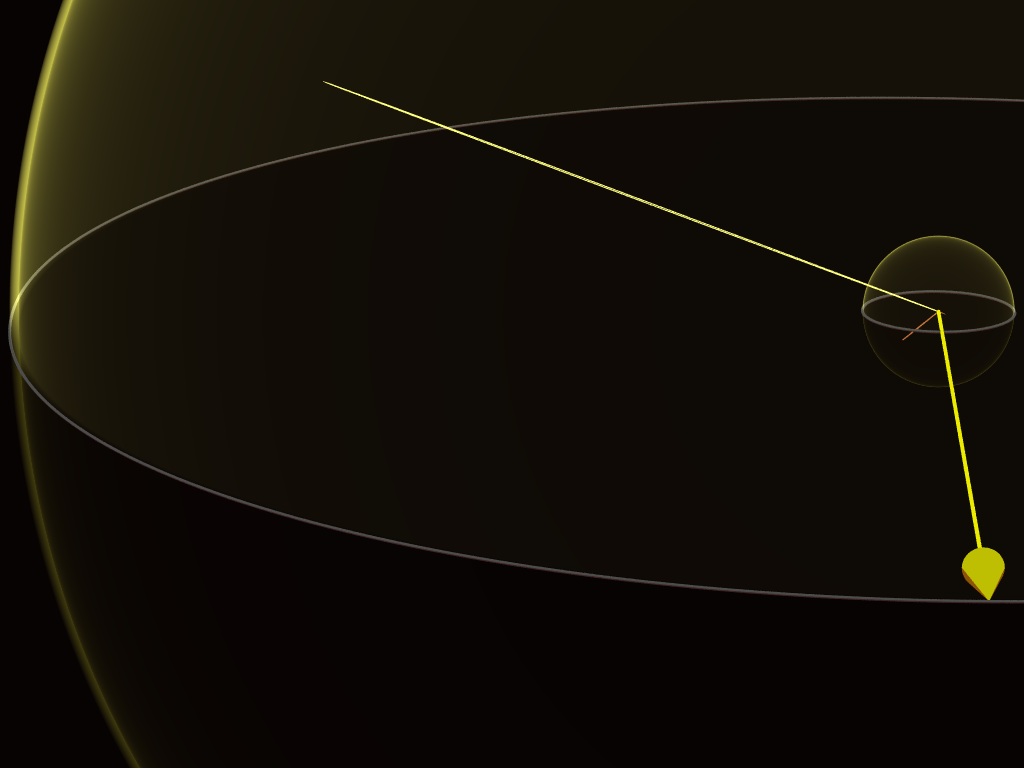
The comet passed extremely close to the Sun on 17 December 1909, but remained about one astronomical unit away. Its brightness increased suddenly in January, and it was first seen only from the Southern Hemisphere. Diamond miners in the Transvaal likely saw it before dawn on 12 January 1910, when it was already a prominent naked-eye object with a magnitude of −1.0 and a declination of −29 degrees. Scottish astronomer Robert T. A. Innes at the Transvaal Observatory in Johannesburg was the first to study it properly, beginning on 17 January after being alerted two days earlier by a newspaper editor.
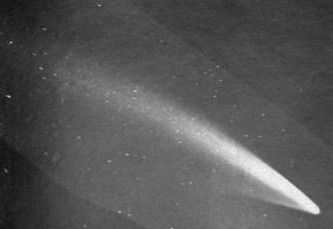
The comet reached its closest point to the Sun on 17 January, becoming visible in daylight without any aid. Forward scattering of light gave it a magnitude of −5.0. It passed near the Sun again on 18 January. After perihelion, it dimmed but became a striking sight from the Northern Hemisphere in the evening twilight, with a noticeably curved tail extending up to 50 degrees by early February.
That same year, the public was already eagerly awaiting the return of Halley's Comet, which reached perihelion on 20 April. The unexpected appearance of the Daylight Comet months earlier surprised many and left a powerful impression. When Halley's Comet returned in 1986, older people who claimed to have seen it in 1910 were often actually remembering the Daylight Comet instead.
Due to a telephone error, the comet was initially reported as Drake's Comet. Once the mistake was corrected, the press called it the Daylight Comet or Sunset Comet, since no single discoverer was credited.
Newspapers in several cities reported that the comet frightened people. The *Morning Post* of Camden, New Jersey noted similar scares had occurred in past years. In Korea, many believed the comet would kill everyone, leading some to stop working, eat and drink, and simply wait for the end of the world.
Quick Facts
- Discovery Date
- 12 January 1910
- Designations
- 1910 I, 1910a
- Orbit Ref
- barycenter
- Epoch
- 9 January 1910 (JD 2418680.5)
- Observation Arc
- 82 days
- Obs
- 25
- Semimajor
- ~440 AU (epoch 2000)
- Perihelion
- 0.12896 AU
- Aphelion
- ~1150 AU (inbound) / ~900 AU (outbound)
- Period
- ~9,200 years (outbound)
- Eccentricity
- 0.99978
- Inclination
- 138.78°
Facts from the source article.
Lore & Background
The comet came to solar conjunction about 1 degree from the Sun on 17 December 1909 but was still about 1 AU from the Sun. In January, the comet brightened rather suddenly and was initially visible from the Southern Hemisphere only. A number of individuals claimed 'discovery', but the comet is thought to have been first spotted by diamond miners in the Transvaal before dawn on 12 January 1910 when it was already a prominent naked-eye object of apparent magnitude −1.0, with a declination of −29 and so was best seen from the Southern Hemisphere. The first person to study the comet properly was the Scottish astronomer Robert T. A. Innes at the Transvaal Observatory in Johannesburg on 17 January after he had been alerted two days earlier by the editor of a Johannesburg newspaper.
The comet reached perihelion on 17 January and was then visible in daylight with the unaided eye. It had a magnitude of −5.0 because of the forward scattering of light. It came to solar conjunction a second time on 18 January 1910. Following perihelion, it declined in brightness but became a spectacular sight from the Northern Hemisphere in the evening twilight, its noticeably curved tail reaching up to 50 degrees by early February.
Owing to a 'telephonic error', the comet was initially reported as being named Drake's Comet, but once the error was realised, the press afterwards referred to it as the Daylight Comet or Sunset Comet, as no single individual was credited with its discovery.
Reader's Guide
The year 1910 saw considerable media interest in the predicted return of Halley's Comet, which reached perihelion on 20 April. The appearance of the Daylight Comet several months earlier therefore came as something of a surprise and made an extremely strong impression on an expectant public. When Halley's Comet returned again in 1986, many older people's accounts of having seen it in 1910 clearly referred to the Daylight Comet instead. Newspapers in various cities reported people having been scared by the appearance of the comet. The Morning Post of Camden, New Jersey reported that similar scares happened in past years that comets had been seen. In Korea, many thought the comet would kill them all off. Some stopped going to work, just ate and drank and waited for the world to end. The comet's legacy is thus tied both to its extraordinary brightness—possibly the brightest comet of the 20th century—and to the public confusion it caused with the more famous Halley's Comet later that same year.
Did You Know?
- At its brightest, it outshone the planet Venus and was possibly the brightest comet of the 20th century.
- In Korea, many thought the comet would kill them all off, and some stopped going to work to wait for the world to end.
The Outgassing Phenomenon and Cometary Structure
When a small icy body from the outer Solar System swings close to the Sun, it undergoes a dramatic transformation. Solar radiation and the streaming solar wind plasma strike the nucleus, heating the frozen volatiles until they sublimate and escape into space. This outgassing creates a vast, gravitationally unbound atmosphere called the coma, which can swell to roughly fifteen times the diameter of Earth. From this glowing envelope, gas and dust are blown outward to form the familiar tail, sometimes stretching beyond one astronomical unit. The entire spectacle is powered by nothing more than sunlight and charged particles interacting with a modest core of ice, dust, and rocky fragments. If the geometry is right and the brightness sufficient, such a display can be seen with the naked eye, sweeping an arc of up to thirty degrees across the sky — equivalent to sixty full Moons strung end to end. These apparitions have been recorded by cultures and religions since antiquity, long before anyone understood the physics behind them.
Orbital Origins and the Vast Comet Reservoir
Comets trace their paths along highly eccentric elliptical orbits, with periods spanning from a handful of years to potentially millions. Short-period visitors are believed to originate in the Kuiper belt and its associated scattered disc, both lying beyond Neptune's orbit. Long-period comets, by contrast, are thought to emerge from the Oort cloud — a vast spherical shell of icy bodies extending from just outside the Kuiper belt to roughly halfway toward the nearest star. Gravitational nudges from passing stars and the galactic tide set these distant wanderers drifting sunward. A small subset, the hyperbolic comets, pass once through the inner Solar System before being ejected entirely into interstellar space. As of November 2021, humanity has catalogued 4,584 known comets, yet this number is a vanishingly small fraction of the true population. The Oort cloud alone is estimated to hold around one trillion comet-like bodies, making the known catalogue a mere whisper of what actually exists in the dark reaches of the Solar System.
The Nucleus: From Dirty Snowball to Deep-Fried Ice Cream
The solid heart of a comet is a jumble of rock, dust, water ice, and frozen gases including carbon dioxide, carbon monoxide, methane, and ammonia. For decades, Fred Whipple's 'dirty snowball' model dominated thinking, but the 2005 Deep Impact mission, which blasted a crater into Comet Tempel 1 to study its interior, suggested 'icy dirtball' might be a fairer description. A 2014 study pushed the analogy further, proposing that comets resemble deep-fried ice cream: a dense, crystalline outer shell laced with organic compounds encasing a colder, less dense interior. Nuclei harbour a rich chemistry — methanol, hydrogen cyanide, formaldehyde, ethanol, ethane, and possibly long-chain hydrocarbons and amino acids. In 2009, glycine was confirmed in dust recovered by NASA's Stardust mission, and 2011 meteorite studies hinted that DNA and RNA building blocks like adenine and guanine may form on comets and asteroids. The surfaces are extraordinarily dark, reflecting only about three to four percent of incoming light — less than asphalt — because solar heating drives off lighter volatiles and leaves behind tar-like organic residues.
Blurring Boundaries: Comets, Asteroids, and Manx Objects
Comets and asteroids were long treated as fundamentally different populations. Comets carry volatile ices that sublimate near the Sun to produce their signature tails, while asteroids are rocky bodies that form no such feature. Their birthplaces were thought to differ as well: comets formed in the cold outer Solar System, asteroids inside Jupiter's orbit. Yet discoveries in the early 21st century have steadily eroded that clean divide. Main-belt comets and active centaur minor planets show cometary activity in regions once considered asteroid territory. A particularly puzzling group, dubbed 'Manx comets,' possess the long-period orbits of classical comets yet display the physical characteristics of inner-solar-system asteroids. They remain officially classified as comets — C/2014 S3 (PANSTARRS) being a notable example — and twenty-seven such objects were identified between 2013 and 2017. These hybrid bodies remind us that the Solar System's small-body taxonomy is far messier than the old textbook picture suggested, and that the line between 'comet' and 'asteroid' may be more of a gradient than a wall.
Gallery


Frequently Asked Questions
What is the Great January Comet of 1910?
It is the popular name for C/1910 A1, a long-period comet that became naked-eye visible in January 1910 and is widely regarded as the most brilliant comet of the entire 20th century.
How bright did the Great January Comet of 1910 get at peak?
At maximum it reached an apparent magnitude of roughly −5.0, outshining Venus and remaining clearly visible even in full daylight.
Who first spotted the Great January Comet of 1910?
Diamond miners in the Transvaal region were among the earliest observers to report it on 12 January 1910, when it already glowed at about magnitude −1.0 without any optical aid.
Why is it nicknamed the Daylight Comet?
The moniker stuck because the comet was bright enough to be easily seen against the blue sky during daytime hours, a feat very few comets ever achieve.
How close did the Great January Comet of 1910 pass the Sun?
It reached perihelion on 17 December 1909, holding roughly one astronomical unit from the Sun's center—about the same separation Earth maintains in its orbit.
More in Named Comets, Part 4 1-24
Spotted an error? Know more?
Reader corrections go straight into our review queue. Suggest an edit · How this site is sourced