
C/2019 Y4 (ATLAS)
A disintegrating near-parabolic comet discovered by the ATLAS survey.

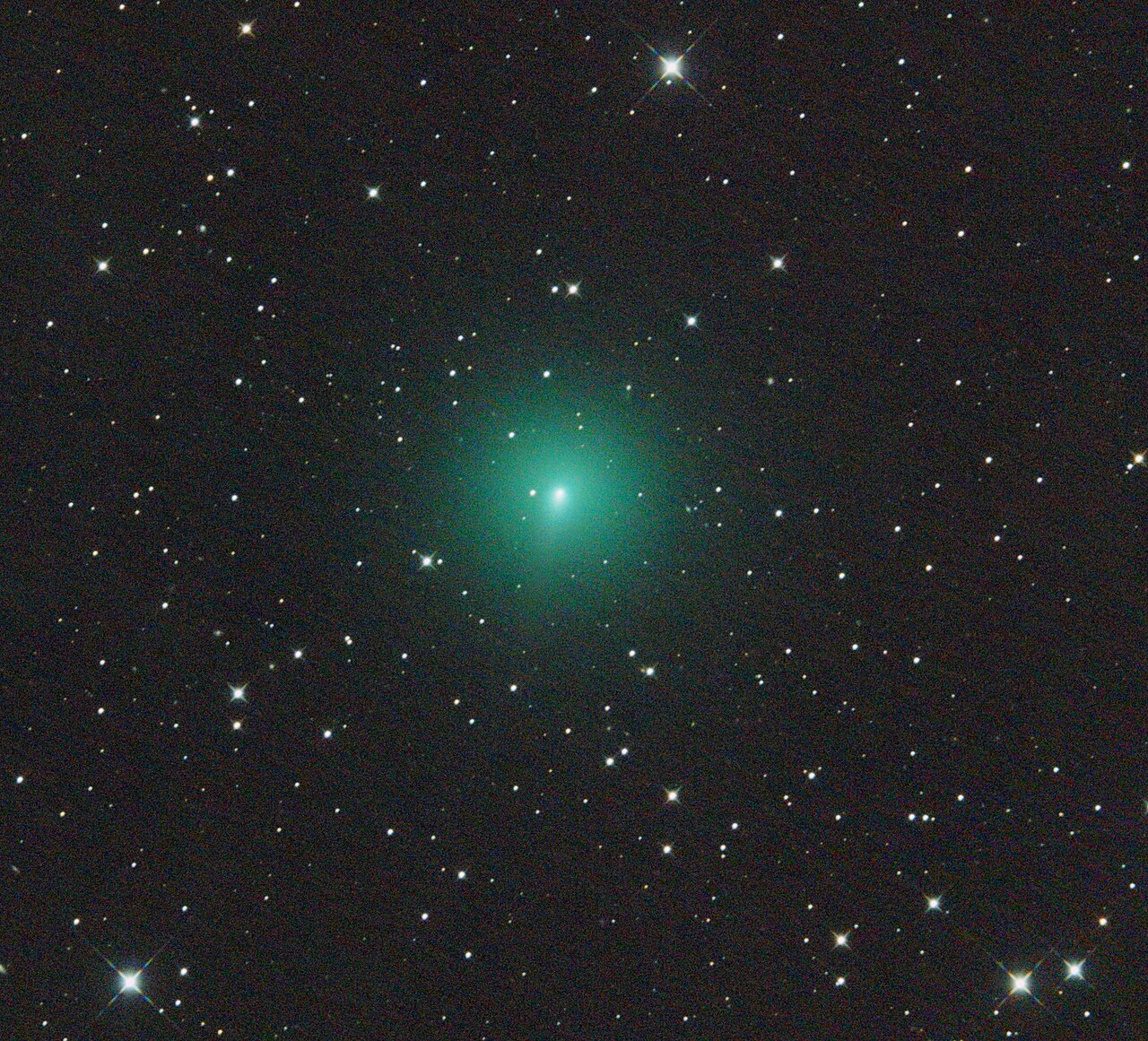
Martin Gembec · CC BY-SA 4.0
C/2019 Y4 (ATLAS) was a comet with a near-parabolic orbit, discovered on December 28, 2019, by the ATLAS survey using a 0.5-meter reflecting telescope on Mauna Loa in Hawaii. At discovery, it shone at magnitude 19.6 in Ursa Major. Larry Denneau first noted its cometary appearance and placed it on the Minor Planet Center's Possible Comet Confirmation Page. Subsequent observations revealed a coma and a growing tail.
Early brightness predictions suggested it could reach magnitude 0, matching Vega, but it never became visible to the naked eye. Between early February and late March 2020, it brightened from magnitude 17 to 8—a 4,000-fold increase—and its green or aqua color came from diatomic carbon emissions, with a multicolored tail spanning up to 3.3 million kilometers. It peaked on March 30 at about magnitude 7. On March 22, the comet began disintegrating, a fragmentation event common among Kreutz Sungrazers. By mid-May, it appeared very diffuse even in telescopes. It was last observed on May 21, 2020.
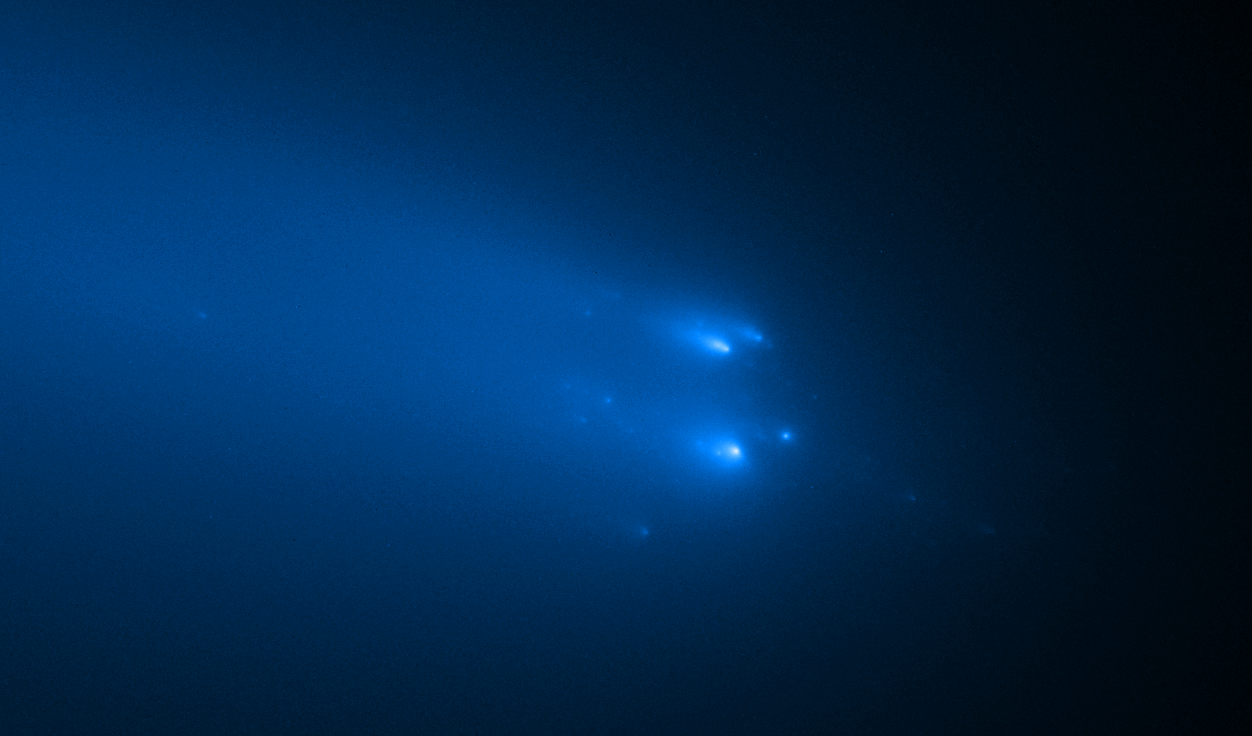
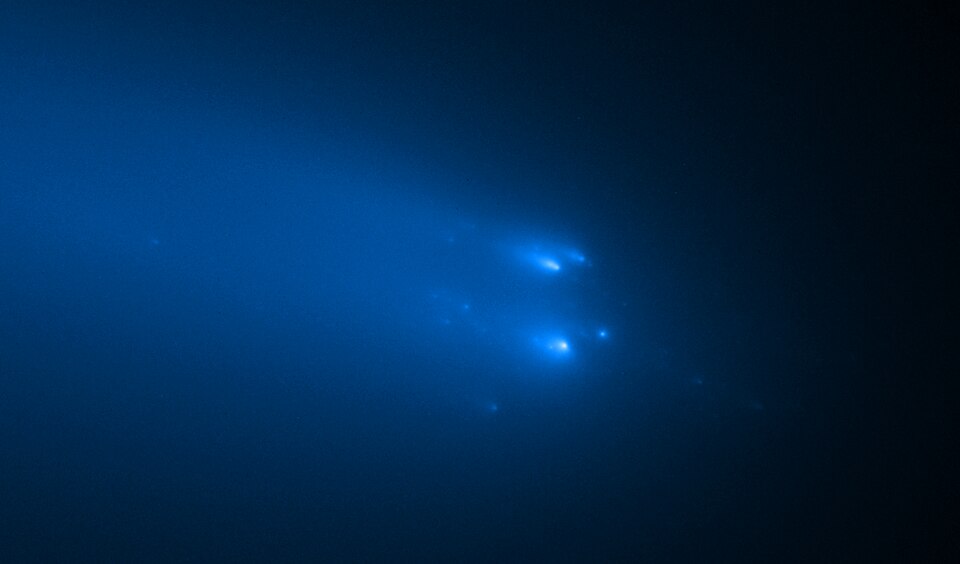
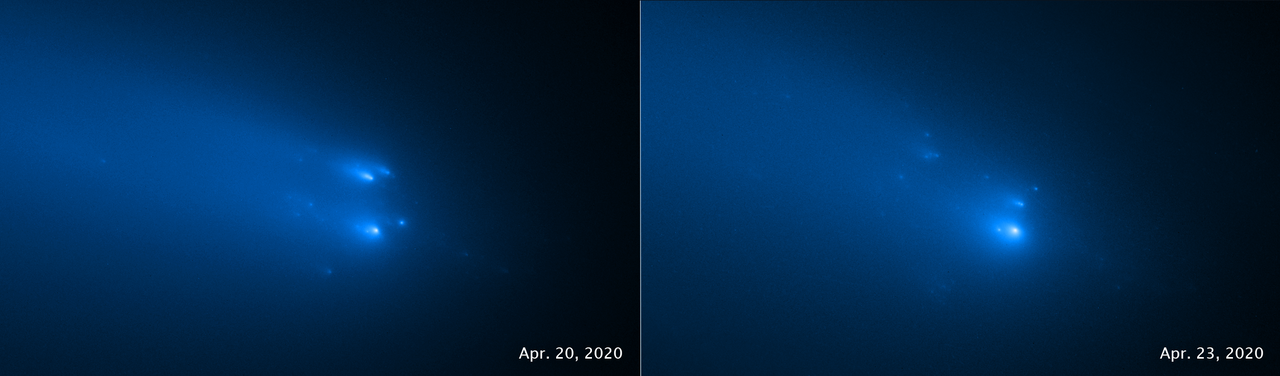
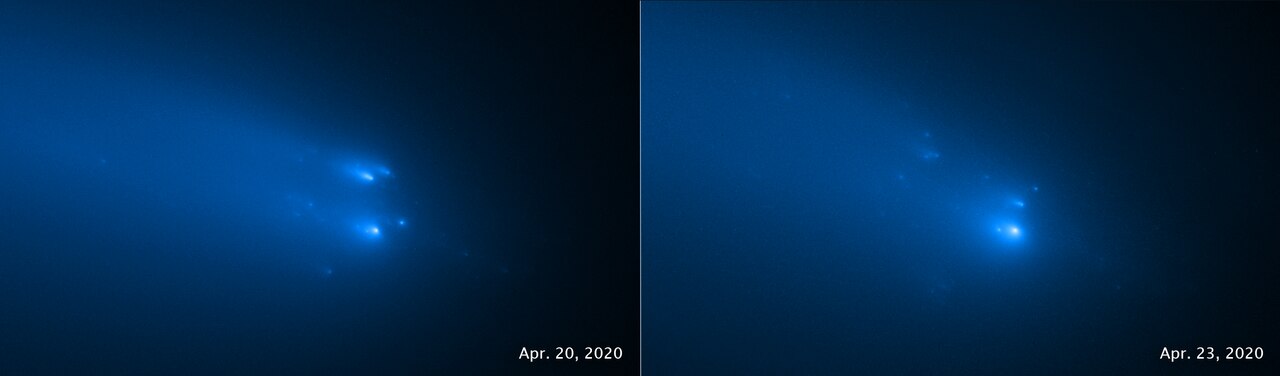
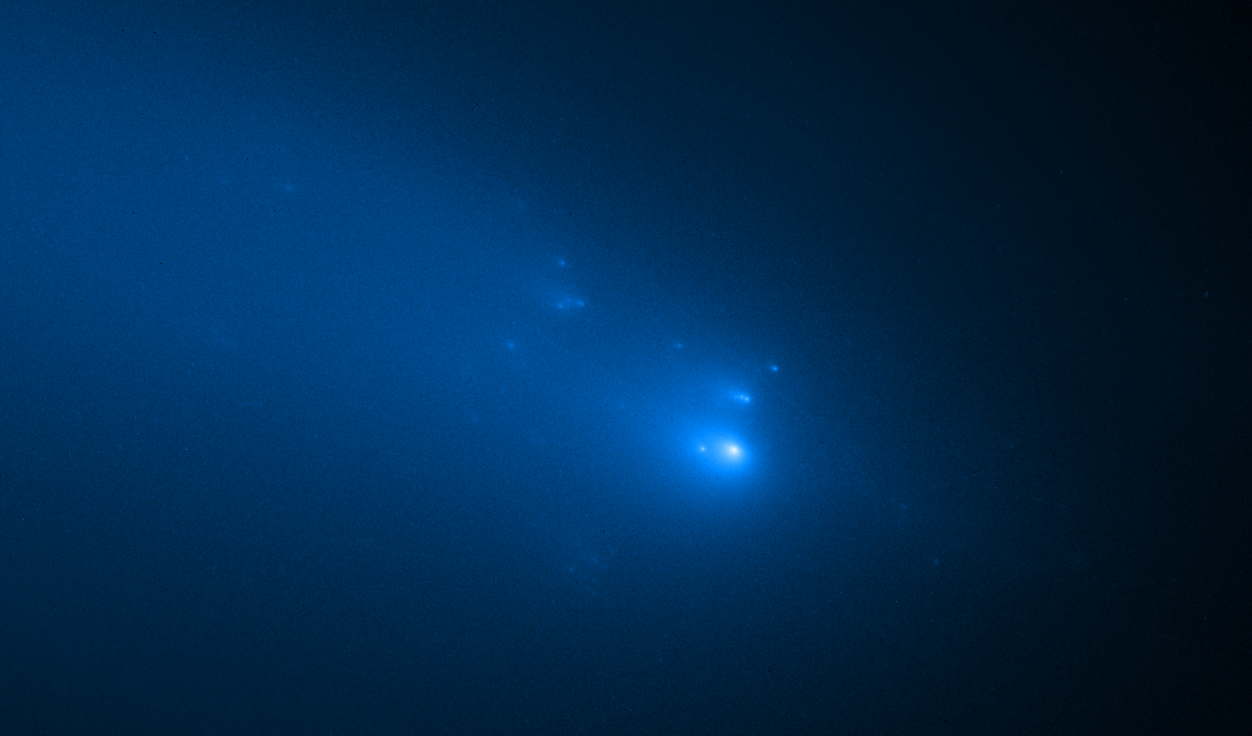
The fragmentation was reported on The Astronomer's Telegram in April 2020, with the comet breaking into at least four pieces. NASA's Hubble Space Telescope later identified roughly 30 fragments on April 20 and 25 on April 23. The breakup may have resulted from outgassing increasing centrifugal force. Observations from Lowell Observatory between July and September 2020 found no remnants, suggesting complete disintegration or inactive fragments no larger than 0.25 km in radius.
The Solar Orbiter flew through the comet's ion tail between May 31 and June 1, 2020, and its dust tail on June 6.
Initial orbital calculations indicated a 4,400-year period and perihelion of 0.25 AU. Similarities to the Great Comet of 1844 suggest C/2019 Y4 is a fragment of the same parent body, split about 5,000 years ago. A barycentric solution shows an inbound orbital period of about 4,800 years and an outbound period of about 5,200 years. Fragmentation changed fragment velocities by up to 10 meters per second, altering long-term orbital periods. Fragment B was observed longest; fragment D may have come closest to Earth, but its short observation arc leaves an uncertainty of ±2 million kilometers in its approach distance.
During January to March 2020, the comet was in Ursa Major. In April, it moved into Camelopardalis, then into Perseus on May 12.
Quick Facts
- Discovery Site
- ATLAS–MLO
- Discovery Date
- December 28, 2019
- Mpc Name
- C/2019 Y4-A · C/2019 Y4-B · C/2019 Y4-C · C/2019 Y4-D · C/2019 Y4-E
- Designations
- A10j7UG
- Orbit Ref
- jpldata
- Epoch
- March 7, 2020 (JD 2458915.5)
- Observation Arc
- 115 days
- Obs
- 1,250
- Perihelion
- 0.2528 AU
- Aphelion
- ~660 AU
- Semimajor
- ~330 AU
- Eccentricity
- 0.99924
Facts from the source article.
Lore & Background
Comet ATLAS was discovered on CCD images taken with a 0.5 m reflecting telescope atop Mauna Loa in Hawaii. Larry Denneau first identified its cometary appearance and placed it on the Minor Planet Center's Possible Comet Confirmation Page. At discovery, the comet shone at magnitude 19.6 in Ursa Major. Early orbital calculations indicated a 4,400-year orbital period and a perihelion of 0.25 AU, with similarities to the Great Comet of 1844 suggesting a common parent body that split about five thousand years ago.
Between early February and late March 2020, the comet brightened from magnitude 17 to magnitude 8, a 4000-fold increase. Its green or aqua colour arose from emissions of diatomic carbon, and it displayed a multicolour tail more than twice as wide as the Sun. On March 22, 2020, the comet started disintegrating; by April, astronomers reported possible fragmentation on The Astronomer's Telegram. The Hubble Space Telescope identified roughly 30 fragments on April 20 and 25 pieces on April 23. The fragmentation may have resulted from outgassing increasing centrifugal force.
The comet reached its brightest on March 30 at apparent magnitude about 7, then faded. It was last observed on May 21, 2020. Subsequent observations from the Lowell Observatory between July and September 2020 failed to see any remnants, indicating complete disintegration or inactive fragments no larger than 0.25 km in radius. The Solar Orbiter flew through the comet's ion tail between May 31 and June 1 and its dust tail on June 6.
Reader's Guide
C/2019 Y4 (ATLAS) is notable as a comet that generated significant public and scientific interest due to its early promise of becoming very bright—early predictions suggested it could reach magnitude 0, matching Vega—but instead disintegrated before reaching naked-eye visibility. Its fragmentation, common among Kreutz Sungrazers, was closely observed by multiple observatories, including the Hubble Space Telescope, which documented dozens of fragments. The comet's orbit, similar to that of the Great Comet of 1844, provided evidence that both objects originated from a single parent body that split roughly five thousand years ago. The disintegration event allowed scientists to study the process of cometary fragmentation in detail, including the role of outgassing in increasing centrifugal force. The Solar Orbiter's passage through the comet's ion and dust tails offered a rare opportunity to sample cometary material in situ. Although the comet never became visible to the naked eye and ultimately faded from view, its dramatic breakup and the wealth of observational data it provided have made it a well-documented case of cometary disruption.
The Disintegration Announcement
On April 6, 2020, astronomers made a notable public statement regarding Comet C/2019 Y4 (ATLAS), reporting what they characterized as the possible disintegration of the object. This finding was communicated through The Astronomer's Telegram, a publication channel used for rapid dissemination of preliminary astronomical observations. The specific wording chosen by the researchers carries weight: they described the event as a "possible" disintegration rather than a confirmed one, suggesting that the observational evidence pointed toward the comet breaking apart but that the situation remained open to further scrutiny. The announcement placed C/2019 Y4 (ATLAS) among the notable astronomical developments catalogued in the second quarter of 2020, a period that saw a remarkable density of scientific reporting across multiple disciplines. The comet's designation, incorporating both its discovery year and the ATLAS survey that identified it, anchors it within the broader framework of modern comet detection efforts. The event was recorded as a discrete entry among the significant science events of that quarter, reflecting its importance to the astronomical community at the time.
Among a Dense Field of Astronomical Discoveries
The possible disintegration of C/2019 Y4 (ATLAS) did not occur in isolation within the astronomical record of early April 2020. Just four days earlier, on April 2, astronomers had reported further evidence suggesting the fragmentation of the interstellar comet 2I/Borisov, with a follow-up study on April 6 observing only a single object and noting that a previously identified fragment component had disappeared. On April 7, researchers published a study containing the first photograph of a relativistic jet emanating from an ongoing galaxy merger, demonstrating that such merger events can trigger these powerful outflows. The same day, the highest-resolution images of the Sun captured by NASA's FOXSI Sounding Rocket were released, revealing coronal loops of narrower widths than previously observed. Additionally, on April 6, scientists using Copernicus Sentinel-5P satellite data reported a "mini-hole" in the Arctic ozone layer. The C/2019 Y4 (ATLAS) announcement thus sat within an extraordinarily concentrated window of astronomical reporting, each discovery illuminating different scales and phenomena across the universe.
The Language of Astronomical Caution
The announcement concerning C/2019 Y4 (ATLAS) on April 6, 2020, was deliberately hedged in its phrasing. Rather than declaring the comet had disintegrated, astronomers described it as a "possible disintegration," a choice of words that reflects the inherent uncertainty in observing distant solar system objects. This cautious terminology is characteristic of how findings are communicated through The Astronomer's Telegram, a venue designed for rapid preliminary reporting where observations may not yet be fully corroborated by independent teams. The use of "possible" signals that the data suggested the comet was breaking apart, but that alternative interpretations or further observational confirmation might still be forthcoming. This stands in contrast to more definitive language used elsewhere in the same quarter's scientific record, such as the confirmed discovery of fossil roots from Cretaceous rainforests near the South Pole or the successful retrieval of genetic information from ancient hominin dental enamel. The measured phrasing around C/2019 Y4 (ATLAS) underscores the provisional nature of many astronomical observations and the importance of subsequent verification in moving from preliminary announcement to established fact.
A Single Entry in a Broader Scientific Tapestry
Within the catalogue of significant science events for the second quarter of 2020, the possible disintegration of Comet C/2019 Y4 (ATLAS) occupies a single entry among dozens of discoveries spanning an extraordinary range of disciplines. The same period saw researchers report the creation of PittCoVacc, a potential COVID-19 vaccine from the University of Pittsburgh, and the discovery of a trial drug from the University of British Columbia that could block early stages of the virus in engineered human tissues. Paleontologists uncovered the oldest known Homo erectus fossils, dated to 2.04 million years, in South Africa's Drimolen palaeocave, while others extracted genetic information from H. antecessor fossils over 772,000 years old. Marine scientists documented severe bleaching across all three regions of the Great Barrier Reef, and a team in Western Australia filmed a siphonophore nearly 50 meters long. The comet's announcement, while significant to astronomers, was one thread in a dense tapestry of findings that collectively marked the quarter as a period of remarkable and wide-ranging scientific activity across the globe.
Gallery
Frequently Asked Questions
What is C/2019 Y4 (ATLAS)?
C/2019 Y4 (ATLAS) is a disintegrating near-parabolic comet that was identified in late December 2019 by the ATLAS survey network. It followed a long, open orbit that brought it close to the Sun in late May 2020 before it began to break apart.
How was C/2019 Y4 (ATLAS) discovered?
The ATLAS survey's 0.5-meter reflector on Mauna Loa, Hawaii, first captured the object on December 28, 2019, when it glowed at a faint magnitude of 19.6 in Ursa Major. Larry Denneau flagged its cometary look, and the Minor Planet Center confirmed it after observers noted a coma and an emerging tail.
How bright did C/2019 Y4 (ATLAS) actually get?
Early models had predicted it might rival Vega at magnitude 0, but the comet topped out around magnitude 7 on March 30, 2020. That made it visible only through binoculars or a small telescope, never to the unaided eye.
What happened to C/2019 Y4 (ATLAS) after it brightened?
After peaking in late March 2020, the comet entered a disintegration phase and never reached its predicted perihelion passage of May 31, 2020 as a single intact body. Its nucleus fragmented, scattering debris along the orbital path and effectively ending its observable life as a coherent comet.
Why do comet fans still talk about C/2019 Y4 (ATLAS)?
It became a cautionary tale of how unpredictable short-period comets can be, since its early brightness forecasts were wildly optimistic before the object fell apart. The episode also highlighted the ATLAS survey's role in catching fragile, disintegrating objects that might otherwise slip past larger observatories.
More in Named Comets, Part 4 1-24
Spotted an error? Know more?
Reader corrections go straight into our review queue. Suggest an edit · How this site is sourced