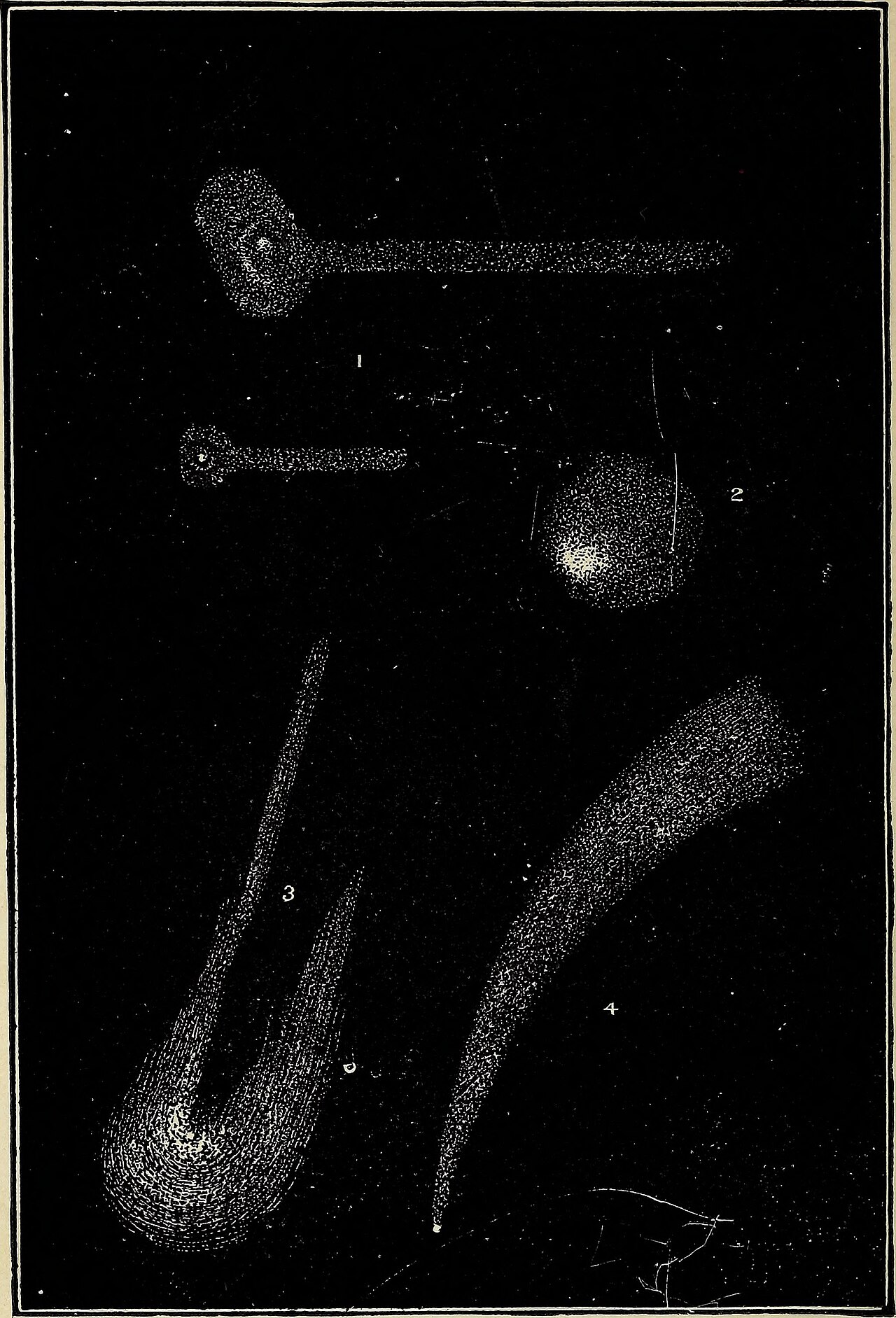
Great Comet of 1901
A bright Southern Hemisphere comet discovered naked-eye in April 1901.

Internet Archive Book Images · No restrictions
The Great Comet of 1901, also known as Comet Viscara and formally designated C/1901 G1, was a non-periodic comet that became bright in the spring of 1901. It was visible exclusively from the Southern Hemisphere and was discovered as a naked-eye object of second magnitude with a short tail on the morning of April 12, 1901.
Quick Facts
- Discovery Ref
- discovery
- Discoverer
- Viscara
- Discovery Site
- Paysandú, Uruguay
- Discovery Date
- 12 April 1901
- Designations
- 1901 I, 1901aICQ1
- Orbit Ref
- jpl1
- Epoch
- 18 May 1901 (JD 2415522.5)
- Observation Arc
- 42 days
- Obs
- 54
- Perihelion
- 0.245 AU
- Aphelion
- ~7,100 AU
- Semimajor
- ~3,500 AU
Facts from the source article.
Lore & Background
The comet was discovered in the pre-dawn of April 12, 1901, by Viscara, the manager of an estancia in the Departamento de Paysandú, Uruguay. On the day of perihelion passage, the comet's head was reported as deep yellowish in color, trailing a 10-degree tail. The comet was observed in Queenstown, South Africa on April 23, and on April 24 by David Gill and Robert Innes at the Royal Observatory, Cape of Good Hope, where the tail was about 10° long. That same day it was also observed at Cape Leeuwin in Western Australia. At the Sydney Observatory on April 25, H. C. Russell found the tail to be about 2° long.
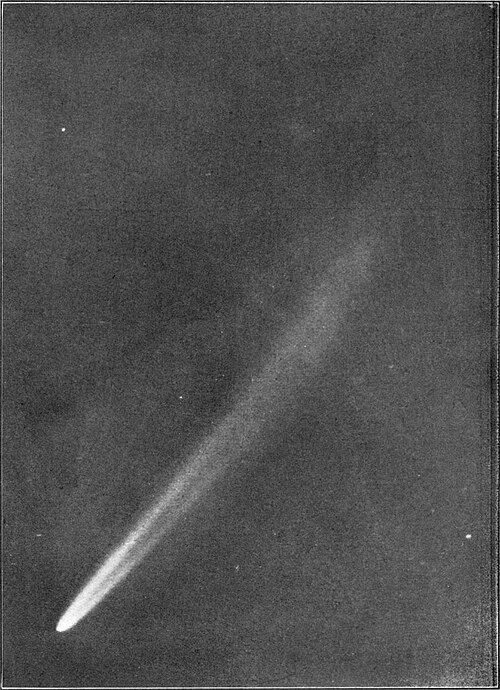
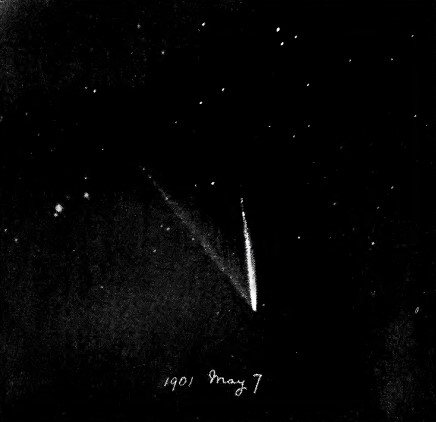
When the comet's brightness reached a maximum on May 5, the tail had fanned out with a weak plasma tail about 45° long and a curved dust tail about 15° long. The brightness reached magnitude 1 or perhaps brighter; some observers of the nucleus viewed telescopically following sunrise suggested the brightness might have reached magnitude −1.5. From naked-eye observations on May 5 there were at least two reports of aurora-like undulations in the tail. The comet was readily visible to the naked eye until about May 20 and visible by telescope until October.
Using 160 observations over 43 days, Charles J. Merfield calculated only a parabolic orbit, inclined about 131° to the ecliptic, with the comet traveling in a retrograde orbit relative to the planetary orbits. The comet was on April 10 about 0.56 AU from Venus and on April 21 about 0.19 AU from Mercury. It reached perihelion at about 0.245 AU from the Sun on April 24, and made its closest approach to Earth at about 0.83 AU on April 30.
Reader's Guide
The Great Comet of 1901 was notable for being visible exclusively from the Southern Hemisphere, where it was observed from observatories including the Royal Observatory, Cape Town, the Argentine National Observatory at Cordoba, and the Government Observatory at Perth, Australia. John Tebbutt observed the comet at Windsor on thirty-two evenings, describing it as a striking and beautiful object during the dark hours, with a secondary fainter tail making an angle of about 35 or 40 degrees toward the south. The comet's orbit was determined to be sensibly parabolic by Charles J. Merfield, who calculated that at perihelion on April 24 the comet was 23 million miles from the Sun. At the time of Tebbutt's first observation on May 3, the comet was 79 million miles from Earth, and by his last observation on June 13 it had receded to 193 million miles. The comet's maximum brightness on May 5, with reports of aurora-like undulations in the tail, and its deep yellowish head at perihelion, contributed to its recognition as a significant cometary apparition of the early 20th century.
Did You Know?
- The comet was discovered naked-eye by Viscara, the manager of an estancia in Uruguay, on April 12, 1901.
- On May 5, 1901, at least two observers reported aurora-like undulations in the comet's tail.
- The comet's head appeared deep yellowish in color on the day of perihelion passage.
- Charles J. Merfield calculated the orbit using 160 observations over 43 days.
Discovery and the Southern Sky's Exclusive Gift
On the pre-dawn of April 12, 1901, a man named Viscara—then serving as manager of a rural estancia in Uruguay's Departamento de Paysandú—looked up and found a naked-eye object of second magnitude trailing a short tail. His casual sighting launched what would become one of the most notable cometary appearances of the early twentieth century. What made the event remarkable was not merely the comet's brilliance but its geography: the object was visible exclusively, or nearly so, from the Southern Hemisphere. Within days, observers across the continent confirmed the discovery. On April 23 it was logged in Queenstown, South Africa, and the following day David Gill and Robert Innes recorded it at the Royal Observatory in Cape Town, noting a tail stretching roughly ten degrees. That same evening, a sighting was made at Cape Leeuwin in Western Australia, and by April 25, H. C. Russell at Sydney Observatory measured a tail of about two degrees. The rapid spread of confirmations across South America, Africa, and Australia underscored how thoroughly the comet belonged to the southern skies, leaving northern observers largely in the dark.
A Dual-Tailed Spectacle at Maximum
The comet's most dazzling phase arrived on May 5, 1901, when its brightness peaked at magnitude 1 or possibly brighter. A handful of observers who tracked the nucleus telescopically just after sunrise suggested it may have briefly touched magnitude minus 1.5, an extraordinary level of luminosity for a cometary head. The tail structure at this peak was particularly striking: rather than a single stream, the comet displayed two distinct components. A faint plasma tail stretched roughly forty-five degrees across the sky, while a curved dust tail extended about fifteen degrees. On the day of perihelion passage, the head itself was described as a deep yellowish hue, trailing a tail of approximately ten degrees. Naked-eye watchers on May 5 reported at least two instances of aurora-like undulations rippling through the tail, lending the object an almost living quality. The comet remained comfortably visible to the unaided eye until around May 20, with its final naked-eye sighting on May 23, and continued to reward telescope users well into October.
A Retrograde Pilgrimage Through the Inner Planets
Charles J. Merfield, working from a dataset of 160 observations gathered over 43 days, determined that the comet followed a parabolic orbit inclined roughly 131 degrees to the ecliptic plane. Crucially, its path was retrograde—traveling in the opposite direction to the planets' orbital motion around the Sun. The trajectory brought the comet into close proximity with several inner planets during its brief sojourn. On April 10 it passed within about 0.56 AU of Venus, and by April 21 it had drawn to roughly 0.19 AU from Mercury. Perihelion came on April 24, with the comet just 0.245 AU from the Sun. Six days later, on April 30, it made its closest approach to Earth at approximately 0.83 AU, or 124 million kilometers. Because the orbit was parabolic rather than elliptical, the comet was classified as non-periodic, meaning it would never return to the inner solar system. Its formal designations—C/1901 G1, with older labels 1901 I and 1901a—reflect the conventions of the era, while its popular name, Comet Viscara, honors the Uruguayan ranch manager who first spotted it.
Tebbutt's Thirty-Two Evenings and the Southern Observing Network
Tebbutt, writing in the 1901 section of his Astronomical Memoirs, praised the comet's striking beauty during the dark hours. He noted that beyond the principal bright tail, a secondary and considerably longer but fainter tail swept at an angle of roughly 35 to 40 degrees toward the south. Tebbutt recorded the comet from his observatory at Windsor on thirty-two separate evenings, a sustained campaign that gave the object a rich observational record. The broader effort was a distinctly Southern Hemisphere affair: the only other institutions contributing data were the Royal Observatory at Cape Town, the Argentine National Observatory in Córdoba, and the Government Observatory in Perth, Australia. Merfield, who also supplied a few observations of his own, used the combined dataset to produce what Tebbutt called the definitive orbit. By the time of Tebbutt's first Windsor observation on May 3, the comet was already 79 million miles from Earth, and by his final sighting on June 13 it had receded to 193 million miles—a rapid departure that underscored the fleeting nature of the encounter.
Gallery
Frequently Asked Questions
Who discovered the Great Comet of 1901?
An observer named Viscara first spotted the comet with the unaided eye on the morning of April 12, 1901, when it already glowed at second magnitude and sported a short tail.
What are the formal designations for the Great Comet of 1901?
It is primarily catalogued as C/1901 G1, with alternate designations 1901 I and 1901a, while its popular name "Comet Viscara" simply honors the person who first reported it.
Where on Earth was the Great Comet of 1901 visible?
Its orbital geometry kept it entirely below the celestial equator, so only observers in the Southern Hemisphere could see it; Northern Hemisphere stargazers never had a chance to view it.
How close did the Great Comet of 1901 pass to the Sun and to Earth?
It swung to perihelion at 0.245 AU from the Sun on April 24, 1901, and then made its nearest approach to our planet at 0.83 AU just six days later, on April 30.
Why is the Great Comet of 1901 considered notable?
As a non-periodic comet that briefly reached naked-eye brightness in a single apparition, it provided a rare and striking spring 1901 spectacle for Southern Hemisphere skywatchers, and it has not returned since.
More in Named Comets, Part 4 1-24
Spotted an error? Know more?
Reader corrections go straight into our review queue. Suggest an edit · How this site is sourced