
Great Comet of 1819
First comet studied with polarimetry, discovered by Tralles in 1819.

George Frederick Chambers 1841-1915 · Public domain
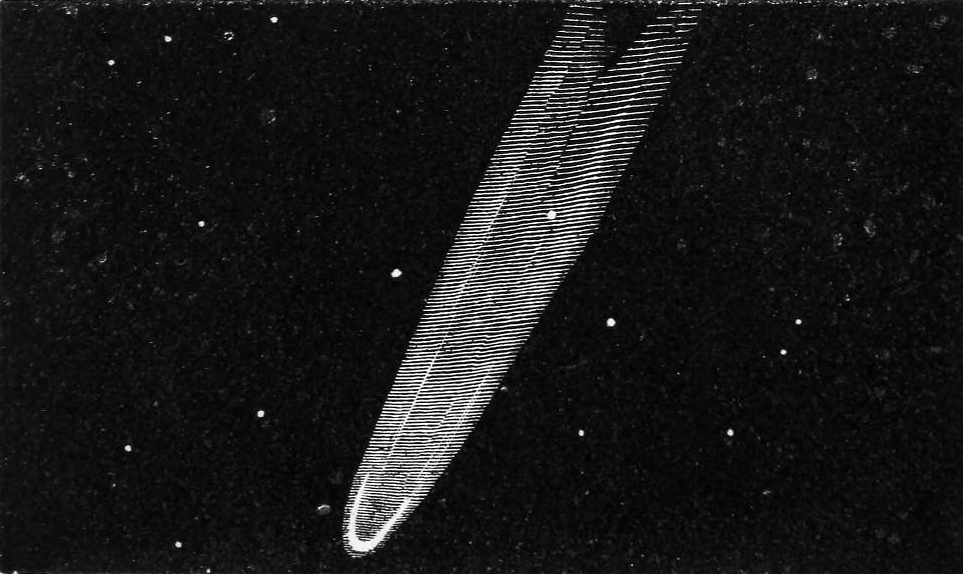
The Great Comet of 1819, officially designated C/1819 N1 and also known as Comet Tralles, was a bright non-periodic comet that reached an apparent magnitude of 1–2. Discovered on 1 July 1819 by German astronomer Johann Georg Tralles in Berlin, it is notable as the first comet analyzed using polarimetry, a technique applied by French mathematician François Arago.
Quick Facts
- Discovery Ref
- Kronk_2003
- Discoverer
- Johann Georg Tralles
- Discovery Site
- Berlin, Germany
- Discovery Date
- 1 July 1819
- Designations
- 1819 II
- Orbit Ref
- Branham_2016
- Epoch
- 25 July 1831 (JD 2385640.5)
- Observation Arc
- 105 daysjpldata
- Earliest Precovery Date
- 26 June 1819
- Obs
- 692
- Semimajor
- ~278 AU
- Perihelion
- 0.342 AU
Facts from the source article.
Lore & Background
Johann Georg Tralles first observed the comet low in the evening sky on 1 July 1819, and the sighting was confirmed the next night by Johann Elert Bode, also in Berlin. On 2 July, Tralles measured the coma at 40″. The following day, Friedrich Georg Wilhelm von Struve found the nucleus to be 8″ with a tail several degrees long, while Heinrich Wilhelm Matthias Olbers reported the nucleus at magnitude 1–2 and a tail about 7–8° in length. The comet was last seen by Struve on 25 October.
On 3 July, François Arago used a polarimeter of his own design to examine light from the comet's tail, discovering it was polarized. He then observed the nearby star Capella, which showed no polarization, indicating that some light from the tail was reflected sunlight. This marked the first polarimetric observation of a comet.
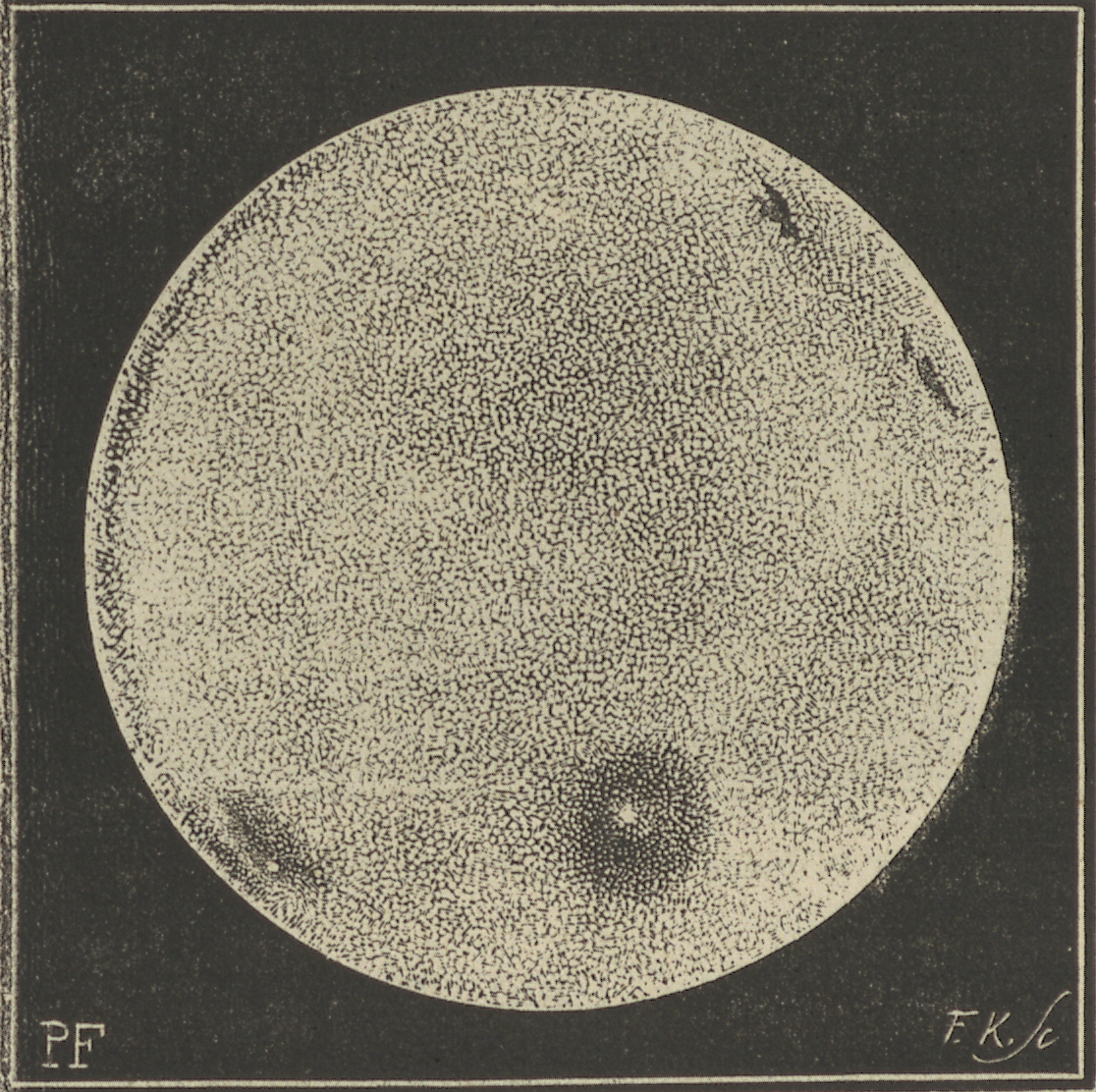
After orbital elements were calculated by Olbers, he determined that the comet had transited the Sun on 26 June, days before its discovery. He reported this to Bode on 27 July. Following the announcement, several Sun observers searched their records. Johann Wilhelm Pastorff reported seeing a round nebulousity with a bright spot near its center on that day and made a sketch. Canon Stark noted in Meteorologisches Jahrbuch that he saw an ill-defined small spot on the Sun at 7:15 A.M. on 26 June, 15′ 25″ from the west limb, which was absent by noon. John Russell Hind later noted that Pastorff's positions differed considerably from the comet's expected location and considered it improbable that the comet matched Pastorff's sketch, but concluded that Canon Stark likely did observe the transit. A 2017 paper by Richard L. Branham Jr. agreed that Stark probably saw it.
Reader's Guide
The Great Comet of 1819 holds a significant place in cometary science as the first comet subjected to polarimetric analysis. François Arago's observation on 3 July 1819 demonstrated that light from the comet's tail was polarized, while light from the star Capella was not, providing early evidence that cometary light includes reflected sunlight. This technique later became a standard tool for studying cometary dust and gas.
The comet's transit of the Sun before its discovery generated considerable interest among contemporary astronomers. The reports from Johann Wilhelm Pastorff and Canon Stark, though debated, represent early attempts to document a comet crossing the solar disk. John Russell Hind's analysis and a 2017 study by Richard L. Branham Jr. support the likelihood that Stark indeed observed the transit.
The comet also entered cultural record. Poet John Keats noted that he and his wife Fanny had stared at it. Historian Nathaniel Philbrick, in his 2000 book In the Heart of the Sea, writes about the comet being seen by people on Nantucket, Massachusetts, in July 1819. The Stephen Long expedition to the Great Plains observed the comet from near present-day Jefferson City, Missouri. A 2016 recalculation of the orbit, based on 692 observations, concluded that the comet will not return for over 3,000 years and poses no threat to Earth, and that Near Eastern records around 2550 BCE may mention its earlier passage.
Did You Know?
- The comet was discovered on 1 July 1819 by Johann Georg Tralles in Berlin.
- François Arago made the first polarimetric observation of a comet using its tail on 3 July 1819.
- The comet transited the Sun on 26 June 1819, days before its discovery.
Cross-Cultural Mythology and Omen
Across the ancient world, comets rarely inspired scientific curiosity; they provoked terror, reverence, or both. In Norse cosmology, the sky itself was the skull of the primordial giant Ymir, slain by Odin and his brothers after the Battle of Ragnarok. Four dwarves representing the cardinal directions held that skull aloft, and any streak of light crossing the heavens was understood as a flake of bone detaching and disintegrating. In Mesoamerica, native peoples of Mexico regarded comets as smoking stars and dire portents—sometimes signaling the death of a ruler—while meteors were imagined as the arrows, cigar butts, or even excrement of stellar gods, dangerous enough to make night walks frightening. Rome offered a rarer, more personal association: a comet was the sole celestial object actually worshipped in a temple, a distinction Augustus claimed as auspicious when one appeared during games honoring Venus Genetrix shortly after his father's death. By the medieval period, the fear had crystallized into political narrative; the 1066 passage of Halley's Comet was depicted as heralding the Norman conquest of England, cementing the comet's role as a harbinger of upheaval across cultures.
Aristotle and the Meteorological Camp
In the first book of his Meteorology, Aristotle articulated a theory of comets that would dominate Western intellectual life for roughly two millennia. He dismissed earlier suggestions that comets were planets or planet-related phenomena, reasoning that while planets trace their paths within the zodiacal circle, comets can appear in any region of the sky. Instead, he placed them in the upper atmosphere, where hot and dry exhalations accumulated and occasionally ignited into flame. This single mechanism, he argued, also explained meteors, the aurora borealis, and even the Milky Way. His cosmological framework divided the world into the terrestrial realm below the Moon—governed by the four elements of water, earth, fire, and air—and the celestial heavens above, filled with a fifth, immutable substance called Aether. Because the heavens were unchanging, comets, which clearly changed and moved, could not originate there. Competing views existed: Anaxagoras and Democritus saw comets as mere after-images or shadows cast by planetary eclipses, while Pythagorean thinkers proposed they were planets completing longer orbits near the Sun's edge. Yet Aristotle's atmospheric explanation proved the most enduring.
Chinese Records as Scientific Heritage
Few ancient civilizations left a record of comet apparitions as systematic, accurate, and long-lasting as China's. Spanning roughly three millennia—from entries on oracle bones through continuous dynastic chronicles—these records have become indispensable to modern astronomers. The orbital histories of numerous comets have been reconstructed entirely from Chinese observations, and the most celebrated example is the retroactive identification of Halley's Comet, whose 75-to-76-year return cycle was confirmed through these ancient entries. Within Chinese cosmology, comets were never neutral; under the Wu Xing, or five-elements, framework, a comet signaled a dangerous imbalance between yin and yang, always interpreted as a harbinger of disaster. Emperors maintained dedicated observers whose sole task was to watch the skies for such signs, and the political consequences could be dramatic. In 712 CE, Emperor Ruizong of the Tang dynasty abdicated following a comet sighting. In 35 CE, the visible breakup of a comet was read as portending the military defeat of Gongsun Shu by the forces of Wu Han, illustrating how celestial events were woven directly into decisions of state and warfare.
From Fear to Fascination
Although humanity has watched comets cross the sky for thousands of years, treating them as genuine astronomical objects is a development of only the last few centuries. For most of that long history, a great comet triggered widespread dread, read as an omen of catastrophe. The intellectual groundwork for a scientific understanding began with thinkers like Immanuel Kant in the eighteenth century, who speculated about the physical makeup of these visitors. Today the picture is far clearer: comets are essentially "dirty snowballs" tracing highly eccentric orbits around the Sun, a model that has replaced the old atmospheric and omen-based explanations. Yet comets remain powerfully present in the modern imagination. In 1994, Shoemaker-Levy collided spectacularly with Jupiter's atmosphere, a spectacle witnessed by telescopes worldwide. In 1997, the passage of Hale-Bopp inspired the Heaven's Gate cult to carry out a mass suicide, a grim reminder that celestial events can still trigger extreme human behavior. Since 1985, spacecraft have visited a total of eight comets, transforming them from distant omens into tangible targets of exploration.
Gallery

Frequently Asked Questions
What is the Great Comet of 1819?
It is a bright non-periodic comet officially designated C/1819 N1, commonly called Comet Tralles after the astronomer who found it. At its brightest it reached an apparent magnitude of 1–2, making it a striking naked-eye object.
Who discovered the Great Comet of 1819 and where?
German astronomer Johann Georg Tralles first observed the comet on 1 July 1819 from his post in Berlin.
What makes the Great Comet of 1819 scientifically notable?
It was the first comet ever examined using polarimetry, a technique applied to it by French mathematician François Arago. That analysis opened a new way to probe the physical properties of cometary material.
How bright did the Great Comet of 1819 appear in the sky?
At peak it reached an apparent magnitude between 1 and 2, placing it well within the range visible to the unaided eye and rivaling the brightest stars.
Why is the Great Comet of 1819 remembered in comet history?
Beyond its impressive brightness, it is celebrated as a turning point in observational astronomy because Arago's polarimetric study introduced a new diagnostic tool for comets. The comet is also permanently linked to Tralles's name as an alternative designation.
More in Named Comets, Part 4 1-24
Spotted an error? Know more?
Reader corrections go straight into our review queue. Suggest an edit · How this site is sourced