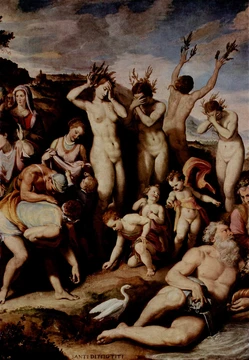
Pentheus
Theban king torn apart by his own mother in a Bacchic frenzy.
Pentheus was a king of Thebes in Greek mythology, the son of Echion and Agave.[1] He is best known for his resistance to the god Dionysus and his violent death at the hands of his own mother and aunts.[2][3][4] Ovid also discusses the Pentheus story in Book III of his Metamorphoses, with several divergences from Euripides' version.[5]
Quick Facts
- Deity of
- King of Thebes
- Abode
- Thebes
- Parents
- Echion and Agave
- Siblings
- Epeiros
- Children
- Oclasus
Facts from the source article.
Biology and range
Pentheus imprisoned Dionysus, but the god's chains fell off and the jail doors opened.[6] Due to his advanced age, Cadmus handed over the kingship of Thebes to his grandson Pentheus.[7][8] Cadmus' daughters spotted Pentheus up in a tree and believed he was a wild beast.[3] They dragged him down and dismembered him in a rite called sparagmos.[3]
According to some accounts, his mother initiated the assault, ripping off his arm and then his head.[4] After Pentheus' identity came to light, the authorities banished the women from Thebes.[4]
What the specialist sources record
In the play, Pentheus accuses the women of using Bacchic rites as a pretext for lust, saying they "steal away to lonely spots to gratify their lust".[8] In Oppian's version, according to Forbes Irving, Dionysus transforms his female followers into leopards and Pentheus into a bull, which the leopards then tear apart.[9] In Euripides' Bacchae, Pentheus is described as a king who "wages war 'gainst my divinity" and omits the god from his prayers.[8] A servant informs Pentheus that the captured followers of the god have "loosed their bonds and fled into the meadows".[8]
References
- Wikipedia, "Pentheus" (CC BY-SA 4.0), which cites: Scholia on Euripides, Phoenician Women 942 (original not read by us) en.wikipedia.org
- Wikipedia, "Pentheus" (CC BY-SA 4.0), which cites: Euripides, Bacchae 654-704 (we also read that source) en.wikipedia.org
- Wikipedia, "Pentheus" (CC BY-SA 4.0), which cites: Euripides, Bacchae 1006-1129 (we also read that source) en.wikipedia.org
- Wikipedia, "Pentheus" (CC BY-SA 4.0), which cites: Euripides, Bacchae 1281 (we also read that source) en.wikipedia.org
- Wikipedia, "Pentheus" (CC BY-SA 4.0), which cites: Kline, "Ovid: The Metamorphoses (Book III)", Poetry in Translation, 2000 (original not read by us) en.wikipedia.org
- Wikipedia, "Pentheus" (CC BY-SA 4.0), which cites: Euripides, Bacchae 434 (we also read that source) en.wikipedia.org
- Wikipedia, "Pentheus" (CC BY-SA 4.0), which cites: Euripides, Bacchae 195-263 (we also read that source) en.wikipedia.org
- Euripides, Bacchae 195-263. facts only, no text reused. topostext.org
- Wikipedia, "Pentheus" (CC BY-SA 4.0), which cites: Forbes Irving, "Metamorphosis in Greek Myths", Oxford University Press, Clarendon Press, 1990, p. 221 (we also read that source) en.wikipedia.org
Each numbered sentence above was checked against the source it cites before publication. Sentences citing Wikipedia adapt text from the English Wikipedia article Pentheus (contributors), used under CC BY-SA 4.0; this entry is available under the same licence. Other sources were used for facts only; no text or images are copied from them.
More in Metamorphoses Into Animals in Greek Mythology
Spotted an error? Know more?
Reader corrections go straight into our review queue. Suggest an edit · How this site is sourced