Phineus
A Thracian king and seer tormented by Harpies.
Phineus was a king of Salmydessus in Thrace and a seer who appears in accounts of the Argonauts' voyage. Some accounts make him a king in Paphlagonia or in Arcadia.
Quick Facts
- Kingdom
- Salmydessus in Thrace
- Role
- Seer and king
- Father (apollonius of rhodes)
- Agenor
- First wife
- Cleopatra, daughter of Boreas and Oreithyia
- Second wife
- Idaea, daughter of the Scythian king Dardanus
Facts from the source article.
Family
In ancient sources, Phineus’s parentage varies. Apollonius of Rhodes names his father as Agenor, while the Bibliotheca notes that others say his father was Poseidon. The Hesiodic Catalogue of Women gives his parents as Phoenix and Cassiopeia. His first wife was Cleopatra, daughter of Boreas and Oreithyia. With her he had two sons, called either Plexippus and Pandion, Gerymbas and Aspondus, Polydector and Polydorus, Parthenius and Crambis, or Oryithus and Crambis. His second wife, Idaea, tricked him into blinding these sons. By this second wife, or by a Scythian concubine, he fathered two more sons, Mariandynus and Thynus. Some accounts also give him daughters: Eraseia and Harpyreia, and another named Olizone, who married Dardanus, son of Zeus and Electra, and became mother of Erichthonius.
Mythology
Phineus received the gift of prophecy from Apollo, but the reasons for his own blinding vary across different accounts. Some say it was punishment for mistreating his sons, others claim it was for giving directions to Phrixus, or because he chose a long life over sight. The best-known version, from the Argonautica, states he was blinded for revealing the future to humanity. As a result, he was also plagued by the Harpies, creatures that stole or spoiled any food he tried to eat; in the Catalogue of Women, they drove him to the edges of the earth. According to scholia on the Odyssey, Zeus asked Phineus whether he would rather die or lose his sight as punishment for allowing his sons to be killed by their stepmother. Phineus chose blindness, saying he would prefer never to see the sun, and the offended Helios then sent the Harpies after him. Another version says Helios blinded Phineus at the request of his son Aeëtes, because Phineus had helped Aeëtes' enemies. In some accounts, Poseidon was the one who punished him. Regardless of how the Harpies tormented him, being freed from this curse became the reason Phineus got involved with the voyage of the Argo. Some stories add that Phineus had blinded his own sons, but the Boreads or Asclepius later restored their sight.
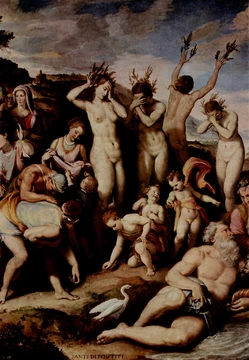
When the Argo landed near his home in Thrace, Phineus told the crew about his suffering and explained that his brothers-in-law, the winged Boreads Zetes and Calais, who were also Argonauts, were destined to rescue him. Zetes hesitated, worried about angering the gods by interfering with a divine punishment, but Phineus assured him that he and Calais would face no consequences. They set a trap: Phineus sat down to eat while the Boreads stood guard. As soon as he touched his food, the Harpies swooped in, devoured it, and flew away. The Boreads chased them all the way to the Floating Islands, where the goddess Iris stopped them from killing the Harpies, which would have defied the gods' will. She swore by the River Styx that the Harpies would never bother Phineus again, so the Boreads turned back. Apollonius says this is why those islands are now called the Strophades, or "Turning Islands." Afterward, Phineus revealed the rest of the Argonauts' journey to them and told them how to safely pass the Symplegades, playing a role for Jason similar to what Circe did for Odysseus in the Odyssey.
More in Metamorphoses Into Animals in Greek Mythology
Spotted an error? Know more?
Reader corrections go straight into our review queue. Suggest an edit · How this site is sourced