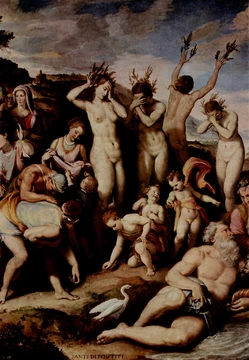
Circe
Witch and goddess who transformed enemies into animals.
Circe is a witch and goddess in Greek mythology, most often described as a daughter of the sun god Helios and the Oceanid Perse. She is renowned for her vast knowledge of potions and herbs, which she used with a magic wand or staff to transform her enemies or those who offended her into animals. The best known of her legends appears in Homer's Odyssey, where she turns most of Odysseus's crew into swine on the island of Aeaea.
Quick Facts
- Abode
- Aeaea
- Consort
- Odysseus, Telemachus
- Parents
- Helios and Perse
- Siblings
- Aeëtes
- Pasiphaë
- Aloeus
- Perses
- Phaethon
- the Heliades
- the Heliadae and others
- Children
- Latinus
- Telegonus
- Cassiphone
- Rhomos
- Ardeas
- Anteias
Facts from the source article.
Did You Know?
- Strabo writes that a tomb-shrine of Circe was attended in one of the Pharmacussae islands, off the coast of Attica.
- The gens Mamilii claimed descent from Mamilia, a granddaughter of Odysseus and Circe through Telegonus.
- Linnaeus named a genus of the Venus clams (Veneridae) after Circe in 1778.
Classical literature
Circe was usually considered the child of the sun god Helios and the Oceanid nymph Perse, though the Orphic Argonautica names her mother as Asterope. Her brother was Aeëtes, who guarded the Golden Fleece and fathered Medea; later sources sometimes add a half-brother named Perses. Pasiphaë, wife of King Minos and mother of the Minotaur, is occasionally described as her half-sister or full sister. In accounts by Dionysius Scytobrachion and Diodorus Siculus, Circe and Medea are made daughters of Hecate by Aeëtes, but both authors stripped the supernatural from the myth, portraying Hecate as a mortal woman who discovered drugs and their properties rather than a goddess. Circe was frequently mixed up with Calypso because of her shifting behavior and personality, as well as both women’s connection to Odysseus. Greek legend placed Circe on the island of Aeaea. Apollonius of Rhodes’s Argonautica sets Aeaea south of Aethalia, visible from the Tyrrhenian coast of Italy. In that poem, Aeëtes recalls taking a ride in Helios’s chariot when his father brought Circe to the western land, where she still lives far from Colchis. A scholiast on Apollonius says he follows Hesiod’s tradition for this journey, while Valerius Flaccus has Circe carried off by winged dragons. Roman poets linked her to the oldest traditions of Latium and placed her home on the promontory of Circeo. Homer called her a dreadful goddess with lovely hair and human speech. Apollonius gave her flashing golden eyes that shot rays of light, and the author of the Argonautica Orphica said her hair resembled fiery rays. Ovid’s The Cure for Love hints that Circe learned her knowledge of herbs and potions from her mother Perse, who apparently had similar skills.
Later literature
Giovanni Boccaccio provided a digest of what was known of Circe during the Middle Ages in his De mulieribus claris, commenting wryly that there are now many more temptresses like her to lead men astray. John Gower's Confessio Amantis presents a different interpretation: Ulysses is depicted as deeper in sorcery and readier of tongue than Circe, and through this means he leaves her pregnant with Telegonus. Most of the account deals with the son's later quest for and accidental killing of his father, drawing the moral that only evil can come of the use of sorcery. The story of Ulysses and Circe was retold as an episode in Georg Rollenhagen's German verse epic Froschmeuseler, where it is related at the court of the mice and takes up sections 5–8 of the first part. In Lope de Vega's miscellany La Circe – con otras rimas y prosas, the story of her encounter with Ulysses appears as a verse epic in three cantos that takes its beginning from Homer's account but is then embroidered; in particular, Circe's love for Ulysses remains unrequited. Nathaniel Hawthorne retold the Homeric account as Circe's Palace in his Tanglewood Tales, where the transformed Picus continually appears trying to warn Ulysses and Eurylochus of the danger, and is rewarded at the end by being given back his human shape. Judith Yarnall comments that Circe started out as a comparatively minor goddess of unclear origin and that different versions of her myth can be seen as mirrors of the fantasies and assumptions of the cultures that produced them. She notes that Circe herself has gone through far more metamorphoses than those she inflicted on Odysseus's companions.
Visual representations
When Greek potters painted scenes from the Odyssey, the Circe story was a favorite. Two main images appear again and again: Circe surrounded by her transformed victims, and Odysseus menacing her with a sword. In the first type, the animals aren't always pigs. On a 6th-century BC cup from Boston, a ram, a dog, and a lion join the scene. The transformations are often incomplete—just the head changes, maybe a tail sprouts, while the rest of the body stays human. A 5th-century BC bronze in the Walters Art Museum shows a man on all fours with a pig's front half, and one scholar noted that an artist had little choice but to give a bewitched man an animal head. Circe almost always stirs her potion with a wand, though in Homer she uses the wand only after the sailors have already drunk. An exception is a Berlin amphora where she sits and points the wand at a half-changed man. In the second scene, Odysseus threatens her with a drawn sword, but on an Athens vase he carries spears, even though Homer says he had a bow over his shoulder. Circe usually flees, and on an Erlangen vase she drops her bowl and wand behind her. Two rough wine bowls include the Homeric detail of her handloom, where she sang while weaving. Other vases suggest that in comic satyr plays about this encounter, Odysseus's half-animal men formed the chorus instead of the usual satyrs.
Musical treatments
Before full-blown opera took over, composers set poetic texts as secular cantatas. One of the earliest examples is Alessandro Stradella's La Circe, performed in 1667 at Frascati for Cardinal Leopoldo de Medici. Its opening recitative has Circe claim that her son Telegonus founded Frascati, and she speaks with the south wind Zeffiro and the local river Algido. A century later, Antonio Vivaldi wrote All'ombra di sospetto (RV 678) for a single voice, with Circe addressing Ulysses. The countertenor part is accompanied by flute, harpsichord, cello, and theorbo, and the piece is known for the flirtatious dialogue between flute and voice before the two become lovers. In French, Jean-Baptiste Rousseau's poem Circé (1703) was written specifically as a cantata. Its varied verse forms let musicians express different emotions. The poem begins with Circe abandoned on a high mountain, mourning Ulysses' departure. She summons the infernal gods and makes a terrible sacrifice: vapors darken the light, stars halt, rivers retreat, and even Death's god trembles. Yet though the earth shakes, Love cannot be commanded, and the wintery fields revive.
More in Metamorphoses Into Animals in Greek Mythology
Spotted an error? Know more?
Reader corrections go straight into our review queue. Suggest an edit · How this site is sourced