Église Sainte-Onenne
Last updated

via Wikipedia: Église Sainte-Onenne · see source
Where it is
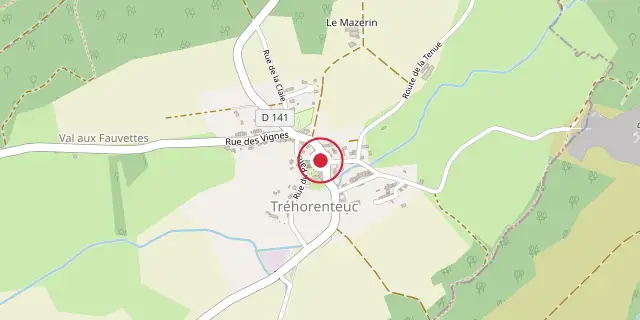
Coordinates: 48°00′29″N 2°17′13″W (48.0080, -2.2870) · Open in OpenStreetMap
Coordinates and connected clubs: the infobox of Wikipedia: Église Sainte-Onenne (CC BY-SA 4.0). Map: drawn by Codexery from OpenStreetMap tiles.
The Église Sainte-Onenne, also known as the Église Saint-Eutrope and the Église du Graal, is a parish church in the commune of Tréhorenteuc in Brittany. It is the only church dedicated to a local Breton saint, St Onenne. However, it is best known for its fittings and stained glass windows commissioned by the Abbé Gillard between 1942 and 1962 which mix pagan themes from Arthurian legend with Christian elements.
History
The church's first patron was Eutropius, Bishop of Saintes, with Onenne as secondary patroness. A Christian religious building seems to have existed in Tréhorenteuc from the 7th century, its purpose then being to compete with a druidic centre. A priory dependent on the Abbaye Notre-Dame de Paimpont dates back to 1191. Anne of Brittany sent a letter of protection to Seneschal Allaire on October 27, 1489, and donated a banner representing St Onenne in 1506.
The parish building was rebuilt in 1516 by Dom Hamon. From 1573, Tréhorenteuc was one of the first parishes in the region to keep a burial register. During the French Revolution, properties of the priory were confiscated, including the presbytery used as a school. The first mayor, elected on 26 December 1791, had the parish calvary demolished and the church bells sent to the foundry to make cannons.
In 1809 a law abolished worship in Tréhorenteuc, removing it to Néant-sur-Yvel. Parishioners protested because of the remoteness of Néant and the difficulty of getting there in winter on dirt roads. On 26 January 1820 the parish was reinstated. The building had been abandoned for more than ten years and fell into ruins.
Father Brogard restored it, creating a high altar, and had a floor laid. The church also acquired bells. By 1861 Sigismond Ropartz noted it was small, low and coated with clay, not very different from a barn. Father Alliot, arriving in 1930, testified that he 'risked his life' there, the gable threatening to collapse.
Artworks
Henri Gillard, appointed rector in March 1942, undertook to restore the church at his own expense, completing his task in 1962. His restoration included destroying some works of art he deemed unworthy and commissioning many more to replace them. These include two wooden statues of Saints Onenne and Judicaël by sculptor Edmond Delphaut, a series of stained-glass windows by Henry Uzureau illustrating the life of St Onenne, and a series of paintings, altarpieces and other fittings by Karl Rezabeck and Peter Wisdorff, both released German prisoners-of-war.
A mosaic of the white hart of Brocéliande, symbolizing Christ, was made by Jean Delpech. Many artworks depict Arthurian subjects, including the Holy Grail.
The Grail appears in the east window with Joseph of Arimathea and Christ, and it manifests itself to King Arthur and his knights in a painting above the sacristy door. Morgan le Fay figures in one of a series of paintings on the Stations of the Cross, notable for setting the story in local Breton scenes. A statue of Gillard himself is stationed outside the church door.
More in Locations Associated with Arthurian Legend
Sources
Compiled from Wikipedia and the sources listed below. Text from Wikipedia is available under CC BY-SA 4.0; this entry is adapted from it.
- Wikipedia: Église Sainte-Onenne (CC BY-SA 4.0).
Spotted an error? Know more?
Reader corrections go straight into our review queue. Suggest an edit · How this site is sourced