
Rez Abbasi
Pakistan-born American jazz guitarist fusing east and west.

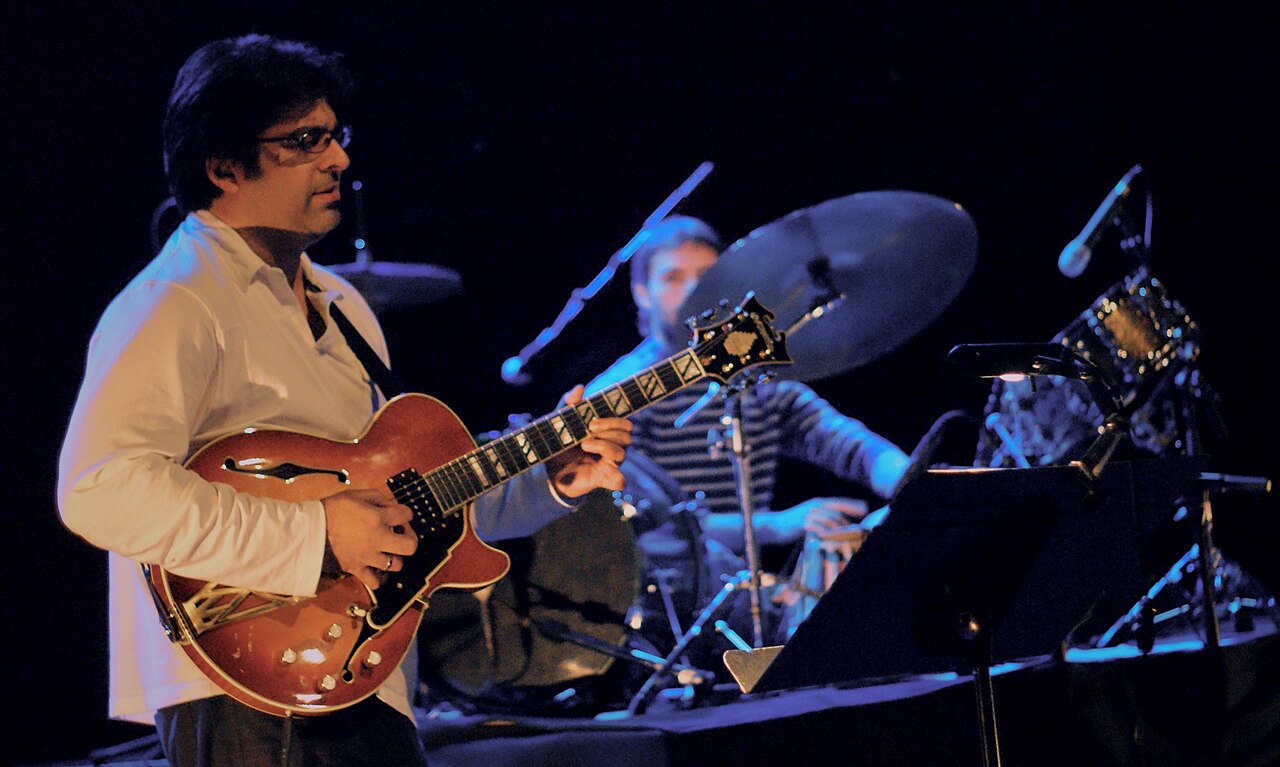
Dirk Neven · Public domain
Rez Abbasi, a guitarist, composer, and record producer, was born in Karachi, Pakistan, and now lives in New York City. His family relocated to Los Angeles when he was four, and he picked up the guitar at age eleven. After spending his early teens in rock bands, a concert featuring Ella Fitzgerald and Joe Pass inspired him to explore jazz and classical music.
He studied guitar at the University of Southern California and the Manhattan School of Music, graduating in 1989. In 1990, he spent two months in India learning tabla from Alla Rakha, which sparked his interest in the music of both India and Pakistan. Though he developed a fusion of Eastern and Western styles, he has never formally studied instruments like the sitar or sarod, instead absorbing their techniques at what he called a "jazz street level." As he told *Guitar Player*, rock, jazz, and other music have influenced him since childhood.
Abbasi has played with saxophonist Rudresh Mahanthappa in the groups Indo-Pak Coalition and Dakshani, and has arranged and performed for his wife, singer Kiran Ahluwalia. His other collaborators include Billy Hart, D. D. Jackson, Dave Liebman, Dave Pietro, Gary Thomas, Gary Versace, Kenny Werner, Marvin Smith, Rick Margitza, Sunny Jain, Tim Hagans, and Tony Malaby.
His discography as a leader includes albums such as *Rez Abbasi* (1993), *Third Ear* (1995), *Modern Memory* (1998), *Out of Body* (2002), *Snake Charmer* (2005), *Bazaar* (2006), *Things to Come* (2009), *Natural Selection* (2010), *Suno Suno* (2011), *Continuous Beat* (2012), *Intents and Purposes* (2015), *Behind the Vibration* (2016), *Unfiltered Universe* (2017), *A Throw of Dice* (2019), *Django-Shift* (2020), *Oasis* with Isabelle Oliver (2020), and *Charm* (2023). He has also appeared as a guest on recordings by Kiran Ahluwalia, Mike Clark, Sunny Jain, Rudresh Mahanthappa, Dave Pietro, and Adam Rudolph.
- Born
- August 27, 1965
- Field
- Jazz guitarist, composer, record producer
- Nationality
- Pakistan-born American
- Known for
- East–west fusion style blending jazz with Indian and Pakistani music
Lore & Background
Rez Abbasi was born in Karachi, Pakistan, and moved to Los Angeles at age four. He began learning guitar at eleven and spent his early teens playing in rock bands. Inspired by a concert featuring vocalist Ella Fitzgerald and guitarist Joe Pass, he turned to jazz and classical music. He studied guitar at the University of Southern California and the Manhattan School of Music, graduating in 1989. In 1990, he spent two months in India studying tabla with Alla Rakha, which sparked his interest in the music of India and Pakistan.
Abbasi traveled to India to study under master tabla player Ustad Alla Rakha to develop an east–west fusion style. He told Guitar Player magazine that he never studied sitar or sarod because doing so would have required giving up everything else; instead, he learned some techniques on what he called a 'jazz street level.' He has been a member of the Indo-Pak Coalition and Dakshani, groups led by saxophonist Rudresh Mahanthappa, and has played and arranged for his wife, singer Kiran Ahluwalia. He has also worked with numerous musicians including Billy Hart, D. D. Jackson, Dave Liebman, and Kenny Werner.
Reader's Guide
Rez Abbasi's significance lies in his role as a guitarist and composer who has synthesized jazz with the classical and folk traditions of South Asia. His study of tabla with Alla Rakha and his immersion in Indian and Pakistani music have informed a style that is neither purely jazz nor purely Eastern, but a hybrid that respects both. His discography as a leader, spanning from 1993 to 2023, shows a consistent exploration of this fusion, with albums such as 'Bazaar,' 'Things to Come,' and 'Django-Shift.' His work as a guest on recordings by Rudresh Mahanthappa, Kiran Ahluwalia, and others further demonstrates his collaborative approach. Abbasi's legacy is that of a musician who has expanded the vocabulary of jazz guitar by incorporating microtonal and rhythmic elements from South Asian music, without abandoning his rock and jazz roots. His approach, as he described, is learned on a 'jazz street level,' making his fusion accessible and grounded.
Did You Know?
- He studied tabla with master player Ustad Alla Rakha in India after graduating in 1989.
- His wife is singer Kiran Ahluwalia, for whom he has played and arranged.
Early Life & Musical Formation
Rez Abbasi entered the world on August 27, 1965, in Karachi, Pakistan, but his musical story unfolded largely on American soil. His family relocated to Los Angeles when he was just four years old, and by the age of eleven he had picked up a guitar. His early teenage years were spent in rock bands, a period that would later inform his broader sonic palette. A pivotal turning point came when he attended a concert pairing vocalist Ella Fitzgerald with guitarist Joe Pass; that single evening redirected his ambitions toward jazz and classical traditions. He went on to pursue formal guitar studies at the University of Southern California and later at the Manhattan School of Music, graduating in 1989. That education gave him a technical foundation, but it was the rock-and-roll energy of his youth and the jazz inspiration of that concert that together shaped the guitarist he would become in New York City.
East-West Fusion & the Indian Connection
After completing his degree in 1989, Abbasi made a deliberate trip to India to study tabla under the legendary Ustad Alla Rakha. Those few months ignited a lasting fascination with the musical traditions of India and Pakistan, one that would permeate his work for decades. Yet he was candid about the limits of his cross-cultural study. In an interview with Guitar Player magazine, he explained that he never undertook formal training on the sitar or sarod, reasoning that mastering either instrument would have demanded he abandon everything else. Instead, he absorbed select techniques at what he called a jazz street level, layering them atop the rock and roll and jazz that had shaped him since childhood. This philosophy of selective, pragmatic borrowing rather than exhaustive mastery became a hallmark of his compositional voice, allowing him to weave South Asian rhythmic and melodic ideas into a fundamentally jazz-guitar framework without sacrificing the instruments and genres he already commanded.
A Three-Decade Catalog
From a self-released debut in 1993 to Charm on Whirlwind in 2023, Rez Abbasi has maintained a remarkably steady output as a bandleader, spanning roughly three decades and well over a dozen albums. His early records on Cathexis—Third Ear in 1995 and Modern Memory in 1998—established his voice, followed by Out of Body on String Jazz and Snake Charmer on Earth Sounds in the early-to-mid 2000s. The latter half of his catalog shows a broadening of both scope and label partnerships: Bazaar on Zoho, Things to Come and Natural Selection on Sunnyside, a pair of Enja releases in 2011 and 2012, Behind the Vibration on Cuneiform, and a run of Whirlwind titles from 2017 through 2020 that include the collaborative album Oasis with Isabelle Oliver. Guest credits further illustrate his range, appearing on recordings by his wife Kiran Ahluwalia, Rudresh Mahanthappa, Dave Pietro, Adam Rudolph, and others. The sheer volume and variety of this catalog testify to a musician who treats each project as a distinct creative statement rather than a formulaic exercise.
Collaborative Network & the NYC Jazz Ecosystem
Based in New York City, Rez Abbasi has embedded himself in one of the most densely collaborative jazz communities in the world. His credits as a sideman and arranger read like a who's-who of contemporary and traditional jazz: he has played alongside Billy Hart, D. D. Jackson, Dave Liebman, Dave Pietro, Gary Thomas, Gary Versace, Kenny Werner, Marvin Smith, Rick Margitza, Sunny Jain, Tim Hagans, and Tony Malaby. Two of his most sustained ensemble commitments have been with saxophonist Rudresh Mahanthappa, for whom he has served as a member of both the Indo-Pak Coalition and the group Dakshani, projects that explicitly bridge South Asian and American jazz idioms. He has also arranged and performed for his wife, vocalist Kiran Ahluwalia, contributing to albums such as Wanderlust and Aam Zameen: Common Ground. This web of relationships—spanning rock roots, Indian classical traditions, and the New York avant-garde—positions Abbasi not as a soloist in isolation but as connective tissue within the city's musical ecosystem.
Gallery
Frequently Asked Questions
Who is Rez Abbasi?
Rez Abbasi is a Pakistan-born American jazz guitarist, composer, and record producer who is based in New York City. He is widely recognized for his East–West fusion style that weaves together jazz with Indian and Pakistani musical traditions.
What inspired Rez Abbasi to shift from rock to jazz?
While playing in rock bands during his early teens, he saw a live concert featuring Ella Fitzgerald and Joe Pass. That single performance opened the door to jazz and classical music and fundamentally redirected his artistic trajectory.
Where did Rez Abbasi receive his formal guitar training?
He studied guitar at the University of Southern California and then continued his education at the Manhattan School of Music. He completed his studies there in 1989.
How did Rez Abbasi develop his connection to Indian music?
In 1990 he traveled to India and spent two months learning tabla from the renowned Alla Rakha. That immersive experience cemented his lifelong interest in South Asian rhythms and melodies as a core element of his compositions.
What sets Rez Abbasi apart within the jazz fusion scene?
He treats Indian and Pakistani musical structures not as decorative accents but as foundational elements of his harmonic and rhythmic language. This deep East–West integration distinguishes his work from much of the broader jazz fusion landscape.
More in Jazz fusion musicians 1-24
Spotted an error? Know more?
Reader corrections go straight into our review queue. Suggest an edit · How this site is sourced