Nuremberg trials
International trials of Nazi leaders for aggression and atrocities.

Office of the Military Government, United States · Public domain
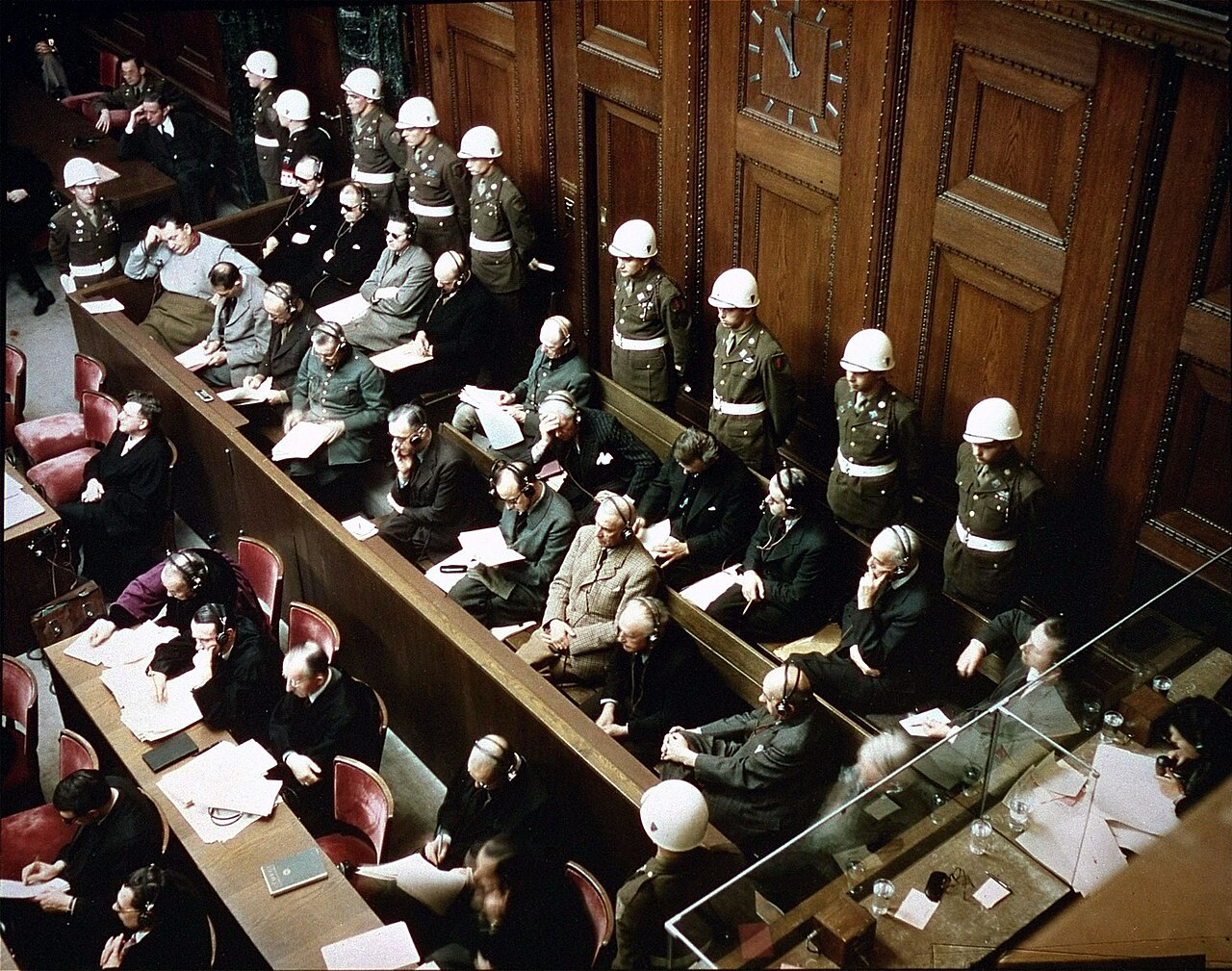
After Nazi Germany invaded multiple European nations between 1939 and 1945—causing 27 million deaths in the Soviet Union alone—the Allies debated how to handle the defeated regime's leaders. The Soviet Union wanted a show trial with a predetermined outcome, while the United Kingdom preferred summary executions. In mid-1945, France, the Soviet Union, the UK, and the US finally agreed to create a joint tribunal in Nuremberg, occupied Germany, using the Nuremberg Charter as its legal foundation. From November 20, 1945, to October 1, 1946, the International Military Tribunal (IMT) prosecuted 22 of the most senior surviving Nazi figures from political, military, and economic sectors, along with six German organizations. The trial aimed not only to convict the accused but also to compile undeniable proof of Nazi war crimes, educate defeated Germans about what had happened, and undermine the traditional German elite.
The IMT's verdict labeled the crime of planning and waging aggressive war as "the supreme international crime," arguing it contained all other evils. Most defendants also faced charges for war crimes and crimes against humanity, with the Holocaust receiving major attention during the proceedings. The United States later conducted twelve additional trials focused on lower-level perpetrators and the Holocaust. Although controversial at the time for applying retroactive charges of aggression, the trials established the principle that individuals could be held accountable for breaking international law—a milestone widely seen as the true beginning of international criminal law.
The idea for an international court first emerged in early 1942, when nine governments-in-exile from German-occupied Europe demanded one to try German crimes. The US and UK rejected this, citing failed war crimes prosecutions after World War I. The United Nations War Crimes Commission, based in London and excluding the Soviet Union, met in October 1943 but struggled over its scope; some jurists pushed for a broader definition that included "the crime of war." On November 1, 1943, the Soviet Union, UK, and US issued the Moscow Declaration, vowing to pursue Nazi leaders "to the uttermost ends of the earth" and stating that high-ranking Nazis who committed crimes in multiple countries would be tried jointly, while others would face justice where their crimes occurred.
Quick Facts
- Start Date
- 20 November 1945
- Date Decided
- 1 October 1946
- Indictment
- Conspiracy · crimes against peace · war crimes · crimes against humanity
- Transcripts
- https: · nuremberg.law.harvard.edu · Harvard Law School / https: · avalon.law.yale.edu/subject_menus/imt.asp · Yale Law School
- Defendant
- 24 (see list)
- Witnesses
- 37 prosecution, 83 defense
- Related Actions
- Subsequent Nuremberg trials · International Military Tribunal for the Far East
- Italic Title
- no
Facts from the source article.
Lore & Background
Between 1939 and 1945, Nazi Germany invaded many countries across Europe, inflicting 27 million deaths in the Soviet Union alone. Proposals for how to punish the defeated Nazi leaders ranged from a show trial (the Soviet Union) to summary executions (the United Kingdom). In mid-1945, France, the Soviet Union, the United Kingdom, and the United States agreed to convene a joint tribunal in Nuremberg, with the Nuremberg Charter as its legal instrument. The purpose of the trial was not only to try the defendants but also to assemble irrefutable evidence of Nazi war crimes, offer a history lesson to the defeated Germans, and delegitimize the traditional German elite.
Reader's Guide
The Nuremberg trials mark a pivotal moment in international law. The IMT verdict declared the crime of plotting and waging aggressive war 'the supreme international crime' because 'it contains within itself the accumulated evil of the whole'. Most defendants were also charged with war crimes and crimes against humanity, with the Holocaust being a major focus. Controversial at the time for their retroactive criminalization of aggression, the trials' innovation of holding individuals responsible for violations of international law is considered 'the true beginning of international criminal law'. Twelve further trials were conducted by the United States against lower-level perpetrators, focusing more on the Holocaust. The trials established a precedent that leaders could be held criminally liable for state-sponsored atrocities, influencing subsequent international tribunals and the development of human rights law.
Did You Know?
- The IMT tried 22 of the most important surviving leaders of Nazi Germany and six German organizations.
- The Soviet Union initially wanted a show trial, while the United Kingdom preferred summary executions.
The Allied Fracture Over Justice
The four victorious powers entered the postwar period with fundamentally incompatible visions of how to deal with Nazi leadership. The Soviet Union, reeling from 27 million dead—roughly a seventh of its prewar population—pushed hardest for a predetermined verdict, modeling its approach on the 1930s Moscow show trials. Its goal was twofold: publicly demonstrate the guilt of German leaders and build a legal foundation for war reparations to rebuild a devastated economy. The United Kingdom, scarred by what it saw as the failure of post–World War I prosecutions, leaned toward simply executing the top Nazis without a trial. The United States, by contrast, wanted a proceeding perceived as legitimate, one that could promote German reform and showcase the superiority of Western legal institutions. France joined the coalition, and by mid-1945 the four powers agreed on a joint tribunal in occupied Germany. The form of retribution remained unresolved even at the Yalta Conference in February 1945, and it was not until Truman announced the formation of an international military tribunal at the San Francisco Conference on 2 May that the path forward crystallized.
Forging New Legal Ground
The legal architecture of the Nuremberg proceedings required filling gaps that no existing statute had addressed. War crimes already existed in international law, but those rules did not cover a government's treatment of its own citizens, leaving the systematic murder of German Jews without a clear legal hook. Soviet jurist Aron Trainin had developed the concept of crimes against peace—the waging of aggressive war—which would become central to the proceedings and was widely adopted after his ideas were reprinted in Western publications. At the London Conference from 26 June to 2 August 1945, negotiators debated whether aggressive war was already prohibited under customary international law; in reality, no law existed that imposed criminal responsibility for aggression. American Supreme Court justice Robert H. Jackson threatened U.S. withdrawal if aggression was not prosecuted, since it had been the very rationale for American entry into the war. He ultimately conceded on the precise definition of crimes against peace, as the other three Allies feared it would undermine the Security Council's freedom of action. The final charter encompassed three categories: crimes against peace, crimes against humanity, and war crimes.
A Tribunal With Multiple Purposes
The International Military Tribunal, sitting between 20 November 1945 and 1 October 1946, was never merely a courtroom exercise. Its stated purposes extended well beyond convicting the 22 surviving top leaders in political, military, and economic spheres, along with six German organizations. The tribunal was designed to assemble an irrefutable evidentiary record of Nazi war crimes, to deliver what amounted to a history lesson to the defeated German population, and to delegitimize the traditional German elite that had underpinned the Nazi state. The verdict echoed the prosecution in declaring the crime of plotting and waging aggressive war 'the supreme international crime' because it 'contains within itself the accumulated evil of the whole.' Beyond the IMT, the United States conducted twelve additional trials against lower-level perpetrators, with a sharper focus on the Holocaust. The legal reckoning was premised on what observers perceived as the extraordinary and singular nature of Nazi criminality, particularly the systematic murder of millions of Jews.
Seeds of International Criminal Law
At the time, the Nuremberg proceedings were controversial, largely because they retroactively criminalized the act of waging aggressive war—a charge for which no prior statute existed. Yet the trials' most enduring innovation was the principle of holding individual human beings accountable for violations of international law, a concept with no clear precedent in the existing legal order. This shift is widely regarded as 'the true beginning of international criminal law.' The groundwork had been laid earlier: in early 1942, representatives of nine governments-in-exile from German-occupied Europe issued a declaration demanding an international court, though the United States and United Kingdom initially refused to endorse it, citing the failure of post–World War I prosecutions. The London-based United Nations War Crimes Commission first met in October 1943, though it became mired in disputes over the scope of its mandate, with Belgian and Czech legal scholars arguing for a broader definition. The Moscow Declaration of 1 November 1943, issued jointly by the Soviet Union, United Kingdom, and United States, warned Nazi leadership that the signatories would 'pursue them to the uttermost ends of the earth.' These incremental steps charted the evolution from abstract demand to concrete legal mechanism.
Gallery
Frequently Asked Questions
What were the Nuremberg trials?
The Nuremberg trials were international court proceedings in which the four Allied powers—France, the Soviet Union, the United Kingdom, and the United States—prosecuted senior Nazi officials and organizations for aggression, war crimes, and crimes against humanity. The main International Military Tribunal sat from November 20, 1945, to October 1, 1946, trying 22 individual defendants and six organizations.
Who conducted the Nuremberg trials?
France, the Soviet Union, the United Kingdom, and the United States jointly established and staffed the International Military Tribunal, each nation appointing a judge and a prosecutor. The entire proceeding operated under the Nuremberg Charter, the legal framework the four powers agreed upon in mid-1945.
Why was Nuremberg chosen as the trial location?
Nuremberg had previously hosted major Nazi Party rallies, giving the venue strong symbolic weight, and its large palace of justice was one of the few significant court buildings in Germany that survived the war largely intact. The city also lay in the American occupation zone, which simplified logistics for the multinational tribunal.
What crimes were prosecuted at the Nuremberg trials?
The IMT charged four categories of offenses: crimes against peace (planning and waging aggressive war), war crimes, crimes against humanity, and conspiracy to commit those acts. The 22 individual defendants and six organizations—including the SS, the Gestapo, and the Nazi leadership council—were indicted under these headings.
What was the outcome of the Nuremberg trials?
Of the 22 individuals tried, 12 received death sentences, three were given life imprisonment, four got fixed prison terms, and three were acquitted. The six organizations were formally declared criminal, and the proceedings concluded with final verdicts on October 1, 1946.
More in International And Comparative Law 1-20
Spotted an error? Know more?
Reader corrections go straight into our review queue. Suggest an edit · How this site is sourced