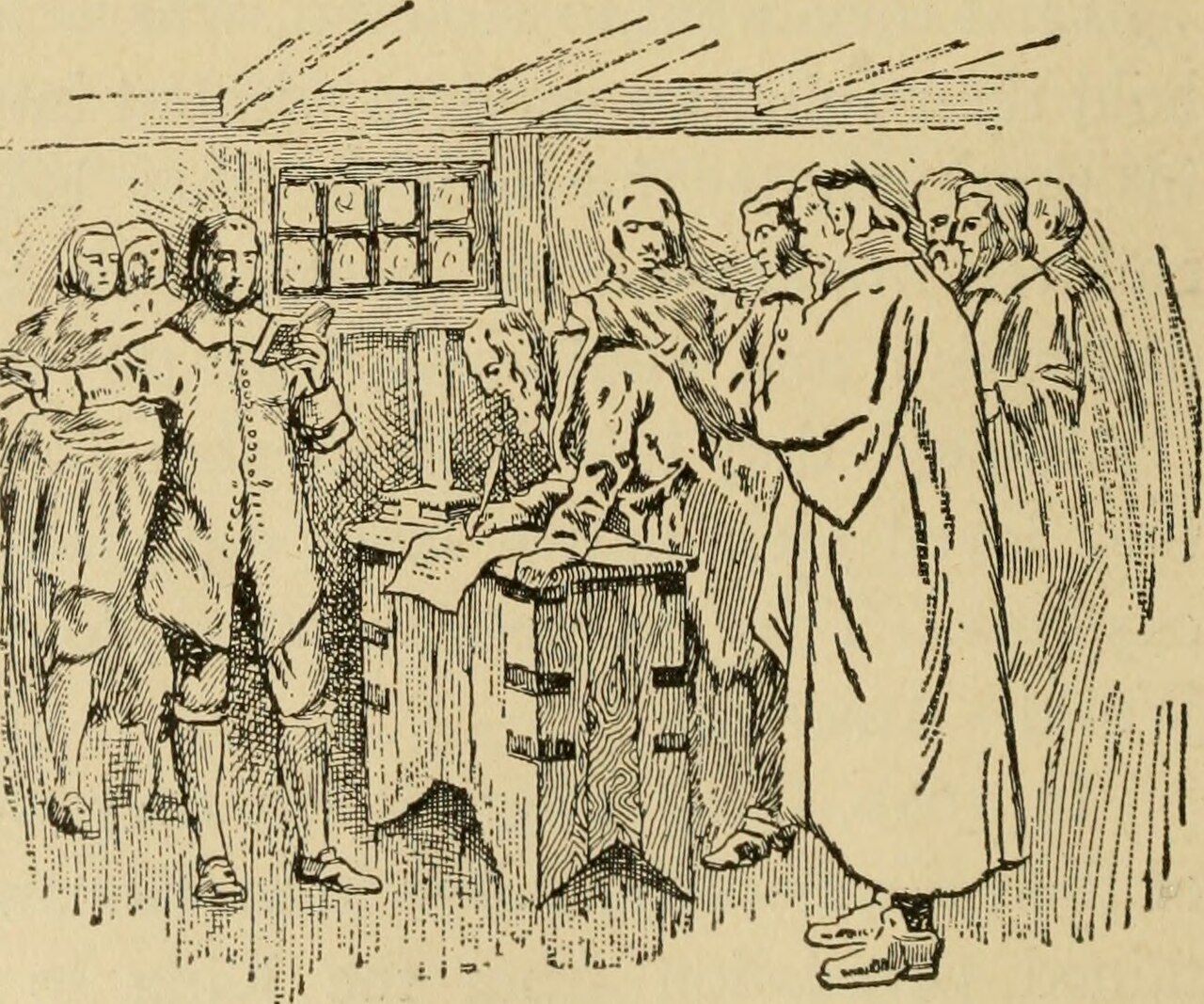
Mayflower Compact
First governing document of Plymouth Colony, signed aboard the Mayflower.

Internet Archive Book Images · CC0
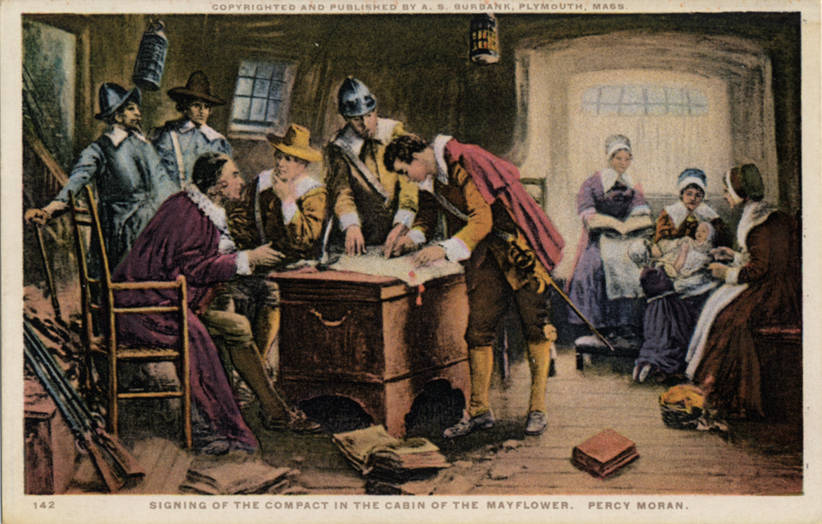
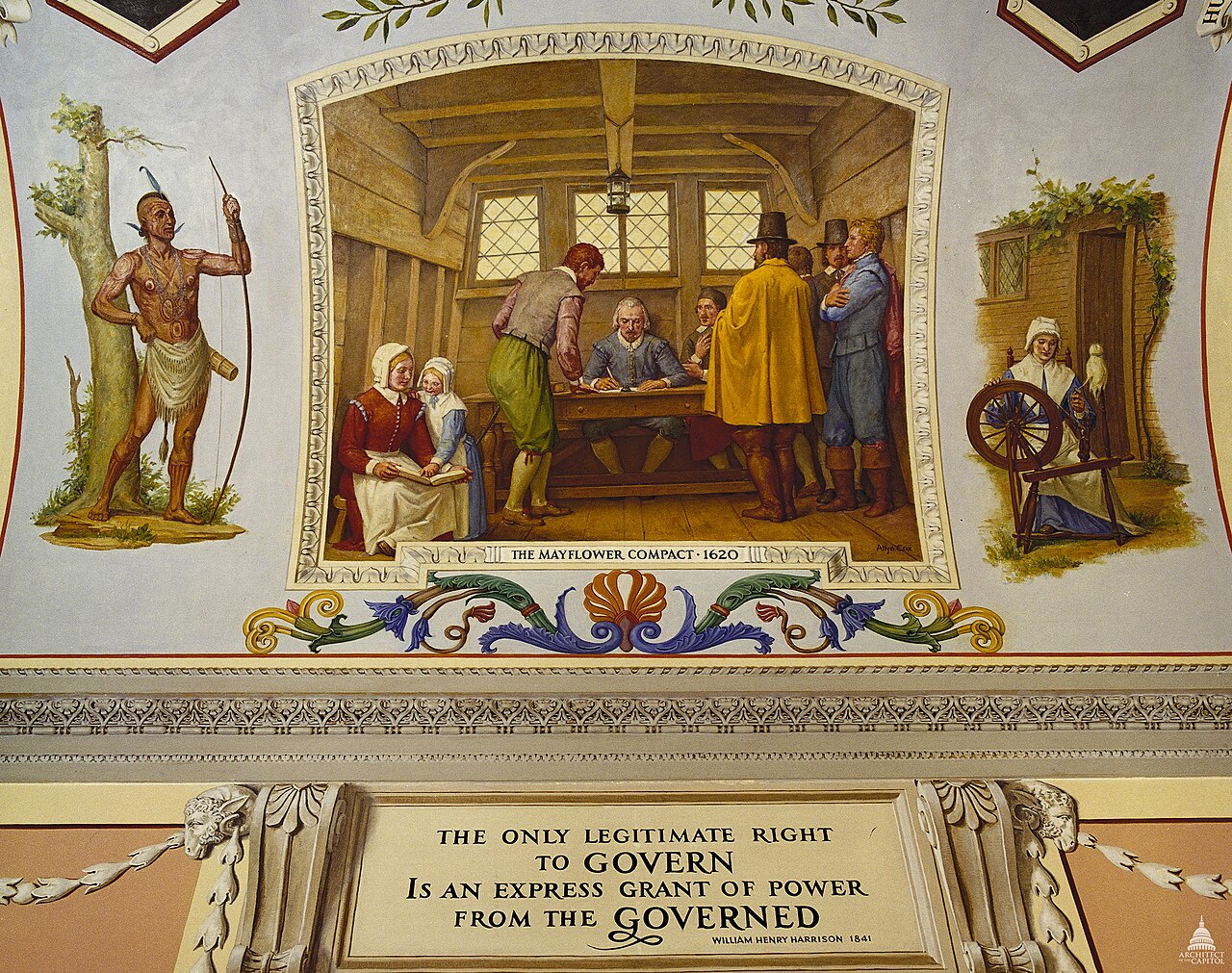
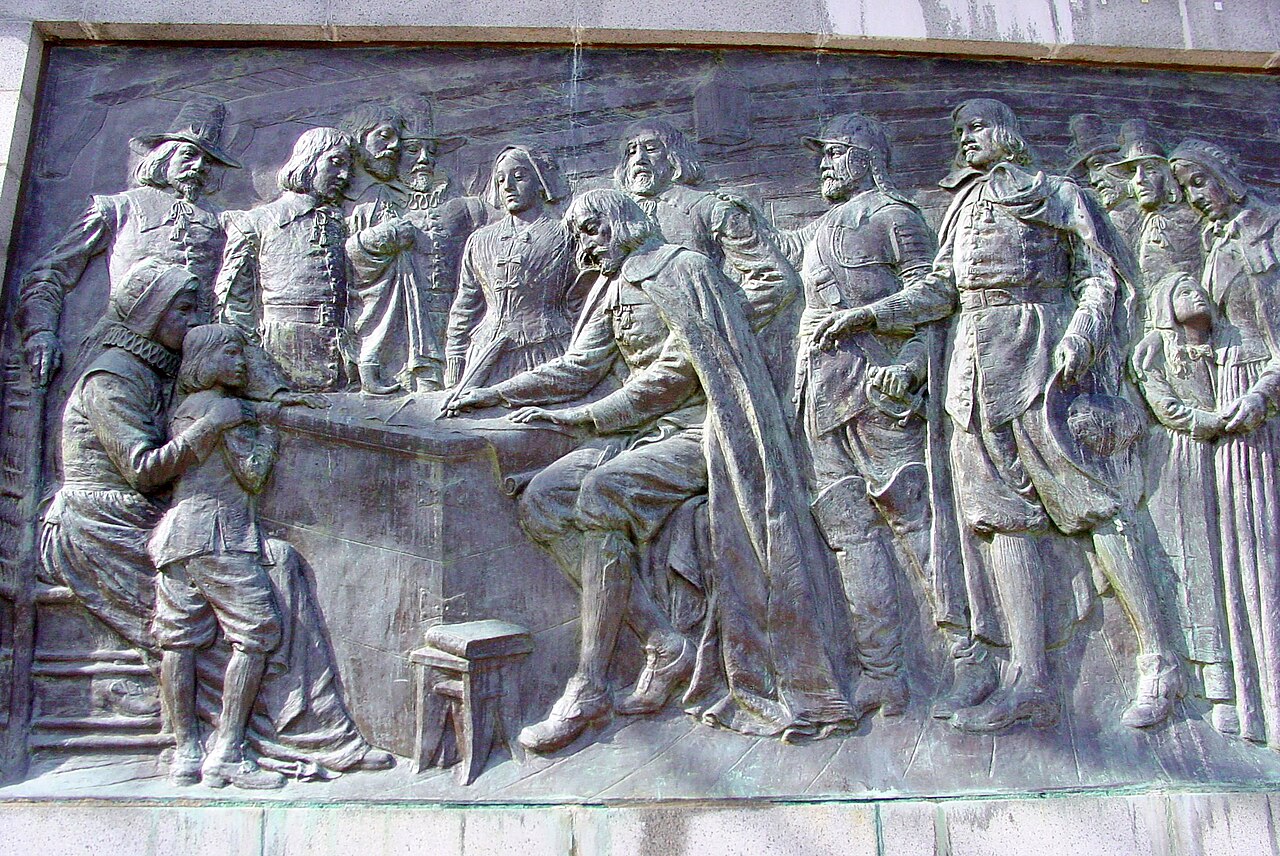
The Mayflower Compact, first called the Agreement Between the Settlers of New Plymouth, served as Plymouth Colony’s earliest governing document. Drafted by the men on the Mayflower—a group that included Separatist Puritans, adventurers, and tradesmen—the compact included a pledge of loyalty to the king. However, the Puritans and other Protestant Separatists were unhappy with the Church of England, the limited scope of the English Reformation, and King James I’s unwillingness to push for further reforms. The document was signed on November 21 (Old Style November 11), 1620, while the ship was anchored in Provincetown Harbor, inside the hook at Cape Cod’s northern tip. Forty-one of the 101 passengers signed it.
Quick Facts
- Document Name
- Mayflower Compact
- Title Orig
- Agreement Between the Settlers of New Plymouth
- Date Repeal
- First repealed in 1686, reinstated in 1689, and repealed again in 1691
- Signers
- List of signatories
Facts from the source article.
Lore & Background
The Pilgrims had originally hoped to reach America in early October using two ships, but delays and complications meant they could use only one, the Mayflower. Their intended destination had been the Colony of Virginia, with the journey financed by the Company of Merchant Adventurers of London. Storms forced them to anchor at the hook of Cape Cod in Massachusetts, however, as it was unwise to continue with provisions running short. This inspired some of the non-Puritan passengers (whom the Puritans referred to as 'Strangers') to proclaim that they 'would use their own liberty; for none had power to command them' since they would not be settling in the agreed-upon Virginia territory. To prevent this, the Pilgrims determined to establish their own government, while still affirming their allegiance to the Crown of England. Thus, the Mayflower Compact was based simultaneously upon a majoritarian model and the settlers' allegiance to the king. It was in essence a social contract in which the settlers consented to follow the community's rules and regulations for the sake of order and survival.
Reader's Guide
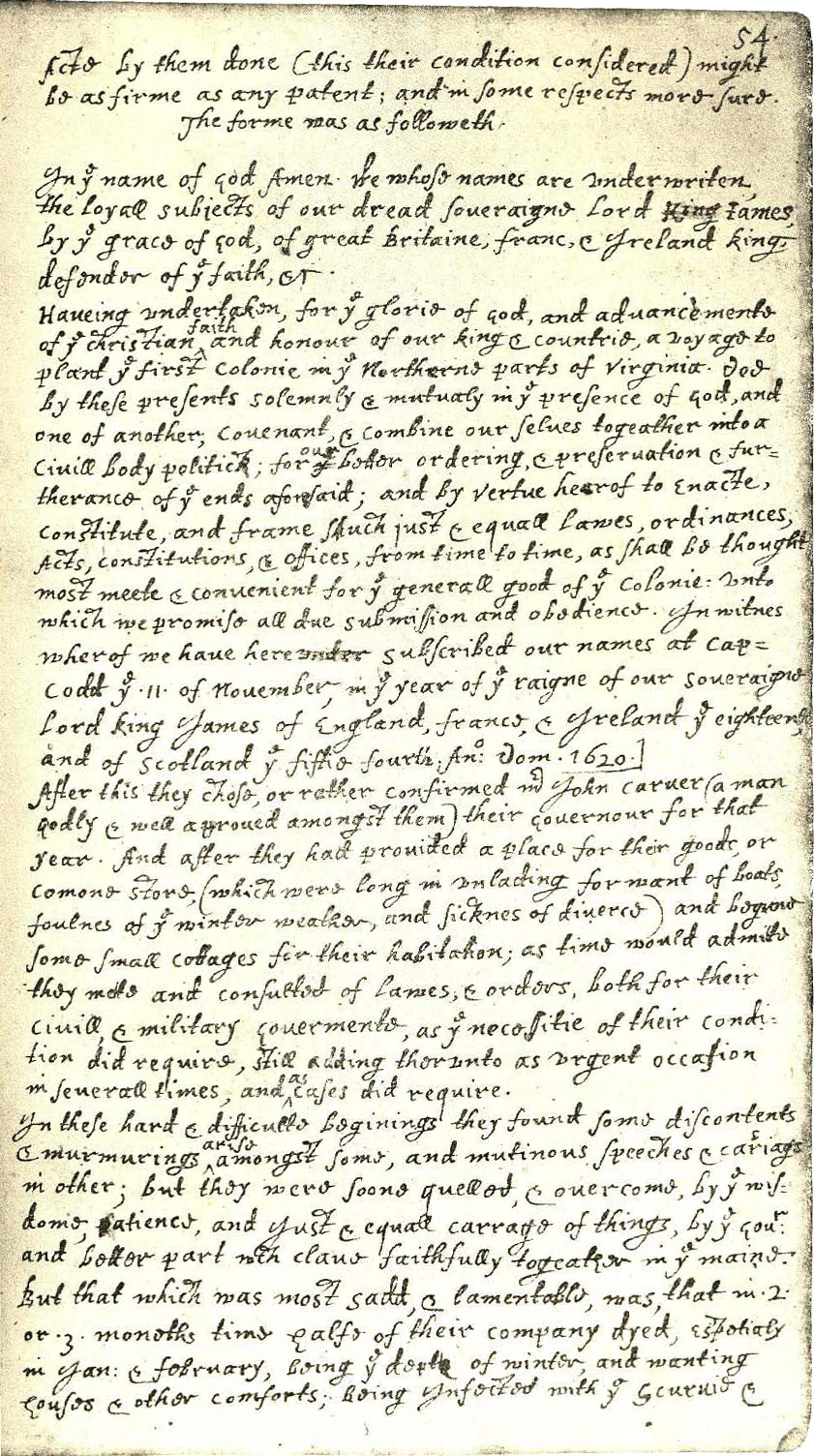
The Mayflower Compact is significant as the first governing document of Plymouth Colony, establishing a framework for self-government based on majority rule and allegiance to the English Crown. It was a response to the threat of disorder when some passengers declared they would follow no authority outside Virginia. The compact reflected the Pilgrims' experience with church covenants in Leiden, as historian Nathaniel Philbrick noted: 'Just as a spiritual covenant had marked the beginning of their congregation in Leiden, a civil covenant would provide the basis for a secular government in America.' The original document has been lost, but three 17th-century versions survive, including one in William Bradford's handwritten journal kept at the State Library of Massachusetts. The list of 41 signers comes solely from Bradford's nephew Nathaniel Morton's 1669 work, and the order of names may not reflect the original arrangement. The compact's legacy was noted by Massachusetts governor Calvin Coolidge at a 1920 commemoration ceremony for the 300th anniversary of the Mayflower landing.
Did You Know?
- The Mayflower Compact was signed by 41 of the ship's 101 passengers.
- The original document has been lost; three 17th-century versions exist, including one handwritten by William Bradford.
- One signer, Stephen Hopkins, had previously been convicted of mutiny and sentenced to death after the shipwreck of the Sea Venture, but was pardoned.
- The compact was signed while the Mayflower was anchored in Provincetown Harbor at the northern tip of Cape Cod.
Gallery
Frequently Asked Questions
What is the Mayflower Compact?
The Mayflower Compact, originally titled the Agreement Between the Settlers of New Plymouth, was the first governing document of Plymouth Colony. It was drafted and signed aboard the Mayflower in November 1620 by the ship's adult male passengers, a mixed group of Separatist Puritans, adventurers, and tradesmen.
What legal role did the Mayflower Compact play?
It functioned as Plymouth Colony's earliest framework for self-governance, establishing a collective pledge among the signers to form a body politic and enact laws for the general good. Notably, it also contained an explicit declaration of loyalty to the English crown, balancing colonial autonomy with feudal obligation.
Who signed the Mayflower Compact?
The document was drafted and signed by the adult male passengers aboard the Mayflower, a mixed group of Separatist Puritans, merchants, and skilled tradesmen. It was not a universal vote by all aboard but a compact among those willing to commit to shared governance at that moment.
Why is the Mayflower Compact important in comparative law?
Scholars frequently cite it as an early practical example of a social contract—governance derived from the consent of the governed rather than solely from a royal charter. In comparative-law discussions it is often placed alongside other foundational colonial and revolutionary texts to trace how consent-based governance evolved within the Anglo-American tradition.
What happened to the Mayflower Compact after it was signed?
The compact served as the operative governing agreement for Plymouth Colony's earliest years, guiding the settlers' collective decisions until more formal colonial structures took shape. The original parchment was lost over time, and what survives are transcriptions made by later historians, most notably recorded in William Bradford's journal.
More in International And Comparative Law 1-20
Spotted an error? Know more?
Reader corrections go straight into our review queue. Suggest an edit · How this site is sourced