Neutral country
A sovereign state that refrains from joining warring sides.

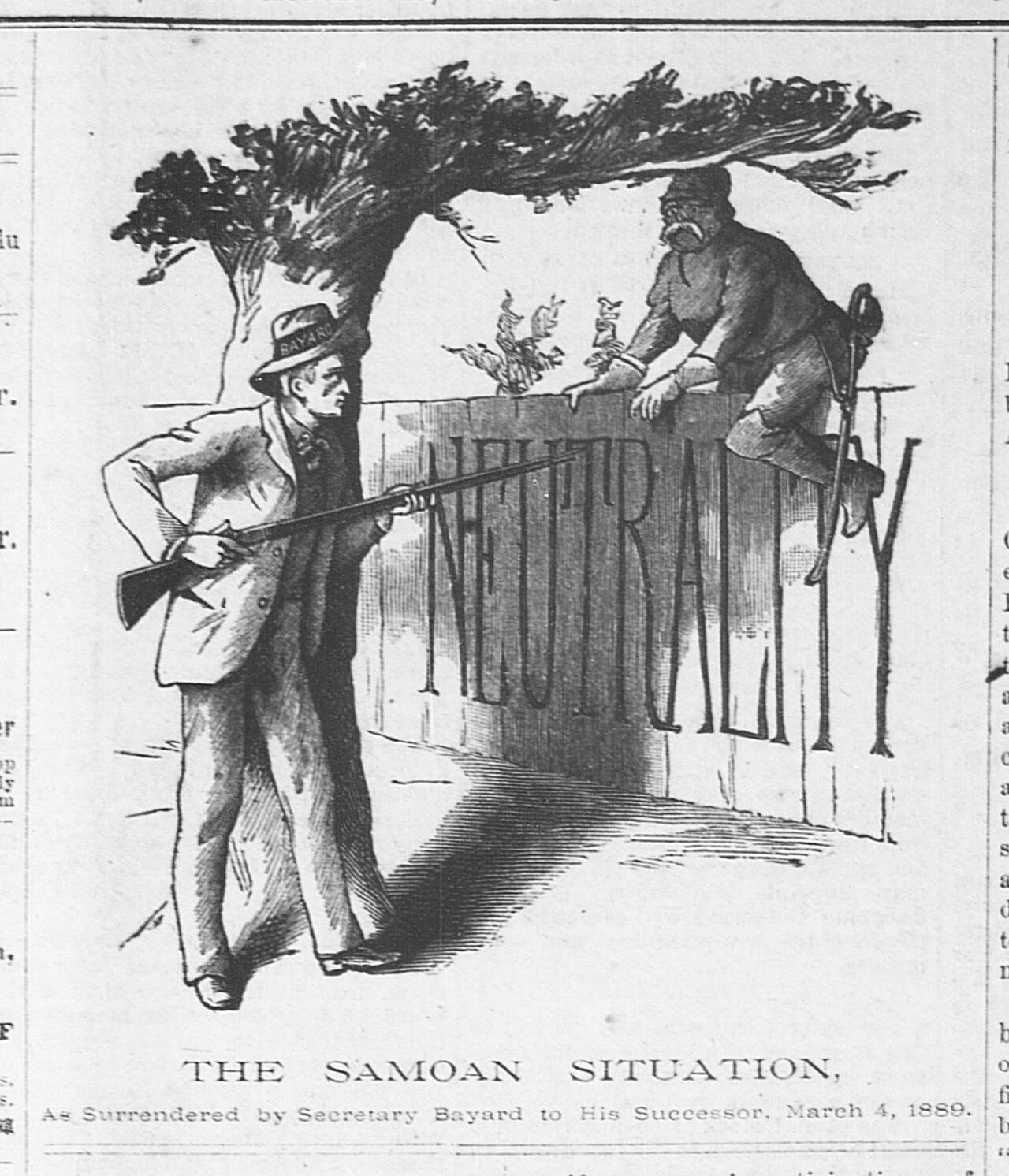
The Hawaiian Gazette (newspaper), April 2, 1889, Image 1 · Public domain
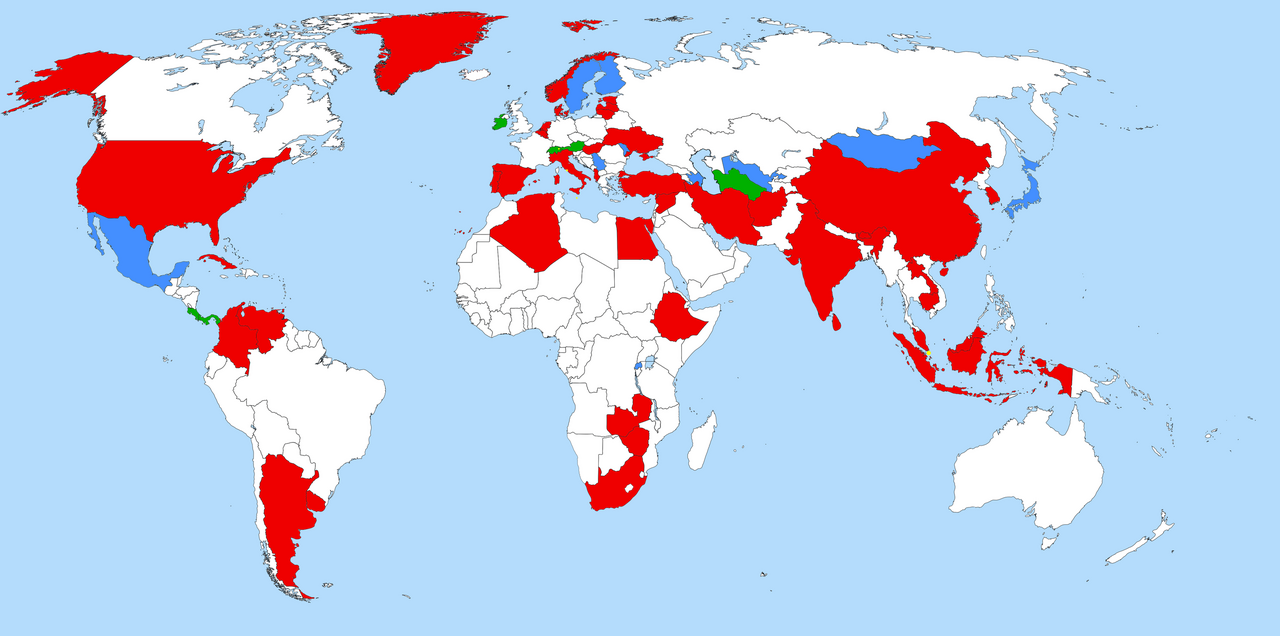
A neutral country is a sovereign state that refrains from joining either side of a specific war or holds itself as permanently neutral in all future conflicts, including avoiding military alliances such as NATO, CSTO, or the SCO. Protection under the law of war from belligerent actions is based on non-combatant status, not nationality. Different countries interpret neutrality differently: some, like Costa Rica, have demilitarized, while Switzerland practices armed neutrality, maintaining a sizeable military but barring itself from foreign deployment. Not all neutral countries avoid foreign deployment or alliances; Austria and Ireland, for example, participate in UN peacekeeping and are part of the European Union.
- Key examples
- Switzerland, Austria, Costa Rica, Ireland
- Notable change
- Finland ended neutrality to join NATO in 2023; Sweden ended its neutrality policy in 2009 and joined NATO in 2024
Lore & Background
The concept of neutrality has evolved over centuries. A neutral country in a particular war is a sovereign state that refrains from joining either side and adheres to the Law of Neutrality under international law. The rights and duties of a neutral power are defined in the Hague Convention of 1907. A permanently neutral power, such as Switzerland, is bound by international treaty or its own declaration to be neutral toward belligerents of all future wars. Neutralism, or a neutralist policy, is a foreign policy position wherein a state intends to remain neutral in future wars, while armed neutrality involves reserving the right to become a belligerent if attacked.
Reader's Guide
Neutrality functions as a mechanism that counteracts the division of the international system into two opposing blocs, such as the Capitalist–Communist divide of the Cold War. It helps maintain an environment of multiple sovereign equals rather than a polarized structure. The interpretation of neutral conduct has changed considerably over time. For example, Sweden's traditional policy of non-participation in military alliances shifted during the Winter War to non-belligerence, and it upheld neutrality until the 2022 Russian invasion of Ukraine, after which Finland and Sweden applied to join NATO. Switzerland and Sweden are famed for their armed neutralities, maintained through both World Wars. Neutrality can be recognized through bilateral or multilateral treaties or UN declarations, and some countries codify it in their constitutions, while others, like Sweden, lack formal codification, allowing more flexibility.
Did You Know?
- A neutral power must intern belligerent troops who reach its territory, as well as escaped prisoners of war.
- Belligerent naval vessels may use neutral ports for a maximum of 24 hours, with exceptions for repairs or if an opposing vessel is already in port.
- Switzerland has not been in a state of war internationally since 1815; Sweden ended its neutrality policy in 2009 and joined NATO in 2024.
- Finland became the 31st member of NATO on 4 April 2023, and Sweden the 32nd member on 7 March 2024.
Origins: A Border Left Deliberately Blank
When the British brokered the Uqair Convention on 2 December 1922 to draw a border between Kuwait and the emerging state of Najd, they deliberately left a stretch of barren desert undefined. This roughly 5,770-square-kilometre strip, later called the Divided Zone, was carved out as a practical compromise. Historian Daniel Yergin notes that the Bedouin tribes roamed freely across what would become an international boundary, and for them the very notion of nationality remained vague. Rather than force a hard line through their grazing routes, the British agreed that both Kuwait and the Government of Najd would hold equal, undivided rights over the territory until a future arrangement could be negotiated under British mediation. The convention's language was deliberately open-ended, promising that a further agreement would eventually be reached. In practice, however, neither side pressed for a definitive settlement for decades. The zone simply existed in a legal limbo—shared, unmarked, and largely ignored—until the ground beneath it revealed its true value.
The Oil Gamble and the Wafra Discovery
The 1938 discovery of oil in Kuwait's Burgan field transformed the Neutral Zone from a forgotten desert strip into a prize worth fighting over. Kuwait moved first, granting a concession to the American Independent Oil Company in July 1948, with former wartime petroleum administrator Ralph Davies handling the negotiations. The following year, Saudi Arabia awarded its half to Pacific Western Oil Corporation, brokered by geologist Paul T. Walton in a Cairo hotel meeting with King Ibn Saud. The two firms then joined forces, signing a joint exploration agreement in June 1949. Their mobile headquarters was a converted World War II landing ship, the LST 1014, rechristened MV Aminoil and loaded with 3,000 tonnes of equipment at a cost of two million dollars. She sailed through the Suez Canal and arrived in the Gulf in late November 1949. The early drilling campaign was punishing: five wildcat wells between 1949 and 1952 all came up dry, burning through thirty million dollars. Then Wafra No. 4, spudded in February 1953, hit oil at 3,470 feet in March. By January 1954, the first cargo of 92,000 barrels was loaded aboard the Tsuruoki Maru and shipped to a refinery in Yokkaichi, Japan.
Partition: Drawing a Line After the Gold Rush
Once the oil flowed, the question of who owned the ground beneath it could no longer be deferred. In October 1960, the rulers of Kuwait and Saudi Arabia met and agreed that the shared zone should finally be split. The formal partition agreement was signed on 7 July 1965 and took effect on 25 July 1966. A separate demarcation treaty, fixing the exact boundary line, was signed on 17 December 1967, but the process dragged on: the exchange of ratification instruments did not occur until 18 December 1969 in Kuwait, with formal ratification following on 18 January 1970 and publication in the Kuwaiti Official Gazette on 25 January of that year. Because the zone was dissolved before the ISO 3166 country-code system was adopted in 1974, it never received an official international identifier. Yet in the oil trade, it had long been treated as its own entity—listed separately in industry journals, with its own production figures and shipping statistics. The bureaucratic tail of the partition stretched nearly a decade from the initial 1960 decision to final legal publication, a reminder that even in the desert, drawing a line on paper takes time.
Legacy: Pipelines, War, and a Half-Century of Pumping
Although the Neutral Zone was formally partitioned in the late 1960s, its story did not end with a boundary line. In 1991, Iraqi forces briefly overran the area during their invasion of Kuwait, but a Coalition of American and Saudi troops quickly repelled the offensive and restored control. More enduringly, the zone's oil infrastructure kept running on the strength of old agreements. The Aminoil joint venture, born from the 1948 and 1949 concessions, saw Saudi Arabia sign a new deal with the Japanese-owned Arabian Oil Company in 1957 and Kuwait follow in 1958. That concession eventually expired in 2000, and the company had made its first offshore discovery back in January 1960. The physical infrastructure built in the 1950s and 1960s—the 34-mile pipeline to the Mena Abdulla terminal, the 30,000-barrel-per-day topping plant completed by 1958, and the 32-mile 24-inch loop line finished in 1961—remained in service for decades. Even half a century after the partition, oil continues to be pumped from the former Neutral Zone under the terms of those original cooperative agreements, a living thread connecting the 1950s to the present.
Gallery




Frequently Asked Questions
What is a neutral country in international law?
A neutral country is a sovereign state that deliberately chooses not to take sides in a particular armed conflict or commits itself to staying out of all future wars. This status means the state avoids military pacts like NATO or the CSTO and does not participate in hostilities.
What are the most well-known examples of neutral countries?
Switzerland and Austria are the classic examples of states that have maintained neutrality for decades, while Costa Rica has gone further by abolishing its standing army entirely. Ireland also traditionally adheres to a policy of non-alignment in military matters.
How does armed neutrality differ from a demilitarized approach?
Armed neutrality, as practiced by Switzerland, means a country keeps a substantial military force but pledges never to deploy it abroad or join foreign coalitions. In contrast, demilitarized neutrality, seen in Costa Rica, involves dismantling or severely limiting the armed forces altogether.
Can a country abandon its neutral status?
Yes, neutrality is a political choice rather than a permanent constitutional lock, and states have shifted their alignment over time. Finland, for instance, dropped its long-standing neutrality to join NATO in 2023, while Sweden ended its neutrality policy in 2009 and formally entered the alliance in 2024.
What legal protections does neutrality grant a state under the law of war?
A recognized neutral state is shielded from belligerent attacks and occupation because it has not taken up arms against any warring party. However, this protection rests on the state's non-combatant posture rather than on the nationality of its citizens, who individually may still be treated as combatants if they fight.
More in International And Comparative Law 1-20
Spotted an error? Know more?
Reader corrections go straight into our review queue. Suggest an edit · How this site is sourced