Nuremberg principles
Guidelines for defining crimes against peace, war crimes, and crimes against humanity.

Work of the United States Government · Public domain
The Nuremberg principles are a set of guidelines that define crimes against peace, war crimes, and crimes against humanity. They were first recognized in the Charter of the Nuremberg Tribunal (1945) and affirmed by the United Nations General Assembly in 1946 (Resolution 95(I)). The International Law Commission later formulated them in 1950 to codify the legal ideas that came out of the Nuremberg Trials, which prosecuted members of the Nazi party after World War II.
**The principles**
**Principle I** Anyone who does something that is a crime under international law is responsible for it and can be punished.
**Principle II** If a country’s own laws do not punish an act that is a crime under international law, that does not let the person who did it off the hook under international law.
**Principle III** Being a head of state or a high-ranking government official does not excuse someone from responsibility under international law for committing a crime under it.
**Principle IV** Following orders from a government or a superior does not excuse someone from responsibility under international law, as long as they actually had a moral choice. This idea is often summed up as: “It is not an acceptable excuse to say ‘I was just following my superior’s orders.’” Before the Nuremberg Trials, this excuse was commonly called “superior orders.” After those trials, many people started calling it the “Nuremberg Defense.” More recently, some use the term “lawful orders.” All three terms are still used today, each with slightly different shades of meaning depending on the situation. This principle is backed by legal reasoning found in certain articles of the Universal Declaration of Human Rights that touch on conscientious objection. It is also supported by ideas in paragraph 171 of the UNHCR’s Handbook on Procedures and Criteria for Determining Refugee Status, which covers when conscientious objectors can seek refugee status in another country if they face persecution at home for refusing to take part in an illegal war.
**Principle V** Anyone charged with a crime under international law has the right to a fair trial on the facts and the law.
- Field
- International law
- Known for
- Codifying legal principles underlying the Nuremberg Trials
- Created by
- International Law Commission of the United Nations (formulated in 1950, based on the Charter of the Nuremberg Tribunal and affirmed by the UN General Assembly in 1946)
- Principles count
- 7
Lore & Background
The Nuremberg principles were developed by UN organs under the limited mandate of Article 13 in Chapter IV of the United Nations Charter, which obliges the General Assembly to initiate studies and make recommendations encouraging the progressive development of international law. In 1947, under UN General Assembly Resolution 177 (II), the International Law Commission was directed to formulate the principles of international law recognized in the Charter of the Nuremberg Tribunal and in the judgment of the Tribunal. The Commission concluded that since the Nuremberg Principles had been affirmed by the General Assembly, its task was merely to formulate them, not to express appreciation of them as principles of international law.
Reader's Guide
The Nuremberg principles establish that any person who commits an act constituting a crime under international law is responsible and liable to punishment, regardless of internal law, official position, or superior orders. Principle IV, which rejects the 'superior orders' defense, is legally supported by certain articles in the Universal Declaration of Human Rights dealing with conscientious objection and by principles in the UNHCR Handbook on refugee status for conscientious objectors. The principles' power is limited because the UN was not given legislative power to enact binding rules of international law; instead, the principles were developed under the General Assembly's powers of study and recommendation. The 1998 Rome Statute of the International Criminal Court addresses superior orders in Article 33, which some interpret as allowing the defense for war crimes under certain conditions, though this interpretation is debated. The principles remain foundational to modern international criminal law, though their status as customary international law depends on state practice and international conviction.
Did You Know?
- Principle IV can be traced back to the rejection of the 'superior orders' defense after the Nuremberg Trials, but it also includes the crucial caveat that a moral choice must have been possible.
- The Nuremberg Principles were first established in the Charter of the Nuremberg Tribunal in 1945, not by the International Law Commission, which only formulated them in 1950.
- Principle VI explicitly lists three categories of crimes: crimes against peace, war crimes, and crimes against humanity—not just war crimes.
The Clash of Allied Visions
After the devastation of World War II, the four victorious powers could not agree on how to deal with Nazi leadership. The Soviet Union, having suffered 27 million dead—roughly a seventh of its prewar population—pushed for a predetermined show trial reminiscent of the 1930s Moscow proceedings, aiming to extract war reparations and publicly demonstrate German guilt. Britain, still haunted by the perceived failures of post-World War I prosecutions, leaned toward simply executing the top leaders without a formal trial. The United States, by contrast, wanted a proceeding that would be perceived as legitimate, serving both to reform Germany and to showcase the superiority of Western legal institutions. These conflicting aims remained unresolved even at the Yalta Conference in February 1945. It was not until the London Conference from late June to early August 1945 that France, the Soviet Union, Britain, and the United States finally hammered out a workable framework, though until the very end of those negotiations, it remained uncertain whether any tribunal would materialize at all.
Forging New Legal Categories
The Nuremberg Charter represented a radical departure from existing international law. While war crimes had long been recognized as violations of the laws and customs of war, those rules did not reach a government's treatment of its own citizens—making the systematic murder of German Jews legally awkward to prosecute. The concept of crimes against peace, or waging aggressive war, was largely the intellectual contribution of Soviet jurist Aron Trainin, whose ideas were reprinted in Western publications and widely adopted. At the London Conference, American negotiator and Supreme Court Justice Robert H. Jackson threatened to withdraw the United States entirely if aggression could not be prosecuted, since it had been the very rationale for American entry into the war. He ultimately conceded on the precise definition of crimes against peace, as the other three Allies feared it would undermine the Security Council's freedom of action. The result was a legal instrument that criminalized conduct for which no prior statute had existed, a move that drew sharp criticism for its retroactive character.
The Tribunal and Its Verdict
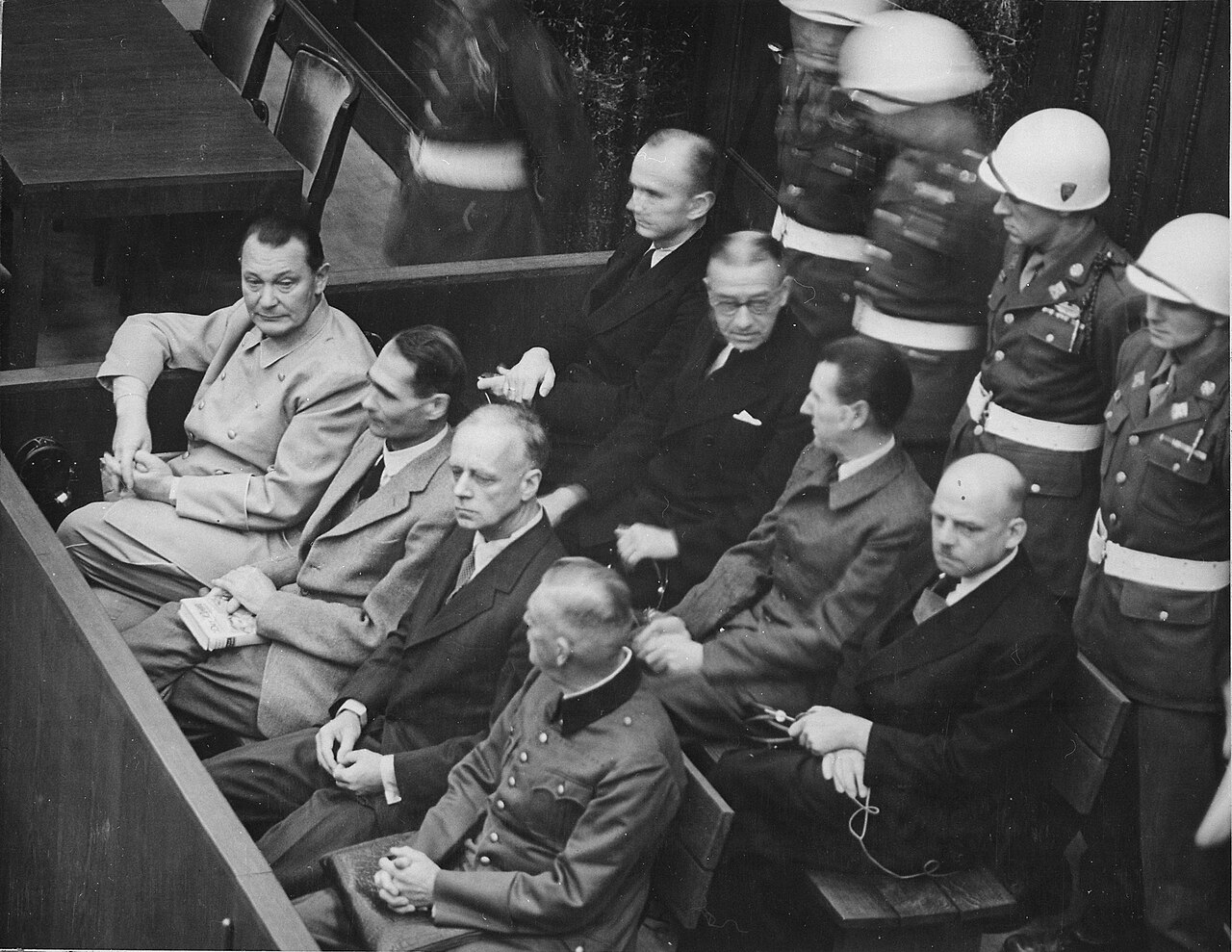
From 20 November 1945 to 1 October 1946, the International Military Tribunal sat in occupied Nuremberg, putting on trial twenty-two of the most prominent surviving Nazi figures across political, military, and economic spheres, along with six German organizations. The proceedings served purposes far beyond mere punishment: the tribunal was tasked with assembling an irrefutable evidentiary record of Nazi atrocities, delivering a history lesson to the German public, and delegitimizing the traditional German elite. The verdict echoed the prosecution in branding the planning and waging of aggressive war 'the supreme international crime' because it 'contains within itself the accumulated evil of the whole.' Most defendants faced additional charges of war crimes and crimes against humanity, with the Holocaust forming a central pillar of the case. Following the IMT, the United States conducted twelve further trials targeting lower-level perpetrators, with a sharper focus on the Holocaust itself.
Seeds of a New Legal Order
Controversial in their own era for criminalizing aggression retroactively, the Nuremberg proceedings are now widely regarded as 'the true beginning of international criminal law.' The most consequential innovation was the principle that individual human beings—rather than only states—could be held personally accountable for violations of international law. This shift emerged from a context of staggering scale: between 1939 and 1945, German armies had overrun Poland, Denmark, Norway, the Netherlands, Belgium, Luxembourg, France, Yugoslavia, Greece, and the Soviet Union, and the legal reckoning was premised on what was perceived as the singular brutality of the systematic murder of millions of Jews. Even before the war's end, governments-in-exile from nine occupied nations had called for an international court, and the 1943 Moscow Declaration had warned that Nazi leaders would be pursued 'to the uttermost ends of the earth.' The Nuremberg Charter ultimately translated those early aspirations into a functioning judicial process whose principles continue to shape international criminal justice.
Gallery
Frequently Asked Questions
What are the Nuremberg Principles?
They are a set of seven legal guidelines that spell out what counts as a crime against peace, a war crime, or a crime against humanity under international law. The UN's International Law Commission drafted them in 1950 to capture the legal reasoning that emerged from the post-World War II Nuremberg Trials.
Who created or formulated the Nuremberg Principles?
The International Law Commission of the United Nations formally wrote them out in 1950, building on the Charter of the Nuremberg Tribunal adopted in 1945. The UN General Assembly had already endorsed the core legal ideas in Resolution 95(I) back in 1946.
How many principles are there and what do they cover?
There are seven principles in total. Together they define the three major categories of international criminal conduct, affirm that individuals bear personal responsibility for such acts, and reject excuses like 'I was just following orders.'
Where do the Nuremberg Principles originate historically?
They trace directly to the 1945 Charter that set up the tribunal to try senior Nazi officials after World War II. The underlying legal concepts were affirmed by the UN General Assembly in 1946 and later codified into a structured list by the International Law Commission in 1950.
Why are the Nuremberg Principles important for international law today?
They cemented the idea that a head of state or any individual can be held personally accountable for grave violations of international law, rather than hiding behind sovereign immunity. That foundational principle went on to shape later war-crimes tribunals and the modern International Criminal Court.
More in International And Comparative Law 1-20
Spotted an error? Know more?
Reader corrections go straight into our review queue. Suggest an edit · How this site is sourced