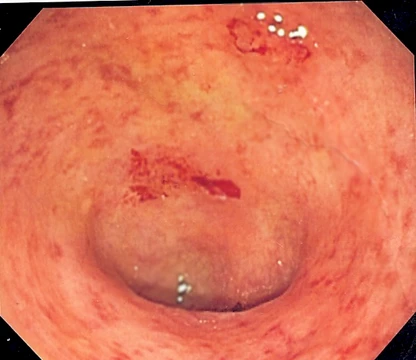
Proctitis
Inflammation of the anus and rectal lining, often from infection.
Last updated
The anus and rectal lining become inflamed in proctitis, with the inflammation limited to the final 6 inches of the rectum.[1][2] Tenesmus, described as a persistent feeling of needing to pass stool, is frequently reported, together with soreness and slight discomfort in the anal and rectal areas.[3] Discharge containing pus and blood, along with cramping and painful defecation, are indicators of more severe disease; substantial blood loss may cause anemia.[4][2]
Quick Facts
- Affected area
- Last 6 inches of the rectum
- Most common cause
- Gonorrhea (Gonococcal proctitis)
- Associated behavior
- Anal intercourse
Facts from the source article.
Key facts and history
Damage by irradiation, such as radiation therapy for cervical cancer and prostate cancer, is a known cause.[5][2] The eMedicineHealth account states that gonorrhea, syphilis, herpes, anal warts, and chlamydia are the most common sexually transmitted causes.[2] The Bronx Gastroenterology account notes that foodborne bacteria such as Salmonella and Shigella can cause proctitis, and streptococcal proctitis can occur in children with strep throat.[6] Patients with inflammatory bowel disease, such as ulcerative colitis or Crohn’s disease, are susceptible to proctitis.[6]
Anorectal trauma, in which the anal and rectal linings stretch and tear, can be a potential cause.[2] The origins of proctitis are numerous; some instances develop idiopathically, meaning they arise without a known cause or spontaneously.[5] Sexually transmitted infections such as lymphogranuloma venereum and herpes proctitis are listed among the causes.[5][2] Gluten intolerance may lead to a form of proctitis associated with celiac disease, according to research.[5]
Among men who have sex with men, a frequent trigger is anal intercourse with partners who have sexually transmitted infections.[7] The spread of lymphogranuloma venereum proctitis is promoted by the sharing of enema equipment.[7]
What the research sources say
The eMedicineHealth account reports that proctitis can last a short time or become a chronic condition lasting weeks or months or longer.[2] The same source states that herpes proctitis is accompanied by anal pain and tenderness, discharge, and constipation.[2] In herpes proctitis, the eMedicineHealth account adds that patients may also have urinary retention, a weak stream, impotence, and pain in the buttocks and thigh.[2] The Bronx Gastroenterology account notes that in patients with HIV and herpes, proctitis can be very severe.[6]
The eMedicineHealth account explains that radiation proctitis is a side effect from treatment for another illness, such as prostate cancer in men and cancers of the cervix and uterus.[2] The Bronx Gastroenterology account states that radiation proctitis may be treated with thermal therapy using sigmoidoscopy or corticosteroid enemas.[6] The eMedicineHealth account indicates that treatment depends on the cause, and because sexually transmitted disease is the most common cause, antibiotics may be given.[2]
References
- Wikipedia, "Proctitis" (CC BY-SA 4.0), which cites: "Proctitis Symptoms, Treatment, Causes & Definition", eMedicineHealth (we also read that source) en.wikipedia.org
- "Proctitis Symptoms, Treatment, Causes & Definition", eMedicineHealth. facts only, no text reused. emedicinehealth.com
- Wikipedia, "Proctitis" (CC BY-SA 4.0), which cites: "Proctitis", Bronx Gastroenterology; "Proctitis-Proctitis - Symptoms & causes - Mayo Clinic", Mayo Clinic (we also read that source) en.wikipedia.org
- Wikipedia, "Proctitis" (CC BY-SA 4.0), which cites: "Proctitis-Proctitis - Symptoms & causes - Mayo Clinic", Mayo Clinic; "Proctitis-Proctitis - Symptoms & causes - Mayo Clinic", Mayo Clinic; "Proctitis Symptoms, Treatment, Causes & Definition", eMedicineHealth (we also read that source) en.wikipedia.org
- Wikipedia, "Proctitis" (CC BY-SA 4.0), which cites: Mazzarella, "Celiac Disease", 2000, p. 163–73; Ensari, "Morphometric analysis of intestinal mucosa. V. Quantitative histological and immunocytochemical studies of rectal mucosae in gluten sensitivity", Gut, Sep 1993, p. 1225–9 (we also read that source) en.wikipedia.org
- "Proctitis", Bronx Gastroenterology. facts only, no text reused. bronxgastroenterology.com
- Wikipedia, "Proctitis" (CC BY-SA 4.0), which cites: Soni, "Lymphogranuloma venereum proctitis masquerading as inflammatory bowel disease in 12 homosexual men", Alimentary Pharmacology & Therapeutics, July 2010, p. 59–65; Romapalo, "Diagnosis and Treatment of Sexually Acquired Proctitis and Proctocolitis: An Update", Clinical Infectious Diseases, 1999, p. S84–90; "Lymphogranuloma venereum proctitis in men who have sex with men is associated with anal enema use and high-risk behavior", Sex Transm Dis, 2008, p. 203–8 (original not read by us) en.wikipedia.org
Each numbered sentence above was checked against the source it cites before publication. Sentences citing Wikipedia adapt text from the English Wikipedia article Proctitis (contributors), used under CC BY-SA 4.0; this entry is available under the same licence. Other sources were used for facts only; no text or images are copied from them.
More in Inflammatory diseases of the digestive system
Sources
Compiled from Wikipedia and the sources listed below. Text from Wikipedia is available under CC BY-SA 4.0; this entry is adapted from it.
- Wikipedia: Proctitis (CC BY-SA 4.0).
- Word definitions: the , each quoted from its Wikipedia article.
Spotted an error? Know more?
Reader corrections go straight into our review queue. Suggest an edit · How this site is sourced