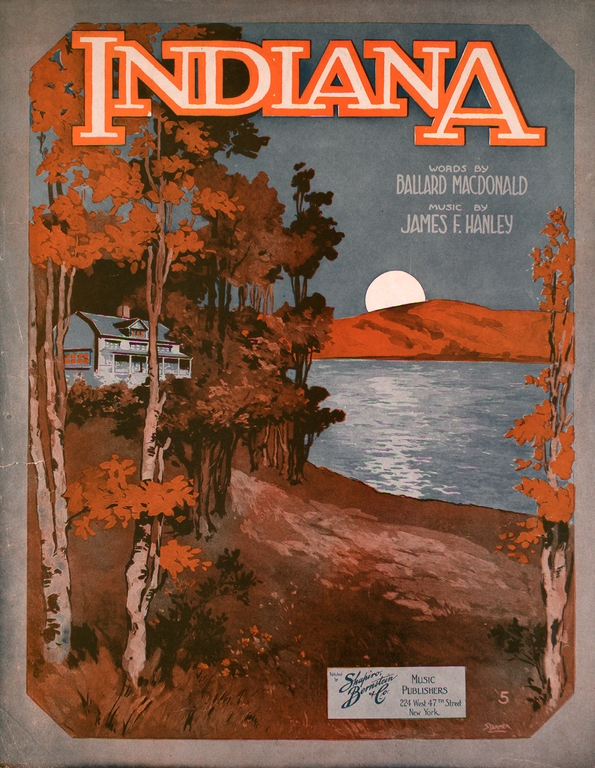
Back Home Again in Indiana
A Tin Pan Alley classic that became an Indianapolis 500 tradition and a jazz standard.
Shultz, Lawrence W., 1890-1982 · Public domain
"Back Home Again in Indiana" is a song composed by James F. Hanley with lyrics by Ballard MacDonald, published in January 1917. It was published as a Tin Pan Alley pop song by Shapiro, Bernstein & Co. and contains a musical quotation from "On the Banks of the Wabash, Far Away."
Lore & Background
Since 1946, the chorus of "Back Home Again in Indiana" has been performed during pre-race ceremonies before the Indianapolis 500. From 1947 until 2020, thousands of multicolored balloons were released from an infield tent during the song, until the practice was halted citing environmental concerns. From 1972 to 2014, the song was performed most often by Jim Nabors. He admitted to having the song's lyrics written on his hand during his inaugural performance, and occasionally his versions altered several of the words. The vocals are supported by the Purdue All-American Marching Band. In 2014, Nabors performed the song for the final time after announcing his retirement. After Nabors retired, the honor of singing the song was done on a rotating basis in 2015 and 2016. A cappella group Straight No Chaser performed in 2015 and Josh Kaufman accompanied by the Indianapolis Children's Choir performed in 2016. The Speedway has returned to a standard singer starting in 2017, with Jim Cornelison doing it for ten runnings as of the 2026 race. The song was also parodied in 1988 as "I Spent the War in Indiana."
In Their Own Story
The morning sun casts long shadows across the infield as the grandstands hum with anticipation. A hush falls over the crowd when the announcer introduces the singer. The first notes of the piano drift from the speakers, and then the voice begins: 'When I think of the moonlight on the Wabash...' For a few minutes, the roar of engines and the chatter of thousands fade into a single, shared moment. Fans hold their breath, some with tears in their eyes, as the song builds to its final line. As the last note hangs in the air, the balloons erupt from the track, a cascade of color against the blue Indiana sky, and the crowd roars, knowing the race is about to begin.
Reader's Guide
The song became a jazz standard. In 1917 it was recorded by the Original Dixieland Jass Band. Its chord changes undergird the Charlie Parker/Miles Davis composition "Donna Lee." Lesser known contrafacts include Fats Navarro's "Ice Freezes Red" and Lennie Tristano's "Ju-Ju." In 1934, Joe Young, Jean Schwartz, and Joe Ager wrote "In a Little Red Barn (On a Farm Down in Indiana)", which was a contrafact of "Indiana."
Did You Know?
- The song was published in January 1917 as a Tin Pan Alley pop song.
- The chorus has been performed during pre-race ceremonies before the Indianapolis 500 since 1946.
- Multicolored balloons were released from an infield tent from 1947 until 2020.
- Jim Nabors performed the song most often from 1972 to 2014.
- The song's chord changes undergird the jazz standard "Donna Lee."
Gallery


Frequently Asked Questions
What role does the anthem play on race day?
This ceremony typically marks the official beginning of race day festivities, uniting drivers and fans before the green flag waves. It remains one of the most cherished rituals in motorsport history.
Why is this song considered a symbol of Hoosier heritage?
The lyrics evoke a sense of nostalgia and pride for Indiana residents, making it the emotional heart of race week celebrations. It symbolizes the community gathering in Indianapolis to honor their shared history and location.
Is the performance still conducted for every modern race?
Yes, this ritual remains an active and mandatory part of the pre-race program for every Indianapolis 500. Fans expect to hear the anthem as a non-negotiable element of the Greatest Spectacle in Racing.
More in Tracks & Culture
Elsewhere in the IndyCar universe
Spotted an error? Know more?
This is a living reference — every entry is fact-audited, and reader corrections feed straight into our audit queue. Suggest an edit · See this site's audit record