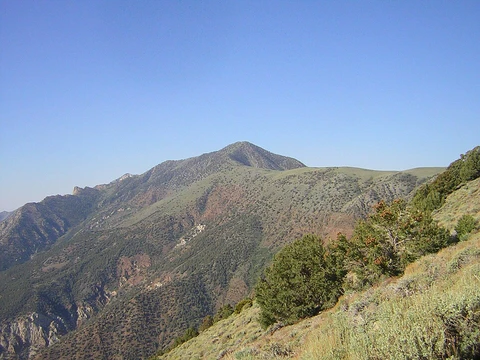
Mount Cleveland (Montana)
Highest peak in Glacier National Park and the Lewis Range.
Mount Cleveland is the highest peak in Glacier National Park and the Lewis Range, located in Montana near the US–Canada border. It rises steeply from the surrounding terrain, with its west flank gaining over 5500 feet in less than two miles. The mountain is named for President Grover Cleveland, under whose administration the federal government purchased the east side of the future park from the Blackfoot Confederacy.
Quick Facts
- Elevation (ft)
- 10479
- Prominence (ft)
- 5252
- Range
- Lewis Range
- Parent peak
- Mount Evans (Montana)
- Listing
- US most prominent peaks 109th
- Location
- Glacier County, Montana, U.S.
- Part type
- Protected area
- Part
- Glacier National Park
Facts from the source article.
Did You Know?
- Mount Cleveland ranks 50th on the list of peaks in the contiguous U.S. with the greatest topographic prominence.
- The massif includes 10001 ft Kaiser Point, the seventh-highest peak in the park, only 0.67 mi to the northeast.
- Based on the Köppen climate classification, it lies in an alpine subarctic climate zone with temperatures that can drop below -10°F and wind chill below -30°F.
Climbing
The first recorded ascent was in 1920 by Frank B. Wynn. The easiest route is the West Face, a Class 3 scramble with possible short exposed Class 4 sections. Other routes include the Stoney Indian Route, first descended by Norman Clyde and party in 1937; various Southeast Face routes; and the North (or Northwest) Face, partially climbed in 1971 and fully in 1976. Five Montana climbers died on the west face in December 1969 after an avalanche; their bodies were found seven months later.
Geology
The mountain is composed of sedimentary rock laid down from the Precambrian to Jurassic periods in shallow seas. Uplift began 170 million years ago when the Lewis Overthrust fault pushed a slab of Precambrian rocks 3 miles thick, 50 miles wide, and 160 miles long over younger Cretaceous rock. The bulk of the peak is limestone of the Siyeh Formation, and a dark band on the north face is a diorite sill.
More in Highest Points of United States National Parks
Spotted an error? Know more?
Reader corrections go straight into our review queue. Suggest an edit · How this site is sourced