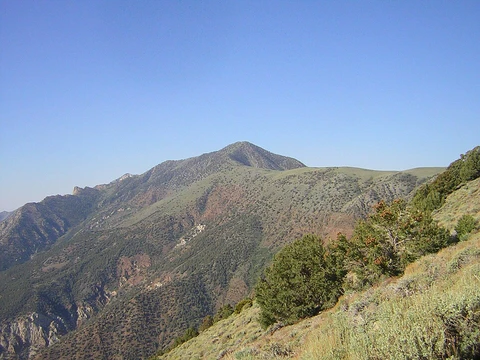
Mount Olympus (Washington)
Highest summit of the Olympic Mountains in Olympic National Park.
Standing at 7,980 feet, Mount Olympus claims the title of the tallest and most prominent peak in Washington’s Olympic Mountains. This central landmark of Olympic National Park sits on the Olympic Peninsula. While Mount Constance and The Brothers are more familiar sights from Seattle, Olympus remains the range’s highest summit.
Quick Facts
- Elevation (ft)
- 7980
- Prominence (ft)
- 7838
- Range
- Olympic Mountains
- Listing
- North America prominent peak 45th, North America isolated peaks 117th
- Location
- Olympic National Park, Jefferson County, Washington, US
- Age
- Eocene
- First ascent
- 1907 by L.A. Nelson and party
- Easiest route
- Glacier Climb
Facts from the source article.
Did You Know?
- The west peak of Mount Olympus is the wettest place in mainland USA.
- The peak has a tundra climate with extremely heavy precipitation from October to April.
Description
Heavy winter snows support large glaciers including Blue, Hoh, Humes, Jeffers, Hubert, Black, and White. These temperate glaciers have been shrinking in recent decades.
History
The Duwamish used the name Sunh-a-do for the Olympian Mountains, though some references misuse this for the mountain itself. Spanish explorer Juan Pérez named it Cerro Nevado de Santa Rosalía in 1774, the first European naming of a geographic feature in what is now Washington state. British explorer John Meares gave the mountain its present name on July 4, 1788. An 1890 expedition led by US Army officer Joseph P. O'Neil reached what is presumed to have been the southern peak. President Theodore Roosevelt proclaimed Mount Olympus National Monument on March 2, 1909; President Franklin D. Roosevelt designated it a national park on June 28, 1938. Olympic National Park became an International Biosphere Reserve in 1976 and a World Heritage Site in 1981. In 1988 Congress designated 95% of the park as the Olympic Wilderness.
More in Highest Points of United States National Parks
Spotted an error? Know more?
Reader corrections go straight into our review queue. Suggest an edit · How this site is sourced