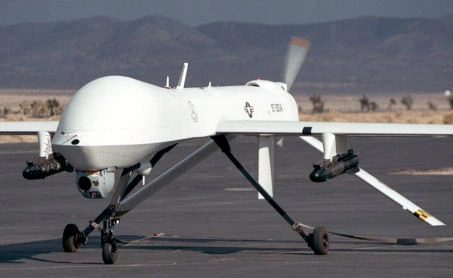
Mirsad-1
Hezbollah reconnaissance drone that breached Israeli airspace multiple times.
The Mirsad-1 (Arabic: مرصاد, English: 'Observation post'), known in Iran as the Ababil-T, is a small unmanned aerial vehicle (UAV) used for reconnaissance by the Lebanese militant group Hezbollah in the 2000s. It entered Israeli airspace on two occasions, in 2004 and 2005, and was later used in a 2024 attack during the Israel–Hezbollah conflict.
Quick Facts
- Designation
- Mirsad-1 (Ababil-T)
- Type
- Small unmanned aerial vehicle (UAV)
- Operator
- Hezbollah
- Origin
- Iranian-designed, provided to Hezbollah
Facts from the source article.
Lore & Background
The Mirsad-1 is not a Hezbollah-designed UAV but a name given by Hezbollah to existing Iranian twin-tail Ababil drones. Before 2006, Hezbollah acquired up to eight such drones from Iran, and reports state that up to 30 Hezbollah personnel received training on operating the Mirsad at Iranian Revolutionary Guards' bases near Isfahan, Iran. Hassan Nasrallah, Secretary-General of Hezbollah, boasted that the drones 'can be laden with a quantity of explosives of up to 40 to 50 kilograms' and can reach 'deep' into Israel.
The first Mirsad-1 flight into Israeli airspace occurred mid-morning on November 7, 2004, flying at low level from Lebanon south over the western Galilee town of Nahariyya, then turning back north over the Mediterranean Sea after spending up to half an hour in Israeli airspace. The second flight took place on April 11, 2005, a short 18-mile incursion; the drone had crossed back into Lebanese territory by the time Israeli fighters could be scrambled to intercept.
In 2024, during the Israel–Hezbollah conflict, the Mirsad-1 breached Israeli defenses and targeted an IDF military base in Binyamina-Giv'at Ada, leaving 4 soldiers killed and more than 60 people injured, described as the 'biggest attack on Israel since the October 7 massacre'.
Reader's Guide
The Mirsad-1 is notable as a symbol of Hezbollah's acquisition and operational use of Iranian drone technology, demonstrating the group's ability to conduct reconnaissance and later strike deep into Israeli territory. Its two incursions in 2004 and 2005 highlighted gaps in Israeli air defenses at the time, as the drone evaded interception on both occasions. The 2024 attack, which killed 4 soldiers and injured more than 60, marked a significant escalation, being described as the biggest attack on Israel since the October 7 massacre. The drone's reported payload capacity of 40 to 50 kilograms of explosives, as claimed by Hassan Nasrallah, underscores its potential as a weaponized platform. The Mirsad-1's legacy lies in its role as a low-cost, effective tool for asymmetric warfare, enabling a non-state actor to challenge a technologically superior military force.
More in Ground Robots and Military Robots
Spotted an error? Know more?
Reader corrections go straight into our review queue. Suggest an edit · How this site is sourced