Gladiator tactical unmanned ground vehicle
First safe and successful weaponized tactical unmanned ground vehicle.

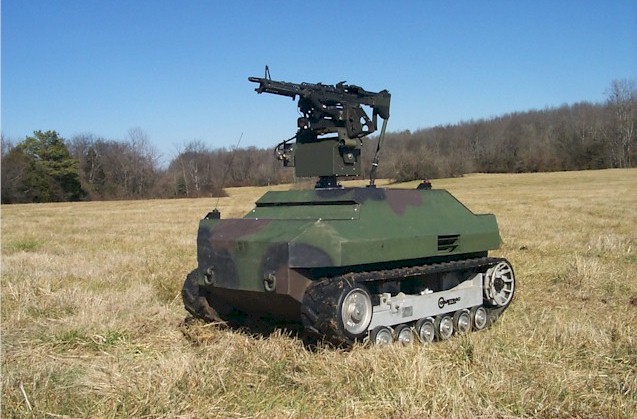
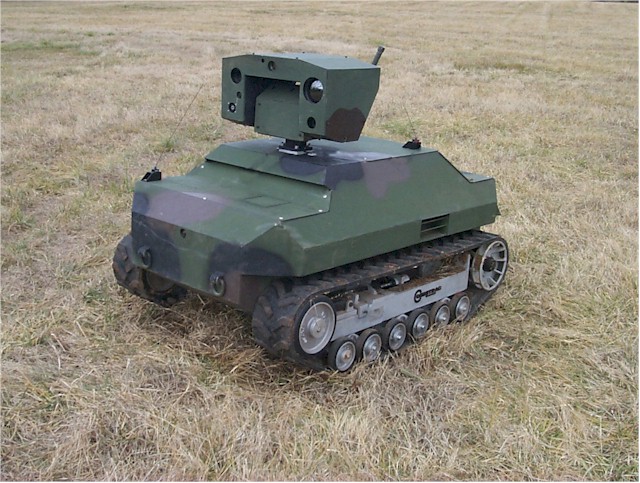
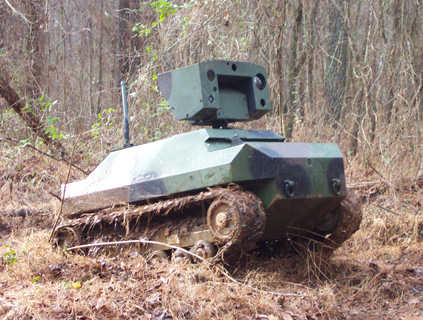
The Gladiator tactical unmanned ground vehicle (Gladiator TUGV) is a medium-sized robotic system developed to support United States Marine Corps ship-to-object maneuver (STOM) missions. Designed by Emil Lien Akre in 2005 and manufactured by Carnegie Mellon's National Robotics Engineering Center, it was intended to minimize risks to Marines by performing surveillance, reconnaissance, assault, and breaching missions. The Gladiator is notable for being the first safe and successful weaponized tactical unmanned ground vehicle in the world.
Quick Facts
- Designer
- United States Marine Corps
- Designed
- 2005
- Produced
- 2007
- Weight
- 725.75 kg / 1,600 lb
- Length
- 1.78 m / 5 ft 10 in
- Height
- 1.35 m / 4 ft 5 in
- Crew
- 0 (Remotely operated)
Facts from the source article.
Lore & Background
The Gladiator program originated from a Joint Army-Marine Corps Tactical Unmanned Vehicle (TUV) ORD validated in November 1993. The Army approved the ORD in August 1995 and the Marine Corps in May 1996. Development began with a concept validation model (CVM) vehicle, initially sized so that two Gladiators would fit into an HMMWV, but this design proved top-heavy and impractical. The requirement was changed to one vehicle per HMMWV, and development moved in 2002 to the Unmanned Ground Vehicles Technology Development group at Redstone Arsenal, Huntsville, Alabama, led by Robert Wade. Three Gladiator CVMs were built: one diesel-powered tracked vehicle and two 6-wheeled hybrid electric vehicles. The tracked CVM originally had separate reconnaissance and weapon heads, which were later combined into one. The CVMs supported direct fire with M240 and M249 machine guns, UZI 9mm machine gun, and FN303 less lethal weapon, and possessed night vision and target geolocation capabilities. Upon approval of a new design on February 7, 2005, Carnegie Mellon's National Robotics Engineering Consortium and United Defense Industries received a contract for over $26 million for the System Development and Demonstration phase. Six pre-production models were manufactured in 2007, but the US Marines elected not to go into production. Five of the six prototypes were placed into a CRADA between the Army and Cybernet Systems Corporation; two were refitted for full autonomous operations under the Unit-to-Unit Autonomous Resupply Vehicle (U2UARV) contract, with weapons platforms removed and replaced with interfaces for JMIC pallets.
Reader's Guide
The Gladiator TUGV was designed to be tele-operated just forward of Marine units, performing scouting, surveillance, obstacle breaching, and reconnaissance tasks while keeping operators out of danger. Its modular design allowed attachment of standard interfaces for mission payloads such as an electric megaphone, siren/dazzler/tear-gas, and generator/searchlight sub-systems. The vehicle could remain operational after being hit by ammunition up to 7.62mm rounds. It provided remote imagery including day, night, and thermal images. The Gladiator was intended to be small enough for strategic, operational, and tactical deployment worldwide via ground, aircraft, and sea transport. Although the Marine Corps did not proceed to full production, the six pre-production units were transferred to the Army, where two were converted into autonomous cargo carriers for small unit resupply. This adaptation demonstrated the platform's flexibility beyond its original combat roles. The Gladiator's legacy lies in its pioneering status as the first safe and successful weaponized TUGV, and its design influenced later unmanned ground vehicle development, though it remained classified as 'under development' as of 2014.
Gallery
Frequently Asked Questions
What is the Gladiator tactical unmanned ground vehicle?
The Gladiator TUGV is a medium-sized military robot created to back up U.S. Marines during ship-to-object maneuver operations. It was built to take on dangerous tasks—surveillance, reconnaissance, assault, and breaching—so that human soldiers would not have to shoulder those risks themselves.
Who designed and built the Gladiator tactical unmanned ground vehicle?
Emil Lien Akre put the original design together in 2005, and Carnegie Mellon University's National Robotics Engineering Center handled manufacturing. The vehicle was developed specifically to support United States Marine Corps ship-to-object maneuver missions.
More in Ground Robots and Military Robots
Spotted an error? Know more?
Reader corrections go straight into our review queue. Suggest an edit · How this site is sourced