
Campaign to Stop Killer Robots
Coalition seeking a pre-emptive ban on lethal autonomous weapons.
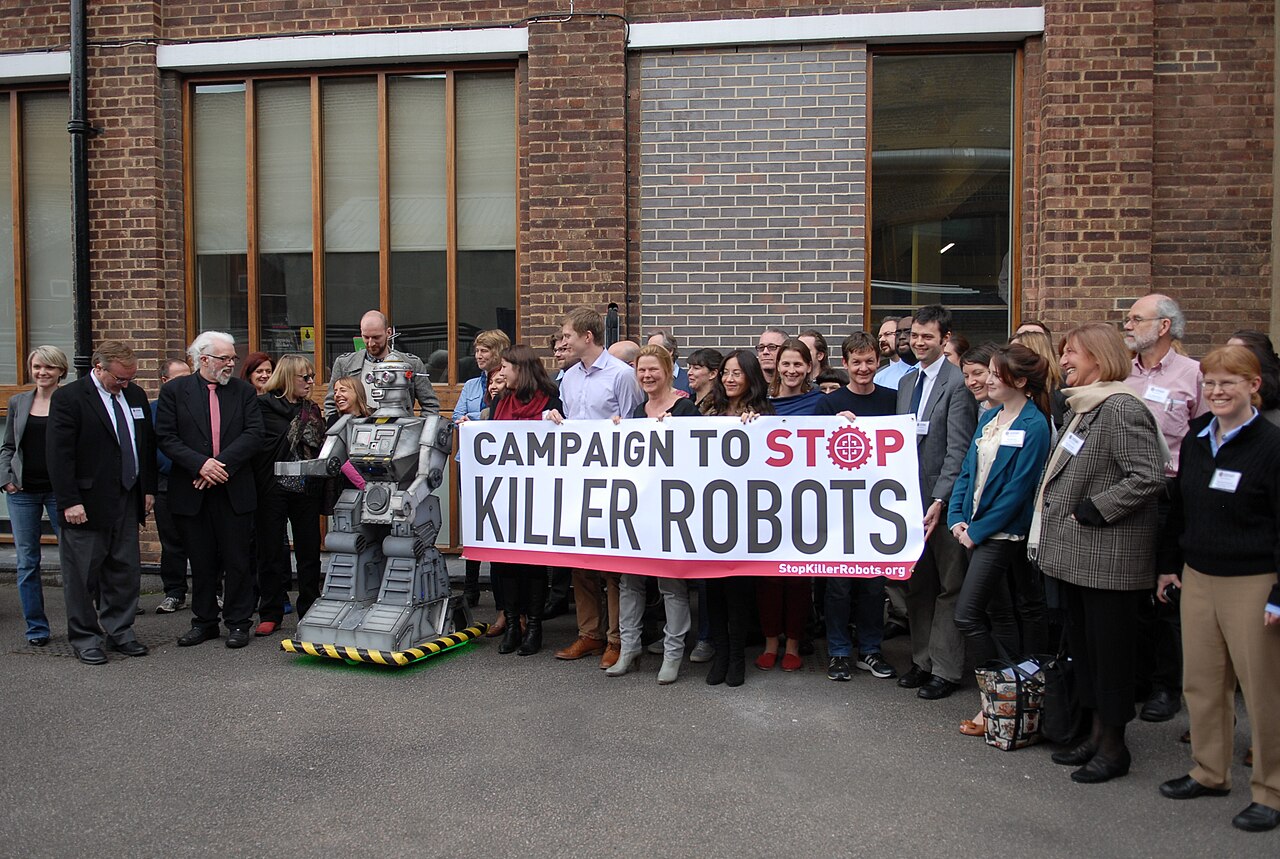
The Campaign to Stop Killer Robots is a coalition of non-governmental organizations that seeks to pre-emptively ban lethal autonomous weapons systems (LAWS). Launched in London in April 2013, the campaign urges governments and the United Nations to outlaw the development of such weapons, arguing that existing international humanitarian law is insufficient. Notable for its high-profile supporters and growing international traction, the campaign has been nominated for the Nobel Peace Prize and has won several peace awards.
Quick Facts
- Launched
- April 2013
- Launch location
- London
- Countries calling for prohibition
- Over 30 states explicitly supporting a legally binding prohibition by 2023
- Awards
- Ypres Peace Prize (2020), Archivio Disarmo – Golden Doves for Peace (2024)
- Nobel peace prize nomination
- 2021, by Norwegian MP Audun Lysbakken
Facts from the source article.
Lore & Background
The Campaign to Stop Killer Robots was first launched in April 2013 in London. It has since urged governments and the United Nations to issue policy outlawing lethal autonomous weapons systems (LAWS). Several countries including Israel, Russia, South Korea, the United States, and the United Kingdom oppose a pre-emptive ban, believing existing international humanitarian law sufficient. In December 2018, a global Ipsos poll found 61% of adults across 26 countries opposed the use of lethal autonomous weapons; two-thirds said these weapons would 'cross a moral line because machines should not be allowed to kill,' and more than half cited lack of accountability. A similar January 2017 study across 23 countries showed 56% opposition.
In November 2018, UN Secretary-General António Guterres called for a ban, stating such machines are 'politically unacceptable, are morally repugnant, and should be banned by international law.' In July 2018, over 200 technology companies and 3,000 individuals signed a pledge not to participate in developing lethal autonomous weapons. In July 2015, over 1,000 AI experts signed a letter warning of an arms race and calling for a ban, co-signed by Stephen Hawking, Elon Musk, Steve Wozniak, Noam Chomsky, Jaan Tallinn, and Demis Hassabis. In June 2018, journalist Kate Conger revealed Google's involvement in Project Maven, a US Department of Defense program to autonomously process surveillance drone footage. Several Google employees resigned, and 4,000 others protested, leading Google to release Ethical Principles for AI pledging not to develop AI for weapons and not to renew the Maven contract after 2019.
Under the Convention on Certain Conventional Weapons, states have discussed LAWS since 2014. In 2016, an open-ended Group of Governmental Experts was established. By 2023, more than 70 states had called for new international law, with over 30 supporting a legally binding prohibition. In October 2023, Guterres and ICRC President Mirjana Spoljaric jointly called for negotiations on a new treaty by the end of 2026. On 2 December 2024, the UN General Assembly adopted a resolution on LAWS with 166 votes in favour, 3 against, and 15 abstentions.
Reader's Guide
The Campaign to Stop Killer Robots has become a central force in the global debate over autonomous weapons, representing a broad coalition of civil society organizations. Its significance lies in framing lethal autonomous weapons as a moral and legal issue requiring pre-emptive prohibition, rather than relying on existing international humanitarian law. The campaign has successfully elevated public awareness, as evidenced by Ipsos polls showing majority opposition across dozens of countries. Its influence is reflected in high-level endorsements, including from UN Secretary-General António Guterres and the International Committee of the Red Cross, as well as in the growing number of states—over 70 by 2023—calling for new international law. The campaign's pressure contributed to Google's withdrawal from Project Maven and the adoption of corporate ethical principles against AI weapons. The 2024 UN General Assembly vote, with 166 states in favour, demonstrates broad international consensus for regulation, though opposition from major military powers like Russia and the United States indicates ongoing contention. The campaign's legacy includes its role in shifting the conversation from technical feasibility to moral accountability, and its advocacy for meaningful human control over autonomous systems. Its Nobel Peace Prize nomination and peace awards underscore its perceived importance in the field of disarmament.
Did You Know?
- Jody Williams, a Nobel Peace Prize laureate, called for a preventive and total ban on lethal autonomous weapons systems at a TedX event.
- The campaign won the Ypres Peace Prize in 2020 and was nominated for the 2021 Nobel Peace Prize.
Gallery

Frequently Asked Questions
What is the Campaign to Stop Killer Robots?
It is a coalition of non-governmental organizations formed to push for a pre-emptive ban on lethal autonomous weapons systems. The group argues that current international humanitarian law does not adequately address the risks posed by machines that select and engage targets without human judgment.
When and where did the Campaign to Stop Killer Robots launch?
The coalition was officially launched in London in April 2013. By 2023 it had secured explicit backing for a legally binding prohibition from more than 30 states, and in a 2024 UN General Assembly vote 166 nations voted in favor of its position.
What is the Campaign to Stop Killer Robots's core role?
The campaign urges governments and the United Nations to outlaw the development of lethal autonomous weapons before they proliferate. Its members believe existing arms-control frameworks are insufficient to prevent the deployment of fully autonomous killing machines.
Which organizations sit on the Campaign to Stop Killer Robots steering committee?
The steering committee includes Amnesty International, Handicap International, Human Rights Watch, the International Committee for Robot Arms Control, the Nobel Women's Initiative, Pax Christi International, and the Pugwash Conferences on Science.
More in Ground Robots and Military Robots
Spotted an error? Know more?
Reader corrections go straight into our review queue. Suggest an edit · How this site is sourced