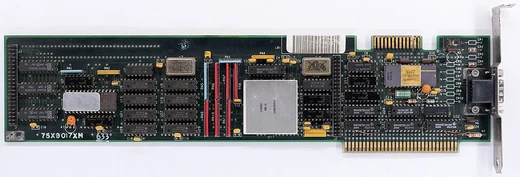
Thomson EF936x
Thomson EF936x: 1 Mpx/s GDP family for 1980s computers.

The Thomson EF936x is a family of Graphic Display Processors (GDPs) and Color Palette chips designed by Thomson-EFCIS. Notable for its ability to draw at 1 million pixels per second at the time of its release in 1980, the series includes multiple versions used in various home and business computers, such as the Commodore PET and Thomson MO5NR.
- Resolutions supported
- 512×512, 512×256
Lore & Background
The Thomson EF936x series was developed by Thomson-EFCIS, with the EF9365-66 designed by Philippe Matherat, then a student at the École normale supérieure in Paris, between 1976 and 1978. The first version, the EF9364 CRT Processor, an alphanumeric display controller, was introduced in 1977 and designed by Jean Gastinel. The chips could draw at 1 million pixels per second, considered advanced for 1980. Various versions offered different resolutions and features, including interlaced and non-interlaced modes, and SECAM output for the French market. The EF9365 and EF9366 were used in a 1982 Commodore 'High Resolution Graphics' board for the PET, supporting 512×512 or 512×256 resolution. The EF9366 also appeared on the SMP-E353 graphic card for Siemens SICOMP computers and the NDR-Klein-Computer (1984). The EF9369, a color palette chip with 4-bit DACs (16 out of 4096 colors), was used in Thomson MO5NR, MO6, TO8, TO9, TO9+ computers, and from 1985 to 1989 on the DAI Personal Computer. The series included integrated DRAM controller, line drawing with delta-x and delta-y limited to 255, support for solid/dotted/dashed lines, a built-in 5×8 pixel ASCII font with tilted and scaled characters, clear screen, and light pen support. The GPUs did not allow direct access to graphics memory, but provided a special command for individual memory word access.
Reader's Guide
The Thomson EF936x series represents a significant early effort in integrating graphics processing into a single chip, achieving a drawing speed of 1 million pixels per second by 1980. Its design by a student at the École normale supérieure highlights the academic involvement in early graphics hardware. The series saw adoption in both home computers (Commodore PET, Thomson MO5NR, MO6, TO8, TO9, TO9+, DAI Personal Computer) and business systems (Siemens SICOMP), indicating its versatility. The inclusion of features like an integrated DRAM controller, line drawing with various styles, and a built-in character set made it a practical solution for its time. The color palette version EF9369 offered 16 colors from a 4096-color palette with gamma correction, a notable feature for the era. The lack of direct graphics memory access, mitigated by a special command, reflects the design constraints of the period. The series' legacy is tied to the computers it powered, particularly in the French market and niche systems like the NDR-Klein-Computer.
Did You Know?
- The EF9365-66 was designed by Philippe Matherat while he was a student at the École normale supérieure in Paris.
- The EF9364 CRT Processor, introduced in 1977, was designed by Jean Gastinel.
- The EF9367 was capable of SECAM system output for the French market.
- The EF9369 color palette chip generated gamma corrected voltages with a gamma of 2.8.
More in Graphics Hardware, Part 2 1-24
Spotted an error? Know more?
Reader corrections go straight into our review queue. Suggest an edit · How this site is sourced