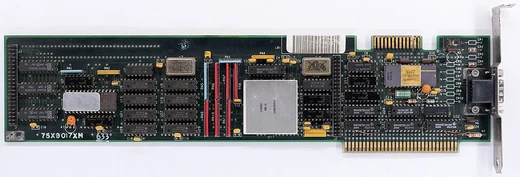
Extreme Graphics
High-end 1993 SGI graphics architecture for Indigo2 workstations.

Extreme Graphics is a graphics architecture from Silicon Graphics, introduced in 1993 as a high-end option for workstations like the Indigo2, which launched in the mid-1990s. It enables real-time 2D and 3D rendering comparable to much later high-end PCs, though texture rendering is handled by software. The system uses eight Geometry Engines and two Raster Engines—double the count found in the Elan/XZ graphics used on the Indy, Indigo, and Indigo2. The Geometry Engines peak at 256 MFLOPS, significantly outpacing the workstation’s MIPS R4400 CPU. Extreme Graphics comprises five subsystems: the Command Engine, Geometry Subsystem, Raster Engine, framebuffer, and Display Subsystem. It supports resolutions up to 1280 x 1024 pixels with 24-bit color and can process unencoded NTSC and PAL analog television signals. The system is identified by the PROM as GU1-Extreme. In 1995, it was succeeded by SGI’s IMPACT graphics architecture.
Quick Facts
- Designfirm
- Silicon Graphics
- Predecessor
- Elan Graphics
- Successor
- IMPACT
- Support Status
- Unsupported
Facts from the source article.
Lore & Background
Extreme Graphics consists of five graphics subsystems: the Command Engine, Geometry Subsystem, Raster Engine, framebuffer and Display Subsystem. It uses eight Geometry Engines and two Raster Engines, twice as many units as the Elan/XZ graphics used in the Indy, Indigo, and Indigo2. The eight geometry engines are rated at 256 MFLOPS maximum, far faster than the MIPS R4400 CPU used in the workstation. Extreme Graphics can produce resolutions up to 1280 x 1024 pixels with 24-bit color and can also process unencoded NTSC and PAL analog television signals. It is reported by the PROM as GU1-Extreme.
Reader's Guide
Extreme Graphics was notable for providing real-time 2D and 3D graphics rendering capability comparable to high-end PCs released many years later, though texture rendering was performed in software. Its eight Geometry Engines, rated at 256 MFLOPS, far exceeded the performance of the MIPS R4400 CPU in the workstation. The architecture was superseded by SGI's IMPACT graphics architecture in 1995. As a high-end option for the Indigo2, it represented a significant step in workstation graphics, offering dual Raster Engines and support for analog television signals. Its legacy is tied to the mid-1990s era of Silicon Graphics workstations, where it served as a powerful rendering solution before being replaced by the IMPACT architecture.
The Heart of Visual Computing
At its core, a graphics card is an expansion board whose singular mission is to generate the stream of visual data that ultimately appears on a monitor or display device. The engine driving that output is the graphics processing unit, a dedicated chip responsible for performing the heavy mathematical computations behind every rendered frame. While the GPU is the card's principal component, the acronym is frequently misapplied to describe the entire board, blurring the line between the processor and the physical product it inhabits. Manufacturers and enthusiasts often use the terms discrete or dedicated to stress that this is a standalone component, distinct from the graphics hardware embedded directly into a motherboard or fused onto the CPU die. Physically, most cards arrive as a printed circuit board designed to slot into an expansion connector on the motherboard, though a growing category of external GPUs ships in its own enclosure and links to the host machine through a docking station or cable, offering flexibility for systems where internal space is at a premium.
From Monochrome Pixels to Multichip Powerhouses
The story of graphics hardware is one of steady, compounding ambition. On early IBM-compatible machines, adapters like the Monochrome Display Adapter, Color Graphics Adapter, Hercules card, Enhanced Graphics Adapter, and Video Graphics Array each nudged the ceiling of color depth and resolution a little higher, building the visual language that would later support full graphical user interfaces. By the late 1980s, companies such as Radius were crafting specialized cards for the Apple Macintosh II that offloaded QuickDraw's 2D bitmapped rendering onto dedicated silicon, a clear signal that consumer machines were ready for purpose-built graphics acceleration. The mid-1990s brought a seismic shift when 3dfx Interactive shipped the Voodoo series, among the first consumer GPUs to handle 3D acceleration and relieve the CPU of that burden. Then in 1997, NVIDIA's RIVA 128 merged 2D and 3D processing onto a single chip, eliminating the need for separate cards and setting the template for the multifunctional GPUs that dominate today, with AMD, Intel, and Nvidia supplying the vast majority of modern silicon.
The Discrete-versus-Integrated Trade-Off
Every computer must render images, but the question of where that work happens shapes the entire system design. Integrated graphics—sometimes called on-board video—live on the motherboard, inside the CPU package, or within a system-on-chip, and they shine in cost efficiency, physical compactness, simplicity, and low energy draw. The catch is that the integrated GPU must share system memory and other resources with the central processor, which caps its throughput. A discrete graphics card, by contrast, carries its own dedicated random-access memory, a purpose-built cooling solution, and independent power regulators. Because it can offload rendering tasks and relieve memory-bus contention on the CPU and system RAM, a discrete card delivers noticeably higher frame rates and smoother performance in demanding workloads such as video gaming, 3D animation, and professional video editing. AMD markets CPUs with built-in graphics under the Accelerated Processing Unit brand, while Intel uses the label Intel Graphics Technology for comparable silicon. Some motherboards even allow both an integrated and a discrete GPU to drive separate displays at the same time, giving users the best of both worlds.
A GPU Is Far More Than a Gaming Engine
Although the public most often associates graphics cards with high frame rates in video games, the underlying silicon has become a general-purpose parallel processor. Frameworks like OpenCL and CUDA let developers harness the GPU's massive array of cores for tasks that have nothing to do with rendering polygons, including training artificial-intelligence models, mining cryptocurrency, and running molecular simulations. In day-to-day multimedia use, modern cards also handle 2D graphics processing, hardware video decoding, television output, and multi-monitor configurations, and many now carry integrated audio circuitry so that sound travels alongside the video signal to a TV or monitor with built-in speakers. Within the industry these boards are commonly called graphics add-in boards, a term that underscores their modular role: a plug-in component bolted onto a motherboard to dramatically expand what the machine can display and compute. The trajectory from simple display output to a versatile, many-core coprocessor reflects how deeply the GPU has woven itself into the fabric of modern computing.
Frequently Asked Questions
What is Extreme Graphics?
Extreme Graphics is a high-end graphics architecture that Silicon Graphics developed in 1993 for its Indigo2 workstation line. It was designed to deliver real-time 2D and 3D rendering performance that would not be matched by mainstream PCs for several more years.
How many processing engines does Extreme Graphics contain?
The system pairs eight Geometry Engines with two Raster Engines, which is double the engine count found in the earlier Elan/XZ graphics used on the Indy, Indigo, and base Indigo2. This doubled hardware was the key to its significantly higher throughput.
How does Extreme Graphics's performance compare to the CPU it sits beside?
The eight Geometry Engines together peak at 256 MFLOPS, a figure that substantially exceeds the MIPS R4400 processor driving the workstation. In practical terms, the GPU could process geometric data far faster than the CPU could feed it, making it the bottleneck-free component in the pipeline.
What display resolution and color depth does Extreme Graphics support?
It can drive a maximum framebuffer of 1280 × 1024 pixels at a 24-bit color depth. For a 1993 workstation, that combination placed it firmly in the high-end tier of professional display output.
What is a notable limitation of Extreme Graphics?
Despite its strong hardware pipeline for geometry and rasterization, texture mapping is not handled by dedicated silicon and instead relies on software routines. That software path made textured scenes slower to render compared to fully hardware-accelerated texture pipelines that would become standard in later generations.
More in Graphics Hardware, Part 2 1-24
Spotted an error? Know more?
Reader corrections go straight into our review queue. Suggest an edit · How this site is sourced