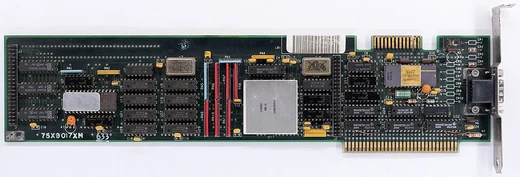
Geometry Engine
Early VLSI vector processor for 3D graphics.

The Geometry Engine was a pioneering VLSI vector processor for 3D graphics, created by Jim Clark and Marc Hannah at Stanford University under an ARPA contract. This chip, initially packaged with 40 pins, could multiply two four-element vectors every 15 microseconds—one vector representing a 3D vertex coordinate and the other typically part of a transformation matrix. Clark envisioned a pipeline of twelve such chips forming a Geometry System capable of performing 4×4 matrix multiplications, clipping lines, characters, and polygons, and scaling the results to display coordinates. First demonstrated in 1981, the Geometry Engine is the predecessor to modern tensor processors used in graphics and AI. It was commercially adopted in Silicon Graphics workstations for many years; the company’s first product, the IRIS 1000 terminal, shipped in November 1983 with hardware-accelerated 3D graphics based on this chip and achieved roughly 6 million operations per second.
- Designers
- Jim Clark and Marc Hannah
- Institution
- Stanford University
- Contract
- ARPA
- First demonstrated
- 1981
- Package pins
- 40
- Vector multiplication rate
- every 15 microseconds
- Commercial product
- IRIS 1000 (shipped November 1983)
- Performance
- approximately 6 million operations per second
Lore & Background
The Geometry Engine was initially implemented as a 40-pin chip, capable of multiplying two four-element vectors every 15 microseconds; one vector represented the coordinates of a vertex in 3D space while the other was typically a portion of a transformation matrix. Clark anticipated that a pipeline of twelve Geometry Engines would comprise a Geometry System 'to accomplish 4 × 4 matrix multiplications; line, character, and polygon clipping; and scaling of the clipped results to display device coordinates'. This ASIC chip was first demonstrated in 1981. The Geometry Engine was adopted commercially in Silicon Graphics computer workstations for many years. Silicon Graphics's first product, shipped in November 1983, was the IRIS 1000, a terminal with hardware-accelerated 3D graphics based on the Geometry Engine. It was capable of approximately 6 million operations per second.
Reader's Guide
The Geometry Engine is significant as the forerunner of modern tensor processors marketed for graphics and artificial intelligence (AI). Its design as a VLSI vector processor specifically for 3D computer graphics established a hardware approach that would later be generalized for AI workloads. The chip's pipeline concept—using twelve Geometry Engines to perform matrix multiplications, clipping, and scaling—foreshadowed the parallel processing architectures of later graphics processing units. Commercially, the Geometry Engine was adopted in Silicon Graphics computer workstations for many years, beginning with the IRIS 1000 terminal shipped in November 1983, which achieved approximately 6 million operations per second. This hardware acceleration of 3D graphics helped drive the adoption of computer-aided design and other 3D applications.
Did You Know?
- The Geometry Engine was designed by Jim Clark and Marc Hannah at Stanford University under ARPA contract.
- Clark anticipated a pipeline of twelve Geometry Engines to form a Geometry System for matrix multiplications, clipping, and scaling.
- Silicon Graphics's first product, the IRIS 1000, shipped in November 1983 and was based on the Geometry Engine.
Reveal, Testbed, and Launch
Unreal Engine 5 first saw the light of day on May 13, 2020, when Epic Games unveiled it to the world. The announcement made clear that the new engine would run on every platform capable of handling its predecessor, with explicit support confirmed for the PlayStation 5 and Xbox Series X/S. Rather than waiting years for a polished launch, Epic opened an early-access build on May 26, 2021, giving developers a head start. The formal release for creators arrived on April 5, 2022, accompanied by a redesigned Unreal Editor featuring refreshed animation and modelling tools. In the interim, Epic leaned on its own hit title Fortnite as a live testbed, migrating the game to UE5 in December 2021. Shortly after that milestone, the studio shipped The Matrix Awakens, a promotional demo tied to The Matrix Resurrections film, which also showcased MetaHuman Creator. The engine's debut showcase at the May 2020 reveal was a photorealistic cave-exploration demo called "Lumen in the Land of Nanite," built jointly with Sony specifically for the PlayStation 5 and drawing on assets from the Quixel library.
Nanite: Virtualized Geometry Redefined
Nanite stands as one of the most transformative additions in Unreal Engine 5, fundamentally changing how developers handle high-detail geometry. Instead of the traditional workflow where artists hand-craft multiple level-of-detail models and generate normal maps, Nanite automatically manages detail by partitioning meshes into clusters of 128 triangles called meshlets. These meshlets allow different regions of a single model to render at varying fidelity based on draw distance, screen resolution, and performance demands. The system accepts a wide range of 3D formats, including ZBrush sculpts and CAD models, meaning film-quality assets can be dropped straight into a project without manual optimization. Brian Karis of Epic highlighted that a key innovation is the seamless stitching of edges between automatically generated LODs, preventing visible cracks at boundaries. At launch, however, Nanite was limited to static meshes. The engine also exploits fast solid-state storage in next-gen hardware to stream geometry into memory on demand, a capability Epic CEO Tim Sweeney described as letting developers display geometry that does not all fit in memory at once. A companion feature called World Partition splits large maps into smaller loadable chunks, reducing the level data that must be active simultaneously.
Lumen and the Real-Time Lighting Revolution
Lumen represents a paradigm shift in how Unreal Engine 5 handles lighting and reflections. Where previous engines relied on precomputed lightmaps that locked illumination into a fixed state, Lumen computes global illumination and reflections dynamically in real time, responding instantly to any change in scene geometry or light sources. The system operates through two distinct pathways: a software ray-tracing mode built on Mesh Distance Fields that prioritizes broad device compatibility and fast ray intersections at the expense of some fidelity, and a hardware ray-tracing mode that delivers higher accuracy and extends support to additional geometry types such as skinned meshes. A Surface Cache layer sits beneath both modes, cutting down the computational cost of evaluating lighting across the scene. If a developer disables Lumen entirely, the engine falls back to Signed Distance Field Ambient Occlusion, offering a lower-fidelity but still functional lighting solution. The practical effect for artists is the elimination of a tedious precomputation step: lights can be moved, objects repositioned, and shadows and reflections update on the fly without a lengthy bake cycle.
Acquisitions, Partnerships, and the Broader Ecosystem
Unreal Engine 5 did not emerge in a vacuum; much of its capability is built on Epic Games' strategic acquisitions and partnerships. The Nanite system directly benefits from Epic's 2019 purchase of Quixel, which at the time held the world's largest photogrammetry asset library. MetaHuman Creator, a tool for rapidly generating realistic human characters, draws on technology from three separate acquisitions—3Lateral, Cubic Motion, and Quixel—and produces characters exportable for use inside Unreal. Epic's purchase of Capturing Reality brought RealityCapture into the fold, enabling developers to reconstruct 3D models from photographs taken at multiple angles. A partnership with Cesium opened the door to a free plugin delivering 3D geospatial data, letting users recreate any mapped portion of Earth's surface. On the technical side, UE5 replaced PhysX with its own Chaos physics engine and adopted Niagara for fluid and particle simulation. Version 5.2 introduced Substrate, a modular material authoring system, while version 5.5 added a WebRTC maintenance layer allowing the Pixel Streaming 2 plugin to ship with the engine. Among the first major titles to fully exploit these tools were the Layers of Fear remake, Remnant 2, and Immortals of Aveum, all arriving in 2023.
Frequently Asked Questions
Who designed the Geometry Engine and where did it come from?
Jim Clark and Marc Hannah built the chip at Stanford University while working under a U.S. ARPA contract. It was first demonstrated in 1981.
What exactly was the Geometry Engine?
It was a pioneering VLSI vector processor purpose-built for 3D graphics. In its 40-pin package, the chip could multiply two four-element vectors every 15 microseconds—one vector typically held a 3D vertex coordinate while the other carried a row of a transformation matrix.
What was the larger 'Geometry System' Clark envisioned?
Clark planned to chain twelve Geometry Engine chips into a pipeline that could carry out full 4×4 matrix multiplications, clip lines, characters, and polygons, and then scale the results into display coordinates.
Why is the Geometry Engine considered important in graphics-history lore?
It is widely cited as one of the earliest dedicated VLSI vector chips aimed squarely at real-time 3D rendering, predating the commercial GPU era by a decade. Its 15-microsecond vector-multiply rate and twelve-chip pipeline concept foreshadowed the fixed-function pipeline architecture that later GPUs would adopt.
What were the Geometry Engine's physical specs?
The chip shipped in a 40-pin package and was rated to complete a four-element-by-four-element vector multiplication in 15 microseconds. Beyond that single multiply, its role in the broader system was to feed a twelve-chip pipeline for clipping and display scaling.
More in Graphics Hardware, Part 2 1-24
Spotted an error? Know more?
Reader corrections go straight into our review queue. Suggest an edit · How this site is sourced