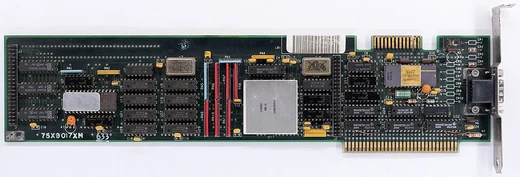
Elan Graphics
High-end 2D/3D graphics architecture for SGI workstations, introduced 1991.

Elan Graphics is a computer graphics architecture designed for Silicon Graphics workstations. Introduced in 1991, it served as a high-end graphics option on mid-1990s workstations within the Express Graphics architectures family. The system delivered real-time 2D and 3D rendering performance comparable to high-end PCs from more than a decade later, though texture mapping required software processing.
The Silicon Graphics Indigo Elan option used four GE7 Geometry Engines, providing a combined 128 MFLOPS, along with one RE3 Raster Engine. This setup could render 180,000 Z-buffered, lit, Gouraud-shaded triangles per second. The framebuffer stored 56 bits per pixel, allocating 12 bits per pixel (dithered RGB 4/4/4) for a double-buffered, depth-buffered RGB layout. When double-buffering was unnecessary, full 24-bit color was possible. Without Z-buffering, a double-buffered 24-bit RGB configuration could be used. Hardware stencil buffering was implemented by reserving 4 bits from the Z-buffer, creating a combined 20-bit Z and 4-bit stencil buffer.
The Elan Graphics system comprised five subsystems: the HQ2 Command Engine, GE7 Geometry Subsystem, RE3 Raster Engine, VM2 framebuffer, and VC1 Display Subsystem. It supported resolutions up to 1280 x 1024 pixels with 24-bit color and could process unencoded NTSC and PAL analog television signals. The entire system consisted of five daughterboards plugged into the workstation motherboard.
Elan Graphics was succeeded by SGI's Extreme Graphics architecture on Indigo2 models and later by the IMPACT graphics architecture in 1995.
Features included subpixel positioning, advanced lighting models (up to eight colored light sources, ambient/diffuse/specular lighting, Phong lighting, spotlights, local and infinite light source positioning, two-sided lighting), anti-aliased lines and points, full scene anti-aliasing, atmospheric effects, sphere rendering, pixel-blending for transparency, soft shadows and depth-of-field, texture mapping, a multimode windowing environment, X11 drawing primitives and pixel move operations, and Non-Uniform Rational B-Spline (NURBS) surfaces.
Quick Facts
- Designfirm
- Silicon Graphics
- Successor
- Extreme Graphics
- Support Status
- Unsupported
Facts from the source article.
Lore & Background
Elan Graphics was developed in 1991 and offered as a high-end graphics option on Silicon Graphics workstations released during the mid-1990s, part of the Express Graphics architectures family. The system consists of five daughterboards that plug into the main workstation motherboard, comprising five graphics subsystems: the HQ2 Command Engine, GE7 Geometry Subsystem, RE3 Raster Engine, VM2 framebuffer, and VC1 Display Subsystem. The Indigo Elan option includes four GE7 Geometry Engines capable of a combined 128 MFLOPS and one RE3 Raster Engine, together rendering 180K Z-buffered, lit, Gouraud-shaded triangles per second.
The framebuffer has 56 bits per pixel, allowing 12 bits per pixel (dithered RGB 4/4/4) for a double-buffered, depth-buffered RGB layout. When double-buffering is not required, full 24-bit color is possible; similarly, when Z-buffering is not required, a double-buffered 24-bit RGB framebuffer configuration is available. The system also implements hardware stencil buffering by allocating 4 bits from the Z-buffer to produce a combined 20-bit Z, 4-bit stencil buffer. Elan Graphics can produce resolutions up to 1280 x 1024 pixels with 24-bit color and can process unencoded NTSC and PAL analog television signals.
The architecture was superseded by SGI's Extreme Graphics architecture on Indigo2 models and eventually by the IMPACT graphics architecture in 1995. Notable features include subpixel positioning, advanced lighting models (multiple colored light sources up to 8, ambient/diffuse/specular, Phong lighting, spotlights, local and infinite light source positioning, two-sided lighting), anti-aliased lines and points, full scene anti-aliasing, atmospheric effects, sphere rendering, pixel-blending for transparency, soft shadows and depth-of-field, texture mapping (performed in software), multimode windowing environment, X11 drawing primitives and pixel move operations, and Non-Uniform Rational B-Spline (NURBS) surfaces.
Reader's Guide
Elan Graphics is significant as a high-end graphics architecture for Silicon Graphics workstations from the mid-1990s, offering real-time 2D and 3D rendering capability that the source article compares favorably to high-end PCs made over ten years later, with the exception of texture mapping, which was performed in software. Its hardware stencil buffering, multiple lighting models, and support for resolutions up to 1280 x 1024 with 24-bit color positioned it as a professional-grade solution. The architecture's five-daughterboard design and integration of four geometry engines and a raster engine highlight its specialized, modular approach to graphics processing. Its legacy includes being superseded by SGI's Extreme Graphics and later IMPACT architectures, marking a progression in SGI's graphics line. The system's ability to process unencoded NTSC and PAL analog television signals also indicates its role in video and broadcast applications.
Did You Know?
- Elan Graphics was developed in 1991 and was part of the Express Graphics architectures family.
- The system uses four GE7 Geometry Engines with a combined 128 MFLOPS and one RE3 Raster Engine.
- Texture mapping had to be performed in software, not hardware.
- The framebuffer has 56 bits per pixel, allowing configurations for double-buffering, depth buffering, and stencil buffering.
The Home Computer Era and Its Video Legacy
Home computers represent the second generation of desktop computing, debuting in 1977 and reaching mainstream popularity throughout the 1980s. By the mid-1990s, they had largely been superseded by IBM PC-compatible machines, though technically home computers fall under the broader personal computer umbrella. Early entrants included the TRS-80, Atari 8-bit family, BBC Micro, ZX Spectrum, MSX, Amstrad CPC 464, and Commodore 64, while later models such as MSX 2 systems, the Amiga, and Atari ST pushed the category's boundaries. The defining characteristic that set these machines apart from their PC successors was their video hardware. Early PCs relied on rudimentary display controllers like MDA, Hercules, CGA, and EGA—chips even simpler than most home computer video hardware. It was only with the VGA standard that PCs could genuinely rival machines like the Amiga, Atari ST, or MSX-2. Dedicated gaming consoles such as the Atari 2600 and Bally Astrocade, despite occasional upgrade paths toward home-computer functionality, remain outside this classification.
The Chip That Made or Broke a Machine
When early home computers shared nearly identical processors—typically the 6502, Z80, or occasionally the 6809—and comparable memory ranging from a modest 1 KB to 128 KB, the video display hardware became the single most consequential differentiator. Software environments were similarly uniform, with BASIC interpreters spanning from 4K to 12K or more. What truly separated one machine from another was how far a programmer could push the display chip to produce compelling games. The Commodore 64 stands as the textbook example of this principle. Its CPU lacked advanced mathematical functions and ran relatively slowly, and its built-in BASIC carried no graphics commands whatsoever, being the same interpreter inherited from the graphics-incapable Commodore PET. None of these limitations mattered in practice, because the VIC-II chip, when driven by machine-language code, made arcade-quality gaming feasible on a home platform. Programmers even discovered quirk-exploiting tricks that coaxed superior images from the VIC-II. The C64's generous memory and audio capabilities further enabled larger, more ambitious titles. At the opposite extreme, Mattel's Aquarius shipped with video hardware so constrained that it vanished from store shelves after merely four months of poor sales.
The Bus Arbitration Battle
A fundamental engineering headache for early home computer video systems was the bus arbitration problem: both the CPU and the video display unit needed continuous read access to the same video RAM, yet the logic and memory chips of the era lacked the switching speed to interleave those accesses in fine time slots. The Apple II pioneered an early interleaving mechanism by exploiting a data-bus feature of the 6502, while the BBC Micro paired 4 MHz RAM with a 2 MHz 6502 so video and CPU reads could alternate cleanly. Most other designers took a simpler route. The TRS-80's video logic had no arbitration at all; the CPU could write to video RAM at any moment, and doing so disabled the display, producing horizontal black stripes. A more common fix involved a status register the CPU could poll to determine when writing was safe, exploiting the blanking periods in composite video signals. If software ignored that register, the stripes returned. Other machines asserted a hardware wait signal—WAIT on the Z80, SYNC on the 6502—to stall the CPU during non-blanking periods. Still others added a hardware FIFO buffer, letting the CPU queue writes while dedicated logic transferred data into RAM during blanking intervals.
Two Roads to a Picture
Home computer designers faced a binary architectural choice when generating the video signal. The first path was a custom design, either assembled from discrete logic chips or built around custom logic components such as ASICs or PLDs. These bespoke solutions were the most flexible of the two approaches, capable of offering a wide range of sometimes unique display features. The second path relied on a video display controller, a single VLSI chip housing the bulk of the circuitry required to produce the video signal. This consolidated approach integrated the display logic into one component rather than spreading it across a board of individual chips. The choice between these two philosophies shaped the entire landscape of home computer video hardware. Machines that adopted custom logic could push into display territory that a standard VDC simply could not reach, while VDC-based systems benefited from having their video logic unified in a single package. The path a manufacturer chose in this regard often determined the ceiling of what programmers could achieve on that platform, reinforcing the central truth of the era: video hardware was the defining axis of competition among home computers.
Frequently Asked Questions
What is Elan Graphics?
Elan Graphics is a high-end real-time 2D/3D rendering architecture that Silicon Graphics shipped in its workstations beginning in 1991. It belonged to the Express Graphics family and was the premium graphics option for mid-1990s SGI machines aimed at professional users.
What hardware did the Indigo Elan option contain?
The Indigo Elan card combined four GE7 Geometry Engines for a total of 128 MFLOPS with a single RE3 Raster Engine. Together they could push roughly 180,000 Z-buffered, lit, Gouraud-shaded triangles per second into a 56-bits-per-pixel framebuffer.
How did Elan Graphics stack up against PC graphics of the era?
Its real-time rendering throughput matched what high-end personal computers would not achieve until well over a decade after 1991. The one clear shortcoming was texture mapping, which had to be handled entirely in software rather than in dedicated silicon.
Why do fans and historians consider Elan Graphics significant?
It gave mid-1990s professionals in animation, CAD, and scientific visualization a fully hardware-accelerated pipeline that delivered cinematic-quality real-time output years before consumer GPUs could compete. Within the Express Graphics lineup it was the top-tier choice for users who needed maximum triangle throughput.
What was the biggest limitation of the Elan Graphics architecture?
Texture mapping was not offloaded to dedicated hardware and instead relied on software processing, which created a bottleneck in texture-heavy scenes. Apart from that gap, the four-GE7 plus RE3 configuration delivered a 180K shaded-triangle-per-second rate that was genuinely ahead of its time.
More in Graphics Hardware, Part 2 1-24
Spotted an error? Know more?
Reader corrections go straight into our review queue. Suggest an edit · How this site is sourced