RealityEngine
High-end 3D graphics hardware for SGI's Crimson and Onyx systems.

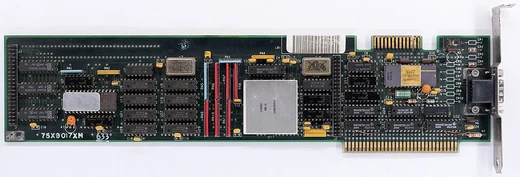
The RealityEngine is a family of 3D graphics systems and an underlying hardware architecture created by Silicon Graphics in the early-to-mid 1990s. It served as the company's top-tier visualization hardware for its MIPS/IRIX platform, and was built solely for use in the Crimson and Onyx visualization systems—machines often called "graphics supercomputers" or "visualization supercomputers." It was marketed to large organizations like corporations and universities involved in simulation, digital content creation, engineering, and research. The RealityEngine was succeeded by the InfiniteReality in early 1996, though it remained available for a time as a lower-cost option for older systems. The RealityEngine itself is a set of boards: a Geometry Engine board, up to four Raster Manager boards, and a DG2 Display Generator board, all plugged into a midplane on the host system. The Geometry Engine is based on the 50 MHz Intel i860XP. A cost-reduced version, the VTX, offers lower features and performance than the full RealityEngine. (It is not the VGX or VGXT board set.) Its name is said to stand for "Venice Too eXpensive," with "Venice" being the internal codename for the RealityEngine. The RealityEngine2 (stylized as "RealityEngine2") is an upgraded version with twelve Geometry Engines instead of eight. The Reality Station workstation is based on the RealityEngine2. In February 1995, SGI cut the entry price of the Reality Station to US$179,540 (about $379,400 in 2025). The RealityEngine2 was succeeded by the InfiniteReality in early 1996. It uses the GE10 Geometry Engine board, RM4 Raster Manager board, and DG2 Display Generator board.
Quick Facts
- Designfirm
- Silicon Graphics
- Midrange
- VTX
- Highend
- RealityEngine
- Enthusiast
- RealityEngine2
- Successor
- InfiniteReality
- Support Status
- Unsupported
Facts from the source article.
Lore & Background
The RealityEngine was marketed to large organizations such as companies and universities involved in computer simulation, digital content creation, engineering, and research. It was succeeded by the InfiniteReality in early 1996, but coexisted with it for a time as an entry-level option for older systems. The RealityEngine board set comprises a Geometry Engine board, up to four Raster Manager boards, and a DG2 Display Generator board, which plug into a midplane on the host system. The Geometry Engine is based on the 50 MHz Intel i860XP.
Reader's Guide
The RealityEngine represents Silicon Graphics' high-end visualization hardware for the MIPS/IRIX platform during the early to mid 1990s. Its significance lies in its exclusive deployment within the Crimson and Onyx family of visualization systems, which were marketed as 'graphics supercomputers' to large organizations in simulation, digital content creation, engineering, and research. The architecture's board set design—comprising a Geometry Engine board, up to four Raster Manager boards, and a DG2 Display Generator board—established a modular approach to high-end 3D graphics. The RealityEngine was succeeded by the InfiniteReality in early 1996, but continued to serve as an entry-level option for older systems, indicating its role as a transitional product. A cost-reduced variant, the VTX, offered lower features and performance, while the upgraded RealityEngine2 featured twelve Geometry Engines and was used in the Reality Station workstation. The RealityEngine's legacy includes its influence on subsequent SGI graphics architectures and its use in demanding professional visualization tasks.
More in Graphics Hardware, Part 2 1-24
Spotted an error? Know more?
Reader corrections go straight into our review queue. Suggest an edit · How this site is sourced