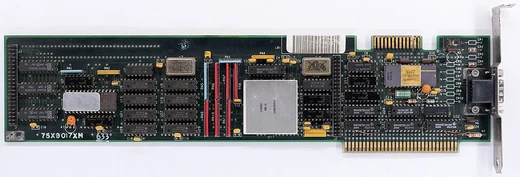
RAMDAC
A RAMDAC stored a color palette and generated analog signals for monitors.

A RAMDAC (random-access memory digital-to-analog converter) combines three fast digital-to-analog converters (DACs) with a small static random-access memory (SRAM). It is used in computer graphics display controllers or video cards to store a color palette and generate analog signals (usually voltage amplitude) to drive a color monitor. The logical color number from display memory selects a palette entry in the SRAM, which outputs three separate values for red, green, and blue; each value feeds a separate DAC whose analog output goes to the monitor's electron guns (or equivalent in non-CRT displays). RAMDACs became obsolete as DVI, HDMI, DisplayPort and other digital interfaces became mainstream, transferring video data digitally and deferring digital-to-analog conversion until the monitor's pixels are actuated.
- Introduced by
- IBM VGA display adapter (1987)
- First used chip
- INMOS G171 RAMDAC
- Palette size
- 256 colors from 262,144 possible values
- Max pixel rate initial
- approximately 30 Mpix/s
- Highest documented dac frequency
- 550 MHz (BarcoMed 5MP2 Aura 76Hz)
- Typical dac clock rate as of 2006
- 400 MHz
- Example dac clock rate 2006
- 420 MHz (XGI Volari XP10)
Lore & Background
The term RAMDAC did not enter common PC terminology until IBM introduced the IBM VGA display adapter in 1987, which used the INMOS G171 RAMDAC. This separate chip featured a 256-color (8-bit CLUT) display from a palette of 262,144 possible values and supported pixel-rates up to approximately 30 Mpix/s. As clone manufacturers copied IBM VGA hardware, they also copied the INMOS VGA RAMDAC. Advances in semiconductor manufacturing and PC processing power allowed RAMDACs to add direct-color operation, a mode that lets the SVGA-controller pass a pixel's color value directly to the DAC-inputs, bypassing the RAM lookup-table. Another innovation was Edsun's CEGDAC, which featured hardware-assisted spatial anti-aliasing for line/vector draw operations. By the early 1990s, the PC chip industry had advanced to the point where RAMDACs were integrated into the display controller chip, reducing the number of discrete chips and the cost of video cards; consequently, the market for standalone RAMDACs disappeared. The display controller chip itself may be mounted on an add-in-board or integrated into the motherboard core-logic chipset. The original purpose of the RAMDAC, to provide a CLUT-based display mode, was supplanted by True Color display modes. Eventually, as digital display interfaces became mainstream, the RAMDAC became obsolete.
Reader's Guide
The RAMDAC's significance lies in its role as the bridge between digital display memory and analog monitors during the era of CRT displays. It enabled color lookup table (CLUT) modes, allowing a limited number of colors to be selected from a larger palette, which was essential for early graphics adapters like IBM VGA. The design typically used three DACs of 6 to 10 bits each, with an SRAM word length at least three times that size; a common configuration was a 256 × 24-bit SRAM, allowing selection of 256 out of 16.7 million colors. The SRAM could be altered during the vertical blanking interval. As direct-color operation became the normal mode from the mid-1990s, the programmable palette was retained mostly as a legacy feature for compatibility with older software. Many later graphics cards could clock the RAMDAC much faster in true color modes when only the DAC part was used. The pixel clock rate for a given output could be estimated by multiplying horizontal pixels, vertical lines, a 1.4 factor for blanking, and the refresh rate; driving sharp edges required significant excess capability. By 2006, graphics card DACs typically ran at 400 MHz, with the XGI Volari XP10 at 420 MHz, and the highest documented frequency on a production PC video card was 550 MHz (BarcoMed 5MP2 Aura 76Hz). The RAMDAC's legacy is that it enabled the transition from analog to digital displays, but it became obsolete once digital interfaces like DVI, HDMI, and DisplayPort transferred video data digitally, deferring conversion to the monitor.
Did You Know?
- The INMOS G171 RAMDAC used in the IBM VGA adapter supported pixel-rates up to approximately 30 Mpix/s.
- The highest documented DAC frequency on a production PC video card was 550 MHz, set by the BarcoMed 5MP2 Aura 76Hz.
- The SRAM in a RAMDAC could be altered during the vertical blanking interval between frames.
More in Graphics Hardware, Part 2 1-24
Spotted an error? Know more?
Reader corrections go straight into our review queue. Suggest an edit · How this site is sourced