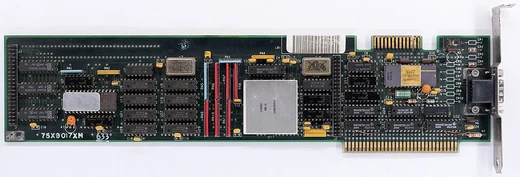
NEC μPD7220
One of the first single-chip graphics display processors.

The NEC μPD7220, also known as the High-Performance Graphics Display Controller 7220, is a video display controller and graphics processing unit capable of drawing lines, circles, arcs, and character graphics to a bit-mapped display. Developed by Nippon Electric Company (NEC) to support the Kanji character set efficiently, it was one of the first implementations of a graphics display processor as a single Large Scale Integration (LSI) integrated circuit chip, enabling low-cost, high-performance video graphics cards. It was one of the best known graphics chips of the 1980s.
Quick Facts
- Date
- 1981-2
- Successor
- μPD72120 Advanced Graphics Display Controller
Facts from the source article.
Lore & Background
The project started in 1979, with trial production in 1980 and mass production beginning in December 1981. It was first used in the NEC N5200 (known in North America as the NEC APC) in 1981, which sported a 5 MHz Intel 8086 processor on a 16-bit bus and came with a text-only display board using a μPD7220 in text mode. An optional graphics-only board with a second μPD7220 in graphics mode merged text and graphics video through an XOR port on each RGB signal. The only OS on the original NEC APC was the UCSD p-System, with CP/M-86 support added in 1982.
In 1981, an English language paper written in 1980 by Tetsuji Oguchi, Misao Higuchi, Takashi Uno, Michiori Kamaya and Munekazu Suzuki was published in the IEEE. NEC deployed the chip in other computers such as the NEC PC-9801, APC II, and APC III, and released it to other manufacturers in Japan starting in 1982. The same year, the 7220 was revealed in North America by NEC Information Systems. By 1983, it was used in computers from NEC, Digital Equipment Corporation, and Wang Laboratories.
The controller could address a maximum 1024 × 1024 pixel display with four-bit color depth, generating 16 colors or grayscale levels. It included a light pen interface that synchronized the pixel clock to input signals without additional processor support. Two I/O channels were used, addressing A0 and A1; reading A0 retrieved status, reading A1 fetched the first byte from the internal queue. Writing used both registers: A1 for commands, A0 for parameters.
Reader's Guide
The μPD7220 was notable for providing a sophisticated graphics co-processor at a time when most computers used memory-mapped character or bit-mapped displays. Its hardware assist features for drawing straight lines and sectors of circles allowed it to draw pixels along a line, circular arc, or from user-defined characters in under 800 ns, freeing the host computer for other processing. The high-resolution capability supported glyph-based languages like Japanese, and the large memory space combined with hardware viewport registers permitted smooth high-speed scrolling. Compatibility with direct memory access hardware enabled bitmaps to be moved to and from controller memory at bus-limited rates, allowing fast blitting while the controller focused on complex rendering. GKS was available on CP/M and MS-DOS systems and formed the basis of early 1980s CAD platforms. A few years after its introduction, one journalist said 'The 7220 GDC chip is a component that even some of NEC's competitors have found too good to pass up.' When the Apple Lisa was announced in 1983, the press questioned why the popular 7220 was not used; Bruce Daniels noted that the Lisa primarily used raster graphics, which could be implemented with less expensive hardware support, and development manager Wayne Rosing added that the 7220 was not quite available when the design began, with restrictions on when display memory could be accessed.
Did You Know?
- The μPD7220 was developed by NEC to efficiently support the Kanji character set.
- Intel licensed the design and called it the 82720 graphics display controller, announced in 1982.
- East Germany produced a replica designated U82720, used with the U880 replica of the Zilog Z80.
More in Graphics Hardware, Part 2 1-24
Spotted an error? Know more?
Reader corrections go straight into our review queue. Suggest an edit · How this site is sourced